Real-World Outcomes with CD20×CD3 Bispecific Antibodies in Relapsed/Refractory Large B-Cell Lymphoma: Insights from the Multicenter REALBiTE Consortium

SUMMARY: The American Cancer Society estimates that in 2026, about 79,320 people will be diagnosed with Non Hodgkin Lymphoma (NHL) in the United States and about 19,970 individuals will die of this disease. Diffuse Large B-Cell Lymphoma (DLBCL) is the most common of the aggressive Non-Hodgkin lymphomas in the United States and more than 25,000 cases of DLBCL are diagnosed each year in the United States, accounting for more than 25 percent of all lymphoma cases. The incidence has steadily increased 3-4% each year. More than half of patients are 65 or older at the time of diagnosis and the incidence is likely to increase with aging of the American population.

Background
DLBCL is a neoplasm of large B cells and the most common chromosome abnormality involves alterations of the BCL-6 gene at the 3q27 locus, which is critical for germinal center formation. Two major molecular subtypes of DLBCL arising from different genetic mechanisms have been identified, using Gene Expression Profiling: Germinal Center B-cell-like (GCB) and Activated B-Cell-like (ABC). Patients in the GCB subgroup have a higher 5-year survival rate, independent of clinical IPI (International Prognostic Index) risk score, whereas patients in the ABC subgroup have a significantly worse outcome. Regardless of molecular subtype, R-CHOP regimen (Rituximab, Cyclophosphamide, Doxorubicin, Vincristine, and Prednisone), given every 21 days, for 6 cycles, delivered with curative intent, is the current standard of care for patients of all ages, with newly diagnosed DLBCL. Approximately 30-40% of patients experience disease progression or relapse during the first 2 years and attempts to improve on R-CHOP regimen have not been successful.

Relapsed or Refractory (R/R) Large B-Cell Lymphoma (LBCL), including Diffuse Large B-Cell Lymphoma (DLBCL), remains a challenging disease state with historically poor outcomes after multiple lines of therapy. CD20×CD3 Bispecific Antibodies (BsAbs), including Epcoritamab (EPKINLY®) and Glofitamab (COLUMVI®), represent a major therapeutic advance by redirecting endogenous T cells to malignant B cells through off-the-shelf immune engagement. Pivotal trials demonstrated encouraging response rates, leading to regulatory approvals in the United States. However, clinical trials often enroll selected patients with favorable performance status and limited comorbidity, underscoring the need for robust Real-World Evidence (RWE) to better understand effectiveness, durability, and outcomes in routine practice.

Study Design and Patient Population
The REALBiTE Consortium conducted a large multicenter retrospective analysis across 21 U.S. academic centers, evaluating patients with R/R DLBCL treated with commercially available Epcoritamab or Glofitamab between January 2023 and October 2024, with updated follow-up through May 2025.

Across multiple analyses, more than 300 patients were evaluated, reflecting a heavily pretreated, high-risk population:

  • Over half were primary refractory to frontline therapy
  • A substantial proportion had double-hit or triple-hit lymphoma
  • Approximately 60% had prior CAR T-cell therapy, many of whom were CAR T-refractory
  • Nearly 70% would have been ineligible for registrational trials due to comorbidities, disease burden, or performance status

This cohort therefore represents a realistic cross-section of patients encountered in contemporary lymphoma practice.

Efficacy Outcomes in the Real World
Despite high-risk features, Overall Response Rates (ORR) with BsAbs in routine practice were comparable to pivotal clinical trials:

  • ORR approximately 51–54%
  • Complete Response (CR) rates ranging from 23–33%

However, response durability was limited:

  • Median Progression-Free Survival (PFS): ~2.5–2.6 months
  • Median Overall Survival (OS): ~7.7–7.8 months
  • Six-month PFS and OS rates were approximately 36% and 60%, respectively

These findings highlight a key real-world gap: while BsAbs induce meaningful initial responses, early disease progression remains common, particularly in biologically aggressive disease.

Predictors of Progression and Resistance
Several baseline clinical and biologic factors were associated with inferior outcomes:

  • Double-hit or triple-hit lymphoma
  • High International Prognostic Index (IPI)
  • Poor performance status (ECOG ≥2)
  • Primary refractory disease
  • Refractoriness to the line of therapy immediately preceding BsAbs

Importantly, loss or absence of CD20 expression emerged as a critical resistance mechanism. Among patients with paired biopsies, nearly 90% lost CD20 expression following BsAb therapy, with rapid progression thereafter. Additionally, undetectable CD20 by immunohistochemistry prior to BsAb initiation was strongly associated with inferior PFS and OS, underscoring the clinical relevance of confirming target antigen expression before treatment.

Safety and Causes of Mortality
Progressive lymphoma was the leading cause of death, accounting for more than 80% of fatalities, followed by infections. Treatment-related deaths due to Cytokine Release Syndrome (CRS) or Immune effector Cell–Associated Neurotoxicity Syndrome (ICANS) were infrequent, reinforcing the manageable safety profile of BsAbs in experienced centers. Notably, infection-related mortality occurred early and late, highlighting the need for vigilance with immune suppression and supportive care.

Outcomes After Progression on Bispecific Antibodies
Disease progression following BsAb therapy was often rapid, with a median time to progression of approximately 1.5 months. Nearly half of progressing patients received no further anti-lymphoma therapy, reflecting clinical decline and limited salvage options.

Among patients who did receive subsequent treatment:

  • Chemoimmunotherapy was most commonly used but achieved modest responses (~30%)
  • Loncastuximab tesirine showed limited activity
  • CAR T-cell therapy, when feasible, demonstrated the most favorable outcomes, with ORRs around 50% and high CR rates
  • Allogeneic hematopoietic cell transplantation, used as consolidation in selected responders, resulted in encouraging short-term disease control, with many patients remaining progression-free at follow-up

Nevertheless, overall post-BsAb survival remained poor, with median OS after salvage therapy of less than 4 months.

Clinical Implications
These Real-World Data confirm that Epcoritamab and Glofitamab are active therapies in heavily pretreated R/R LBCL, even among patients excluded from clinical trials. However, the short duration of benefit in most patients emphasizes the aggressive biology of this population and the urgent need for improved sequencing strategies.

Key clinical takeaways include:

  • Assessment of CD20 expression prior to BsAb initiation is critical
  • Early identification of patients unlikely to benefit may help guide alternative strategies
  • Clinical trial enrollment, novel combinations, or consolidation approaches (CAR T or allogeneic transplant) should be strongly considered for eligible responders
  • Durable remissions, while uncommon, do occur, suggesting that a subset of patients can derive long-term benefit with appropriate selection

Conclusion
The REALBiTE Consortium provides the most comprehensive real-world assessment to date of CD20×CD3 bispecific antibodies in R/R LBCL. While Response Rates mirror those seen in pivotal trials, real-world PFS and OS are shorter, reflecting broader patient inclusion and aggressive disease biology. These findings reinforce the transformative potential of BsAbs while highlighting the need for better predictive biomarkers, rational combinations, and optimized sequencing to improve long-term outcomes for this challenging patient population.

Outcomes following disease progression after epcoritamab or glofitamab in the real-world outcomes of bispecific T-cell engagers (REALBiTE) multi-center, retrospective cohort study. Brooks T, Mian A, Nedved A, et al. Blood. 2025;146(suppl 1):402. doi:10.1182/blood-2025-402
Routine Preoperative Breast MRI for Early-Stage Cancers May Not Be Beneficial: Outcome Data from Alliance A011104

SUMMARY: Breast cancer is the most common cancer among women in the US and about 1 in 8 women (12%) will develop invasive breast cancer during their lifetime. It is estimated that in the US, approximately 321,910 new cases of female breast cancer will be diagnosed in 2026, and about 42,140 women will die of the disease, largely due to metastatic recurrence.

The Evolving Role of Breast MRI in Clinical Practice

Breast Magnetic Resonance Imaging (MRI) has become an important adjunct to mammography and ultrasound across a range of clinical scenarios. Its high sensitivity makes it particularly valuable in complex cases where conventional imaging may be limited, such as dense breast tissue or multifocal disease. As utilization has expanded, a critical question has emerged: does the additional disease detected by breast MRI translate into improved oncologic outcomes?

Established Clinical Indications for Breast MRI

Breast MRI is most clearly supported in selected high-risk and diagnostic settings, where its superior sensitivity can meaningfully inform care.

High-Risk Screening
MRI is recommended for patients with a substantially elevated lifetime risk of breast cancer, including those with:

  • Pathogenic BRCA1/2 variants or first-degree relatives of known carriers
  • Hereditary cancer syndromes such as Li-Fraumeni or Cowden syndrome
  • Prior therapeutic chest irradiation between ages 10 and 30
  • A calculated lifetime breast cancer risk of ≥20–25% using validated risk models

Evaluation of Known Breast Cancer (Staging and Extent)
In patients with newly diagnosed breast cancer, MRI may help define disease burden when conventional imaging is insufficient:

  • Detection of multifocal or multicentric disease, including contralateral breast involvement
  • Improved visualization in dense breast tissue
  • Enhanced detection of invasive lobular carcinoma, which can be underestimated on mammography
  • Identification of occult primary tumors in patients presenting with axillary adenopathy
  • Assessment of posterior lesions and potential chest wall involvement

Diagnostic Evaluation of Symptoms or Indeterminate Findings
MRI is also used selectively to clarify challenging diagnostic scenarios, including:

  • Pathologic nipple discharge or suspected Paget disease
  • Indeterminate mammographic or ultrasound findings that cannot be confidently biopsied
  • Evaluation of breast implant integrity
  • Unexplained new nipple inversion

Treatment Monitoring and Post-Treatment Assessment
In the therapeutic setting, breast MRI may assist with:

  • Monitoring response to neoadjuvant chemotherapy
  • Evaluating residual disease after breast-conserving surgery
  • Distinguishing post-treatment changes from locoregional recurrence

While these indications are well accepted, the impact of breast MRI on long-term outcomes in newly diagnosed breast cancer has remained uncertain.

Does Preoperative Breast MRI Improve Outcomes? Insights from Alliance A011104

Trial Rationale and Design

Despite widespread adoption of preoperative breast MRI for local staging and surgical planning, robust evidence demonstrating improved oncologic outcomes has been limited. The Alliance A011104 phase III trial was designed to directly address whether identifying mammographically occult disease with MRI, and modifying surgery accordingly, reduces local-regional recurrence.

This randomized study enrolled 319 patients with newly diagnosed clinical Stage I–II breast cancer who were eligible for breast-conserving surgery and had biologically aggressive disease, including Triple-Negative breast cancer or Hormone Receptor-negative/HER2-positive tumors. Patients with germline BRCA mutations, bilateral disease, or prior breast cancer were excluded. Participants were randomly assigned to undergo preoperative breast MRI within 30 days of diagnostic mammography or to proceed without MRI.

Patient Characteristics and Treatment

The median age at enrollment was approximately 59 years, with most patients presenting with small, node-negative tumors. Systemic therapy was commonly employed, with 85% of patients receiving chemotherapy and a subset treated in the neoadjuvant setting. Importantly, presurgical ultrasound, while not mandated, was widely utilized across institutions, reflecting contemporary practice.

Key Findings: No Improvement in Local-Regional Control

With a median follow-up exceeding five years, the trial demonstrated no significant difference in local-regional outcomes between the MRI and no-MRI arms.

  • Rates of breast-conserving surgery were high and comparable between groups
  • The majority of patients underwent sentinel lymph node biopsy alone
  • Pathologic Complete Response rates among patients receiving neoadjuvant chemotherapy did not differ significantly between arms
  • Adjuvant radiation use was similar in both groups

Among patients evaluable for the Primary endpoint, 5-year local-regional control exceeded 90% in both arms, with no statistically meaningful difference observed. Distant Recurrence-Free Survival and Overall Survival were also excellent and equivalent regardless of MRI use.

Exploratory subgroup analyses failed to identify any patient population that derived a local control benefit from preoperative MRI.

Interpreting the Results: Why Was No Benefit Observed?

Several explanations may account for the lack of observed advantage with preoperative breast MRI. First, contemporary multimodality therapy, including effective systemic treatment and radiation, may adequately control small foci of disease detected only by MRI, reducing the necessity for surgical excision. Second, advances in mammographic technology and the routine incorporation of ultrasound may have narrowed the incremental value of MRI for local staging compared with earlier eras.

Ongoing analyses from the trial are exploring whether MRI influences other surgical outcomes, such as margin status and reoperation rates.

Clinical Implications and Take-Home Message

In patients with early-stage Triple-Negative or HER2-positive breast cancer treated with modern multimodality therapy, local-regional recurrence rates are low. Results from Alliance A011104 indicate that routine use of preoperative breast MRI for local staging and surgical planning does not improve local-regional control in this setting.

These findings support a more selective, indication-driven approach to breast MRI, reserving its use for high-risk screening, specific diagnostic dilemmas, and carefully chosen staging scenarios, rather than routine deployment in all newly diagnosed patients.

As imaging technologies and systemic therapies continue to evolve, ongoing evaluation of how best to integrate advanced imaging into patient-centered, value-based care remains essential.

Effect of Preoperative Breast MRI Staging on Local Regional Recurrence (LRR) in Early Stage Breast cancer: Alliance A011104/ACRIN 6694. Bedrosian I, Ballman K, McCall LM, et al. Presented at the 2025 San Antonio Breast Cancer Symposium; December 9-12, 2025; San Antonio, TX. Abstract GS2-07.

JAYPIRCA® versus IMBRUVICA® in Treatment Naïve CLL/SLL: Insights from the Phase III BRUIN CLL-314 Trial

SUMMARY: The American Cancer Society estimates that for 2026, about 22,760 new cases of Chronic Lymphocytic Leukemia (CLL) will be diagnosed in the US and 4350 patients will die of the disease. CLL accounts for about one-quarter of the new cases of leukemia. The average age of patients diagnosed with CLL is around 70 years, and is rarely seen in people under age 40, and is extremely rare in children.

Progress and Persistent Gaps with Covalent BTK Inhibitors

The advent of covalent Bruton Tyrosine Kinase inhibitors (cBTKi), Ibrutinib (IMBRUVICA®), Acalabrutinib (CALQUENCE®), and Zanubrutinib (BRUKINSA®), has fundamentally altered the treatment paradigm for Chronic Lymphocytic Leukemia/Small Lymphocytic Lymphoma (CLL/SLL). These agents have demonstrated robust activity across both treatment-naïve (TN) and relapsed/refractory (R/R) settings, establishing BTK inhibition as a cornerstone of therapy.

Despite these advances, cBTKi share inherent pharmacologic and clinical limitations. Short half-lives, variable oral bioavailability, and off-target kinase inhibition can lead to incomplete target suppression, cumulative toxicity, treatment interruptions, and ultimately compromised long-term efficacy. While second-generation agents such as Acalabrutinib and Zanubrutinib were developed to improve selectivity and tolerability, their benefits over Ibrutinib have been demonstrated primarily in the R/R setting, and direct comparisons in the treatment-naïve population have been lacking.

Rationale for Noncovalent BTK Inhibition

Pirtobrutinib (JAYPIRCA®) represents a mechanistically distinct approach to BTK inhibition. As a highly selective, noncovalent BTK inhibitor (ncBTKi), it binds independently of the C481 residue, enabling sustained target inhibition even in the presence of common resistance mutations. Its low nanomolar potency and pharmacokinetic profile allow for continuous BTK suppression throughout the dosing interval, raising the possibility of enhanced efficacy with improved tolerability relative to cBTKi.

BRUIN CLL-314: Trial Design and Objectives

BRUIN CLL-314 (LOXO-BTK-20030) is a global, randomized, open-label Phase III study and, to date, the first trial to directly compare a noncovalent BTK inhibitor with a covalent BTK inhibitor in CLL/SLL. The study enrolled 662 BTKi-naïve patients across 23 countries, including both treatment-naïve patients and those with R/R disease.

Participants were randomized 1:1 to receive Pirtobrutinib (200 mg once daily) or Ibrutinib (420 mg once daily), administered continuously until disease progression or unacceptable toxicity. Stratification factors included del(17p) status and number of prior lines of therapy. The Primary endpoint was Independent Review Committee (IRC)–assessed Overall Response Rate (ORR) in the Intention-to-Treat (ITT) population and in patients with R/R disease. Progression-Free Survival (PFS) was a key Secondary endpoint.

Patient Population

Baseline characteristics were well balanced between treatment arms. The median age was 67 years, approximately two-thirds of patients were male, and over half were enrolled from Europe. High-risk molecular features, including del(17p), unmutated IGHV, and complex karyotype, were evenly distributed. Among patients with R/R disease, the median number of prior therapies was one.

Efficacy Outcomes: ORR and Early PFS Signals

The study met its primary objective, demonstrating statistically significant noninferiority of Pirtobrutinib compared with Ibrutinib for IRC-assessed ORR.

  • Intent to Treat population: ORR was 87.0% with Pirtobrutinib versus 78.5% with Ibrutinib
  • Treatment-Naïve patients: ORR was 92.9% versus 85.8%, respectively
  • Relapsed/Refractory patients: ORR was 84.0% versus 74.8%, respectively

Notably, response rates consistently favored Pirtobrutinib across clinically relevant high-risk subgroups, including patients with del(17p), unmutated IGHV, and complex karyotype.

While PFS data remain immature, early descriptive analyses revealed a favorable trend for Pirtobrutinib. Investigator-assessed PFS suggested a reduction in the risk of progression or death across the ITT, Relapsed/Refractory, and treatment-naïve populations, with the most pronounced benefit observed in treatment-naïve patients, the subgroup with the longest follow-up to date.

Safety and Tolerability

Pirtobrutinib demonstrated a favorable safety profile compared with Ibrutinib. Rates of cardiac adverse events, including atrial fibrillation/flutter and hypertension, were lower with Pirtobrutinib, consistent with its higher selectivity for BTK and reduced off-target kinase inhibition.

Patient-reported outcomes further supported improved tolerability, with lower rates of symptomatic adverse events such as myalgia, bruising, headache, diarrhea, and cough. These findings are particularly relevant in CLL/SLL, where long-term therapy places a premium on safety, adherence, and quality of life.

Clinical Implications and Sequencing Considerations

The results of BRUIN CLL-314 carry important implications for clinical practice. Historically, noncovalent BTK inhibitors were positioned primarily as salvage therapy following cBTKi resistance. These data challenge that paradigm by demonstrating robust activity, favorable tolerability, and early PFS benefit for Pirtobrutinib in BTKi-naïve patients, including those treated in the frontline setting.

The pronounced benefit observed in treatment-naïve patients is especially noteworthy, as this represents the first randomized Phase III evidence directly comparing BTK inhibitors head to head in this population. For patients requiring long-term continuous therapy, improved tolerability may translate into prolonged disease control and better overall outcomes.

Sequencing remains an evolving consideration. Venetoclax-based fixed-duration regimens continue to provide an effective option following BTK inhibition, and prior studies suggest preserved activity of Venetoclax after Pirtobrutinib. For older patients or those anticipated to require limited lines of therapy, initial treatment choice may reasonably prioritize safety, convenience, and durability of response.

Study Limitations

Key limitations include the open-label design and relatively short follow-up for PFS. However, the use of a blinded IRC for response assessment and minimal imbalance in early treatment discontinuation mitigate concerns regarding bias. Ongoing follow-up and prespecified analyses will further clarify the long-term impact of Pirtobrutinib on disease control and survival outcomes.

Conclusion

BRUIN CLL-314 establishes Pirtobrutinib as a compelling next-generation BTK inhibitor, demonstrating noninferior, and numerically superior response rates compared with Ibrutinib, alongside early signals of improved Progression-Free Survival and a more favorable safety profile. These findings support the potential role of Pirtobrutinib not only after cBTKi failure but also in earlier lines of therapy, including the frontline setting, where durable efficacy and tolerability are paramount.

Pirtobrutinib Versus Ibrutinib in Treatment-Naïve and Relapsed/Refractory Chronic Lymphocytic Leukemia/Small Lymphocytic Lymphoma. Woyach JA, Qiu L, Grosicki S, et al. J Clin Oncol. DOI: 10.1200/JCO-25-02477

Adjuvant Giredestrant Reduces Recurrence Risk in ER-Positive/HER2-Negative Early Breast Cancer: Results From the Phase III lidERA Trial

SUMMARY: Breast cancer is the most common cancer among women in the US and about 1 in 8 women (12%) will develop invasive breast cancer during their lifetime. It is estimated that in the US, approximately 321,910 new cases of female breast cancer were diagnosed in 2026, and about 42,140 women will die of the disease, largely due to metastatic recurrence.

Background: Addressing Residual Risk in ER-Positive Early Breast Cancer

Estrogen Receptor-positive (ER-positive) breast cancer represents approximately 70% of all breast cancer diagnoses. Despite the widespread use of adjuvant endocrine therapy as standard of care for patients with ER-positive, HER2-negative early breast cancer, long-term outcomes remain suboptimal. Up to one-third of patients experience disease recurrence during or after completion of adjuvant endocrine treatment, underscoring a persistent unmet need for more effective and better-tolerated therapeutic options that can improve adherence and long-term disease control.

Giredestrant: A Next-Generation Oral SERD

Giredestrant is an investigational, oral, next-generation Selective Estrogen Receptor antagonist and Degrader (SERD). It is designed to completely block estrogen receptor signaling by preventing estrogen binding and inducing receptor degradation. Preclinical and early clinical studies have demonstrated that Giredestrant is more potent than earlier-generation SERDs and exhibits superior antiproliferative activity compared with Aromatase Inhibitors, including Anastrozole, in the neoadjuvant setting. These attributes provided the rationale for evaluating Giredestrant in the adjuvant treatment of ER-positive/HER2-negative early breast cancer.

The lidERA Trial: Study Design and Patient Population

The global, randomized, open-label Phase III lidERA BC trial (NCT04961996) evaluated the efficacy and safety of adjuvant Giredestrant compared with standard-of-care endocrine therapy in patients with medium or high-risk Stage I–III ER-positive, HER2-negative early breast cancer.

A total of 4,170 patients were randomized 1:1 to receive either Giredestrant 30 mg orally once daily or physician’s choice of standard endocrine monotherapy (Tamoxifen or an Aromatase Inhibitor). Premenopausal and perimenopausal women, as well as men, received concurrent LHRH agonist therapy. Treatment was administered for up to five years or until disease recurrence or unacceptable toxicity. At baseline, the median age was 54 years, with nearly 60% of patients postmenopausal. Disease stage distribution included 13% Stage I, 47% Stage II, and 40% Stage III disease. Median follow-up at the prespecified interim analysis was 32.3 months. The Primary endpoint was invasive Disease-Free Survival (iDFS), excluding second primary non–breast cancers. Key Secondary endpoints included Overall Survival (OS), iDFS including second primary malignancies, Distant Recurrence-Free Interval (DRFI), Disease-Free Survival, and Safety.

Efficacy Results: Clinically Meaningful Improvement in iDFS

At the prespecified interim analysis, adjuvant Giredestrant demonstrated a statistically significant and clinically meaningful improvement in invasive DFS compared with standard-of-care endocrine therapy. Treatment with Giredestrant reduced the risk of invasive disease recurrence or death by 30% (Hazard Ratio [HR] 0.70; 95% CI, 0.57–0.87; P=0.0014).

Three-year iDFS rates were 92.4% in the Giredestrant arm versus 89.6% in the standard endocrine therapy arm. Importantly, the iDFS benefit was consistent across all clinically relevant subgroups, including disease stage, menopausal status, geographic region, and prior chemotherapy exposure. Giredestrant also significantly improved Distant Recurrence-Free Interval, with a 31% reduction in the risk of distant relapse (HR=0.69; 95% CI, 0.54–0.89), reinforcing its potential to prevent metastatic progression.

Overall Survival data were immature at the time of analysis. However, a favorable trend was observed in the Giredestrant arm (HR 0.79), with continued follow-up planned for subsequent analyses.

Safety and Tolerability

Giredestrant was generally well tolerated, with a safety profile consistent with previously reported data. The most common adverse events included arthralgia, hot flushes, and headache, occurring at similar rates in both treatment arms. Grade 3–4 adverse events were infrequent and comparable between groups. Notably, treatment discontinuations due to adverse events were lower with Giredestrant than with standard endocrine therapy (5.3% vs 8.2%), suggesting favorable tolerability that may translate into improved long-term adherence in the adjuvant setting.

Clinical Implications

The lidERA trial represents the first Phase III study to demonstrate a significant benefit with an oral SERD in early breast cancer. By delivering superior invasive Disease-Free Survival, reducing distant recurrence risk, and maintaining a manageable safety profile, Giredestrant addresses key limitations of current adjuvant endocrine strategies.

Given the high prevalence of ER-positive breast cancer and the substantial proportion of patients who relapse despite standard therapy, these findings position Giredestrant as a compelling candidate for a new standard of care in appropriately selected patients with HR-positive/HER2-negative early breast cancer.

 Conclusion

Results from the Phase III lidERA trial establish adjuvant Giredestrant as a highly promising next-generation endocrine therapy for ER-positive, HER2-negative early breast cancer. The observed improvements in invasive Disease-Free Survival and distant Recurrence-Free Interval, combined with favorable tolerability and a trend toward improved Overall Survival, support Giredestrant’s potential to meaningfully improve long-term outcomes for a broad patient population.

Giredestrant vs standard-of-care endocrine therapy as adjuvant treatment for patients with estrogen receptor-positive, HER2-negative early breast cancer: Results from the global Phase III lidERA Breast Cancer trial. Bardia A, Schmid P, Martín M, et al. Presented at the 2025 San Antonio Breast Cancer Symposium (SABCS) (Abstract GS1-10)

Fixed-Duration vs Continuous Targeted Therapy in Frontline CLL: Insights from the Phase III CLL17 Trial

SUMMARY: The American Cancer Society estimates that for 2026, about 22,760 new cases of Chronic Lymphocytic Leukemia (CLL) will be diagnosed in the US and 4350 patients will die of the disease. CLL accounts for about one-quarter of the new cases of leukemia. The average age of patients diagnosed with CLL is around 70 years, and is rarely seen in people under age 40, and is extremely rare in children.

Evolving Treatment Paradigms in CLL            

The therapeutic landscape of CLL has undergone a profound transformation over the past decade, moving away from chemoimmunotherapy toward mechanism-based targeted agents. Brutons Tyrosine Kinase (BTK) inhibitors and the BCL2 inhibitor Venetoclax have become foundational therapies, delivering durable disease control across biologic risk groups. Historically, BTK inhibitors were administered continuously until progression or intolerance, whereas Venetoclax-based combinations introduced the possibility of time-limited treatment.

The rationale for fixed-duration therapy stems from the observation that rational combinations can induce deeper remissions, including undetectable Minimal Residual Disease (MRD), potentially allowing for treatment-free intervals and reduced cumulative toxicity. While Venetoclax–Rituximab in relapsed disease and Venetoclax–Obinutuzumab in the frontline setting validated this concept, the relative efficacy of fixed-duration regimens compared with continuous BTK inhibition remained an unanswered question, until now.

Trial Design and Patient Population

CLL17 is an international, investigator-initiated, Phase III randomized trial designed to directly compare fixed-duration and continuous targeted treatment strategies, in previously untreated CLL patients. A total of 909 treatment-naïve patients were enrolled across 174 centers in 13 countries and randomly assigned in a 1:1:1 ratio to receive:

Fixed-duration Venetoclax plus Obinutuzumab (N=303)

Fixed-duration Venetoclax plus Ibrutinib (N=305)

Continuous Ibrutinib monotherapy (N=301)

Randomization was stratified by fitness status, IGHV mutation status, and the presence of del(17p) and/or TP53 mutation. The study population reflected real-world heterogeneity, with a median age of 66 years, 44% classified as unfit (based on CIRS scores greater than 6, a creatinine clearance of less than 70 ml per minute, or both), more than half harboring unmutated IGHV, 7.6% of the patients with del(17p) or TP53 mutation (or both), and nearly 20% exhibiting complex karyotypes. High- and very high-risk disease by the CLL International Prognostic Index was present in more than 60% of patients, underscoring the clinical relevance of the cohort. The Primary endpoint was investigator-assessed Progression-Free Survival (PFS), with the trial powered to test the noninferiority of each fixed-duration regimen versus continuous Ibrutinib. Key Secondary endpoints included Overall Survival (OS), MRD negativity, Response Rates, and Safety.

Efficacy Outcomes: Noninferiority Achieved

At a median follow-up of 34.2 months, in this prespecified interim analysis, both fixed-duration strategies met the prespecified criteria for noninferiority compared with continuous Ibrutinib. Three-year PFS rates were remarkably similar across treatment arms:

81.1% with Venetoclax–Obinutuzumab

79.4% with Venetoclax–Ibrutinib

81.0% with continuous Ibrutinib

Hazard ratios for progression or death favored neither continuous nor fixed-duration therapy, providing the first prospective evidence that time-limited targeted regimens can match the disease control achieved with indefinite BTK inhibition in the frontline setting.

Overall Survival at three years exceeded 90% in all groups, with no meaningful differences observed at this interim analysis. Longer follow-up will be required to determine whether survival curves diverge with time, particularly in biologically high-risk subgroups.

Depth of Remission and MRD Dynamics

Marked differences emerged in depth of response. Undetectable MRD in peripheral blood at the end of treatment was achieved in:

73.3% of patients treated with Venetoclax–Obinutuzumab

47.2% of those receiving Venetoclax–Ibrutinib

0% of patients on continuous Ibrutinib

These findings reinforce the well-established limitation of single-agent BTK inhibition in achieving deep molecular remissions and highlight a key advantage of Venetoclax-based combinations. While end-of-treatment MRD has been associated with long-term outcomes in fixed-duration regimens, its prognostic value relative to continuous BTK inhibition remains less clear. Ongoing longitudinal MRD assessments in CLL17 may help clarify whether differences in MRD depth ultimately translate into durable clinical benefit.

Safety and Tolerability Considerations

Adverse events were common across all treatment arms, reflecting the immunocompromised nature of the CLL population. Infections affected nearly 80% of patients overall, with serious and fatal infections occurring more frequently in the Venetoclax–Obinutuzumab arm. Importantly, trial enrollment coincided with the COVID-19 pandemic, and approximately 10% of patients experienced severe COVID-19–related infections.

Cytopenias, particularly neutropenia, were more frequent with combination regimens, especially Venetoclax–Obinutuzumab. However, these events were largely confined to the first year of therapy and resolved after treatment completion. In contrast, cardiac toxicities, including atrial fibrillation and hypertension, were more commonly associated with Ibrutinib-containing regimens, consistent with prior experience.

Tumor lysis syndrome was infrequent (<5%) across Venetoclax-containing arms, demonstrating that standard ramp-up strategies and debulking approaches effectively mitigate this risk, even in older and unfit patients.

Subgroup Insights and Clinical Implications

Fixed-duration therapy performed well across most biologic subgroups. Notably, patients with unmutated IGHV did not experience inferior outcomes with time-limited treatment compared with continuous Ibrutinib, supporting broader use of fixed-duration strategies. Patients with mutated IGHV achieved particularly favorable outcomes with Venetoclax–Obinutuzumab, consistent with the more indolent biology of this subgroup.

For patients with del(17p) or TP53 mutations, outcomes were encouraging with BTK inhibitor–containing regimens, although the small sample size and limited follow-up preclude definitive conclusions. Continuous therapy did not clearly outperform fixed-duration Venetoclax–Ibrutinib in this population, highlighting the need for ongoing observation and biomarker-driven analyses.

Positioning CLL17 in the Current Treatment Landscape

The results of CLL17 complement and extend findings from earlier studies such as CLL13, CLL14, CAPTIVATE, and GLOW, while providing the first direct, randomized comparison between fixed-duration and continuous targeted therapy. Importantly, the trial was conducted during the emergence of next-generation BTK inhibitors with improved cardiac safety profiles, suggesting that the central question addressed by CLL17, time-limited versus continuous therapy, will remain clinically relevant regardless of the specific BTK inhibitor chosen.

Conclusions

The first analysis of the Phase III CLL17 trial demonstrates that fixed-duration Venetoclax–Obinutuzumab and Venetoclax–Ibrutinib are noninferior to continuous Ibrutinib in previously untreated CLL, with comparable Progression-Free Survival and excellent Overall Survival. These findings provide high-level evidence supporting fixed-duration therapy as a viable frontline strategy for most patients, offering the advantages of treatment-free intervals and deep remissions without compromising efficacy. As follow-up matures, CLL17 will further inform patient selection, remission durability, and the long-term significance of MRD. For now, the trial marks a pivotal step toward more personalized, time-limited treatment strategies in CLL.

Fixed-Duration versus Continuous Treatment for Chronic Lymphocytic Leukemia. Al-Sawaf O, Stumpf J,  Zhang C, et al. for the CLL17 Trial Investigators. Published December 6, 2025. DOI: 10.1056/NEJMoa2515458.

Neoadjuvant Niraparib Plus Dostarlimab in BRCA or PALB2-Mutated Triple Negative Breast Cancer: Phase II TBCRC 056 Results

SUMMARY: Breast cancer is the most common cancer among women in the US and about 1 in 8 women (12%) will develop invasive breast cancer during their lifetime. It is estimated that in the US, approximately 316,950 new cases of female breast cancer were diagnosed in 2025, and about 42,170 women died of the disease, largely due to metastatic recurrence.

Rationale for a Chemotherapy-Free Neoadjuvant Strategy

Patients with germline BRCA1/2 or PALB2–mutated breast cancer represent a biologically distinct population with heightened sensitivity to PARP inhibition. Beyond synthetic lethality, accumulating preclinical evidence suggests that PARP inhibitors activate the cGAS/STING pathway, increasing intratumoral inflammation, recruiting CD8+ T cells, and potentially priming tumors for immune checkpoint blockade.

While prior studies have not demonstrated a clear benefit for combining PARP inhibitors with immunotherapy in the advanced TNBC (Triple-Negative Breast Cancer) setting, investigators hypothesized that the early-stage, neoadjuvant context, characterized by less immune exhaustion and lower tumor burden, might offer a more permissive environment for synergy.

Study Design and Patient Population

TBCRC 056 is a randomized, Phase II study evaluating the PARP inhibitor Niraparib (ZEJULA&reg;) in combination with the anti–PD-1 antibody Dostarlimab (JEMPERLI&reg;) as neoadjuvant therapy for patients with HER2-negative breast cancer harboring germline BRCA1/2 or PALB2 mutations. The trial includes cohorts for both triple-negative and Estrogen Receptor (ER) positive disease. The current analysis focuses on TNBC cohorts (Arms A and B). Participants with ER positive breast cancer will be placed directly into Arm C. There is no randomization for these participants.

Eligible patients were ≥18 years old with Stage I–III TNBC, primary tumors ≥1.0 cm, HER2-negative disease, and confirmed germline BRCA1/2 or PALB2 mutations. Patients were randomized to:

  • Arm A: Niraparib 200 mg orally once daily plus Dostarlimab 500 mg IV every 3 weeks for 18 weeks
  • Arm B: Niraparib monotherapy for 3 weeks followed by Niraparib plus Dostarlimab for 15 weeks

Tumor biopsies were obtained at baseline and week 3 to assess immune modulation. Surgery followed 18 weeks of therapy, with optional additional neoadjuvant treatment at investigator discretion if residual disease was detected.

RCB (Residual Cancer Burden in the breast tissue and axillary lymph nodes) Categories:

  • RCB 0:No invasive cancer cells found (pCR).
  • RCB I (Minimal):Very small amount of residual disease.
  • RCB II (Moderate):Moderate amount of residual disease.
  • RCB III (Extensive):Significant amount of residual disease.

Endpoints and Statistical Considerations

The Primary endpoints were:

  • Pathologic Complete Response (pCR; RCB-0) rate in Arms A and B combined
  • Change in stromal Tumor-Infiltrating Lymphocytes (sTILs) from baseline to week 3

The study was powered to detect a pCR rate of ≥50%, allowing rejection of a null hypothesis pCR rate <30%.

Baseline Characteristics

A total of 46 patients with TNBC were enrolled across Arms A and B. The median age was 39.3 years, reflecting the young demographic typical of germline BRCA-associated disease. Most patients were White (84.8%), with representation from Black, Asian, and Hispanic populations. Clinically, 37.0% had Stage I disease, 45.7% Stage II, and 17.4% Stage III. The majority had node-negative and high-grade (grade 3) tumors. BRCA1 mutations predominated (82.6%), with the remainder harboring BRCA2 mutations. No PALB2-mutated TNBC patients were enrolled in this cohort.

Efficacy Outcomes: pCR and Residual Disease

Neoadjuvant Niraparib plus Dostarlimab achieved a pCR rate of 50.0% (90% CI, 37.1%–62.9%) among evaluable patients, meeting and exceeding the study’s predefined efficacy threshold.

Notably:

  • pCR rates were identical in both treatment strategies, at 50% in Arm A (concurrent therapy) and Arm B (niraparib lead-in)
  • The combined RCB-0/I rate was 60.0%, suggesting meaningful tumor eradication or minimal residual disease in a majority of patients
  • Approximately 24% of patients crossed over to additional preoperative therapy, reflecting real-world decision-making when residual disease is identified

These findings support the robustness of the regimen regardless of initial PARP inhibitor lead-in.

Immune Modulation and Biomarker Insights

A key translational objective of TBCRC 056 was to characterize early immune changes within the tumor microenvironment.

Both treatment arms demonstrated statistically significant increases in sTILs from baseline to week 3:

  • Arm A: Mean sTILs increased from 16% to 27.4%
  • Arm B: Mean sTILs increased from 19.5% to 42.1%, suggesting a pronounced immune activation following PARP inhibitor exposure

Importantly, patients who achieved pCR had higher baseline sTIL levels than those who did not, underscoring the prognostic relevance of preexisting immune infiltration. Baseline sTILs were also associated with achieving RCB-0/I.

In contrast, baseline PD-L1 expression, estrogen receptor status (ER-0 vs ER-low), and short-term changes in sTILs were not independently associated with pCR, highlighting the complexity of immune–genomic interactions in BRCA-driven TNBC.

Safety and Tolerability

The safety profile of Niraparib plus Dostarlimab was consistent with known toxicities of PARP inhibition and immune checkpoint blockade.

  • Grade ≥2 treatment-related adverse events occurred in 82.6% of patients
  • Grade 3 events were reported in 26.1%, and grade 4 events were rare (2.2%)
  • The most common higher-grade toxicities included anemia, fatigue, hypertension, hypothyroidism, and neutropenia

Treatment discontinuation occurred in 13% of patients, with discontinuations split between Niraparib and Dostarlimab, suggesting manageable but clinically relevant toxicity in a neoadjuvant setting.

Key Takeaways for Oncology Practice

  • TBCRC 056 demonstrates that a chemotherapy-free neoadjuvant therapy with Niraparib combined with Dostarlimab achieved a 50% pathologic Complete Response (pCR) rate in patients with germline BRCA-mutated early-stage TNBC, exceeding the study’s predefined efficacy threshold.
  • pCR rates were identical whether Dostarlimab was administered concurrently with Niraparib or following a short PARP inhibitor lead-in, suggesting flexibility in treatment sequencing.
  • Treatment was associated with a significant increase in stromal Tumor-Infiltrating Lymphocytes (sTILs) within 3 weeks, supporting biologic synergy between PARP inhibition and PD-1 blockade in early-stage disease.
  • Higher baseline sTIL levels were associated with both pCR and minimal residual disease (RCB-0/I), whereas baseline PD-L1 expression and ER-low status were not predictive.
  • These findings support further investigation of biomarker-driven, non-chemotherapy neoadjuvant strategies in genetically defined TNBC populations.

TBCRC-056: A phase II study of neoadjuvant niraparib with dostarlimab for patients with BRCA- or PALB2-mutated breast cancer: results from the TNBC cohorts. Mayer EL, Graham N, Leon-Ferre RA, et al. Presented at: 2025 San Antonio Breast Cancer Symposium; December 9-12, 2025; San Antonio, TX. Abstract RF5-02.


Late Breaking Abstract – ASH 2025: Teclistamab Plus Daratumumab Redefines Outcomes in Early Relapsed Multiple Myeloma

SUMMARY: Multiple Myeloma is a clonal disorder of plasma cells in the bone marrow and the American Cancer Society estimates that in the United States, 36,110 new cases will be diagnosed in 2025, and 12,030 patients are expected to die of the disease. Multiple Myeloma is a disease of the elderly, with a median age at diagnosis of 69 years and characterized by intrinsic clonal heterogeneity. Almost all patients eventually will relapse, and patients with a high-risk cytogenetic profile, extramedullary disease or refractory disease have the worst outcomes. The introduction of Proteasome Inhibitors, Immunomodulatory agents and CD38 targeted therapies has resulted in higher Response Rates, as well as longer Progression Free Survival (PFS) and Overall Survival (OS), with the median survival for patients with myeloma approaching 10 years or more. Nonetheless, multiple myeloma in 2025 remains an incurable disease.

Relapsed or Refractory Multiple Myeloma (RRMM) remains a complex clinical challenge, even as therapeutic options continue to expand. Progressive immune dysfunction, cumulative treatment toxicity, and repeated relapses often limit the durability of benefit with conventional salvage regimens. Moreover, the increasingly effective frontline landscape has raised the bar for second- and later-line therapy, leaving fewer highly active, well-tolerated options for patients early in relapse.

BCMA-directed therapies have transformed expectations in advanced disease, particularly with CAR-T cell approaches demonstrating deep responses and prolonged disease control. However, manufacturing timelines, resource intensity, and patient fitness requirements limit universal access. Consequently, there is a critical need for off-the-shelf, immunotherapy-based regimens that deliver CAR-T–like efficacy with broader applicability.

Teclistamab (TECVAYLI&reg;), a bispecific T-cell engaging antibody targeting CD3 on T cells and BCMA on myeloma cells, has previously shown meaningful and durable responses in heavily pretreated RRMM. Daratumumab (DARZALEX&reg;), an anti-CD38 monoclonal antibody, remains a foundational therapy across all disease stages, offering both direct antimyeloma activity and immune modulation. Preclinical and clinical observations suggest that Daratumumab-mediated depletion of immunosuppressive cellular subsets enhances T-cell fitness, providing a strong biological rationale for combination with BCMA-directed bispecific antibodies.

The MajesTEC-3 trial was designed to test whether combining Teclistamab with Daratumumab could improve outcomes compared with established Daratumumab-based regimens in patients with earlier-line RRMM.

Study Design and Patient Population

MajesTEC-3 (NCT05083169) is an ongoing, randomized, open-label, Phase 3 trial conducted across 150 centers in 20 countries. Eligible patients had relapsed or refractory multiple myeloma after one to three prior lines of therapy, including prior exposure to both an immunomodulatory agent and a proteasome inhibitor. Patients with prior BCMA-directed therapy or anti-CD38–refractory disease were excluded.

A total of 587 patients were randomized 1:1 to receive either:

  • Teclistamab plus subcutaneous Daratumumab, or
  • Investigator’s choice of standard Daratumumab-based therapy, consisting of Daratumumab and Dexamethasone combined with either Pomalidomide (DPd) or Bortezomib (DVd).

Randomization was stratified by choice of control regimen, International Staging System stage, prior exposure to anti-CD38 antibodies, and number of prior treatment lines. The median patient age was approximately 64–65 years, with a median of two prior lines of therapy. Importantly, more than one-third of enrolled patients had high-risk cytogenetic features, reflecting a clinically relevant population.

Treatment Administration: A Patient-Centered, Steroid-Sparing Approach

Patients in the investigational arm received subcutaneous Teclistamab using a step-up dosing strategy, followed by a progressively extended dosing interval, transitioning to monthly administration from cycle 7 onward. Daratumumab was administered subcutaneously according to its approved schedule.

Notably, the regimen became steroid-free after cycle 1, an important quality-of-life consideration for patients requiring long-term therapy. Infection prophylaxis, immunoglobulin supplementation, and monitoring of IgG levels were mandated, with protocol amendments reinforcing best practices for infection prevention during BCMA-directed therapy. The Primary end point was Progression-Free Survival (PFS), as assessed by an Independent Review Committee.

Primary Endpoint: Striking Improvement in Progression-Free Survival

At a median follow-up of 34.5 months, Teclistamab plus Daratumumab demonstrated a highly significant and clinically transformative improvement in PFS compared with DPd or DVd.

  • The estimated 36-month PFS rate was 83.4% with Teclistamab–Daratumumab versus 29.7% with standard Daratumumab-based therapy.
  • This translated into an 83% reduction in the risk of disease progression or death (HR 0.17; 95% CI, 0.12–0.23; P<0.001).
  • The prespecified boundary for superiority was crossed at the first interim analysis.

Importantly, the PFS advantage was consistent across all prespecified and clinically relevant subgroups, including patients with high-risk cytogenetics and those treated in earlier versus later relapse.

Depth and Durability of Response

Beyond delaying progression, Teclistamab–Daratumumab induced exceptionally deep and durable responses:

  • Complete Response or better was achieved in 81.8% of patients receiving the combination, compared with 32.1% in the control arm.
  • Overall Response Rates were also higher (89.0% vs. 75.3%).
  • Rates of Minimal Residual Disease negativity at a sensitivity of 10⁻⁵ were more than threefold higher with Teclistamab–Daratumumab (58.4% vs. 17.1%).

Responses occurred rapidly, with a median time to first response of just over one month, and deepened over time. At three years, nearly 90% of responders in the investigational arm remained in response, suggesting the emergence of a plateau in disease control.

Overall Survival and Symptom Outcomes

Although follow-up for overall survival continues, early analyses favored Teclistamab–Daratumumab, with a high proportion of patients remaining alive beyond two years. Improvements were also observed in time to worsening of myeloma-related symptoms, underscoring the regimen’s clinical and patient-reported benefit.

Safety and Tolerability: Manageable With Established Protocols

The safety profile of Teclistamab–Daratumumab was consistent with the known risks of BCMA-directed bispecific antibodies and Daratumumab. Serious adverse events occurred more frequently in the investigational arm, driven primarily by cytopenias and infections.

  • Cytokine Release Syndrome was common but predominantly low grade and largely confined to the step-up dosing period.
  • Importantly, the incidence of CRS was lower than that reported with Teclistamab monotherapy, supporting a favorable interaction between the two agents.
  • Fatal adverse events were infrequent and decreased following protocol-reinforced infection-prevention strategies.

The trial highlights the critical importance of early immunoglobulin replacement, antimicrobial prophylaxis, and vigilant monitoring, now well established in guidelines for patients receiving BCMA-targeted therapies.

Context Within the Evolving Treatment Landscape

The magnitude of benefit observed with Teclistamab–Daratumumab is particularly notable given the strong performance of the control arm, which exceeded historical expectations from prior DPd and DVd studies. Even in this context, the combination delivered superior depth, durability, and consistency of response. As CAR-T therapies move earlier in the disease course, off-the-shelf immunotherapies such as Teclistamab–Daratumumab offer a complementary strategy, one that combines accessibility, scalability, and sustained disease control. Monthly dosing after the initial treatment phase further supports feasibility in community oncology settings.

Clinical Implications

The MajesTEC-3 trial establishes Teclistamab plus Daratumumab as a highly effective immunotherapy-based option for patients with early relapsed multiple myeloma, delivering unprecedented Progression-Free Survival and deep molecular responses without the logistical barriers of cellular therapy. With appropriate supportive care and infection-prevention strategies, this regimen may meaningfully reset expectations for long-term disease control in a population historically characterized by inevitable relapse.

Conclusion

In patients with multiple myeloma who had received one to three prior lines of therapy, Teclistamab combined with Daratumumab significantly outperformed established Daratumumab-based regimens, offering durable disease control, deep responses, and a manageable safety profile. These findings position Teclistamab–Daratumumab as a potential new standard in earlier-line Relapsed or Refractory Multiple Myeloma, and signal continued progress toward prolonged survival in this traditionally incurable disease.

Teclistamab plus Daratumumab in Relapsed or Refractory Multiple Myeloma. Costa LJ,  Bahlis NJ, Perrot A, et al. for the MajesTEC-3 Trial Investigators. N Engl J Med. Published December 9, 2025. DOI: 10.1056/NEJMoa2514663


Late Breaking Abstract – ESMO 2025: Advancing First-Line Therapy in High-Risk NMIBC: Final Results from the Phase III POTOMAC Trial

SUMMARY: The American Cancer Society estimates that 84,870 new cases of bladder cancer will be diagnosed in 2025 and 17,420 will die of the disease. Bladder cancer is the fourth most common cancer in men but is less common in women and the average age at the time of diagnosis is 73 years. Caucasians are more likely to be diagnosed with bladder cancer than African Americans or Hispanic Americans.

Persistent Unmet Need in BCG-Naïve High-Risk NMIBC

High-risk Non–Muscle-Invasive Bladder Cancer (NMIBC) remains a clinically challenging disease despite decades of experience with intravesical Bacillus Calmette-Guérin (BCG). Standard management consists of complete TransUrethral Resection of Bladder Tumor (TURBT) followed by BCG induction and maintenance, However, up to 40% of patients experience early recurrence or progression within two years. For those with high-risk recurrence, radical cystectomy is frequently recommended, an intervention associated with substantial morbidity and quality-of-life implications. These limitations have driven interest in immunotherapy-based strategies aimed at improving disease control earlier in the treatment course and potentially delaying or avoiding radical surgery.

Rationale for Combining PD-L1 Blockade with BCG

Durvalumab (IMFINZI&reg;), a monoclonal antibody targeting Programmed Death-Ligand 1 (PD-L1), has demonstrated clinically meaningful benefit in bladder cancer, most notably in the perioperative setting for muscle-invasive disease. Biologic rationale for combining immune checkpoint inhibition with BCG includes immune priming within the bladder microenvironment and the observation that PD-L1 expression may increase with disease progression or BCG resistance. Introducing checkpoint blockade earlier, before immune escape is fully established, may therefore enhance the durability of response to BCG.

POTOMAC Trial Design and Patient Population

POTOMAC (NCT03528694) was a global, randomized, open-label Phase III trial evaluating whether adding Durvalumab to standard BCG therapy improves outcomes in patients with BCG-naïve, high-risk NMIBC. A total of 1,018 patients from more than 120 centers across 12 countries were randomized 1:1:1 following TURBT to one of three treatment arms:

  • Durvalumab plus BCG induction and maintenance (N=339)
  • Durvalumab plus BCG induction alone (N=339)
  • BCG induction and maintenance alone (control– N=340)

Durvalumab was administered at 1,500 mg IV every four weeks for 13 cycles (one year), while intravesical BCG induction therapy was weekly for 6 weeks and maintenance therapy consisted of three doses at weekly intervals at 3, 6, 12, 18, and 24 months. Patients were stratified by Carcinoma in Situ (CIS) and higher-risk papillary disease. The Primary endpoint was investigator-assessed Disease-Free Survival (DFS) comparing Durvalumab plus BCG induction and maintenance versus BCG alone.

Durable Improvement in Disease-Free Survival

At a median follow-up of 60.7 months, POTOMAC met its primary endpoint. The addition of one year of Durvalumab to BCG induction and maintenance resulted in a 32% reduction in the risk of high-risk disease recurrence or death compared with BCG alone (HR=0.68; P=0.015). Disease-free survival curves separated early and remained consistently apart over time, underscoring both early and sustained benefit. The median DFS was not reached in either arm. Importantly, Durvalumab combined with BCG induction alone, without maintenance BCG, did not improve outcomes, reinforcing the central role of adequate BCG exposure in disease control.

Overall Survival and Long-Term Follow-Up

Although the study was not powered to detect Overall Survival differences, extended follow-up showed no evidence of harm associated with Durvalumab. Descriptive analyses suggested numerically favorable survival outcomes with the combination regimen, providing reassurance regarding long-term safety in this curative-intent population.

Safety Profile and Treatment Tolerability

The safety profile of Durvalumab plus BCG was consistent with the known toxicities of each agent. Grade 3 or 4 treatment-related adverse events occurred more frequently with combination therapy than with BCG alone, but these events were generally manageable. No treatment-related deaths were reported. Common adverse effects reflected expected urinary and immune-related events, supporting the feasibility of integrating systemic immunotherapy into NMIBC management.

Context within the Evolving NMIBC Landscape

POTOMAC represents one of the longest follow-up datasets evaluating immune checkpoint inhibition in NMIBC and adds to a growing body of evidence supporting this strategy. Together with prior positive trials exploring PD-1/PD-L1 inhibitors alongside BCG, the data suggest that immune checkpoint blockade can meaningfully augment standard therapy when combined with full-course BCG. Differences among trials highlight the importance of patient selection, adequate maintenance therapy, and sufficient duration of treatment exposure.

Clinical Implications for Practice

The POTOMAC findings reinforce several key principles for clinicians:

  • Maintenance BCG remains essential and should not be replaced by systemic immunotherapy alone
  • Early integration of immune checkpoint blockade can improve disease control in carefully selected high-risk patients
  • Long-term follow-up matters, particularly in NMIBC where durable bladder preservation is a primary goal

Conclusion

For patients with BCG-naïve, high-risk NMIBC, the addition of one year of Durvalumab to standard BCG induction and maintenance delivers a statistically significant and clinically meaningful improvement in Disease-Free Survival with a manageable safety profile. POTOMAC raises the bar for first-line NMIBC therapy and positions combined systemic and intravesical immunotherapy as a compelling new option for this high-risk population.

Durvalumab in combination with BCG for BCG-naive, high-risk, non-muscle-invasive bladder cancer (POTOMAC): final analysis of a randomised, open-label, phase 3 trial. De Santis M, Redorta JP, Nishiyama H, et al. The Lancet. 2025;406:2221-2234.

Reassessing First-Line Chemotherapy Selection in Metastatic PDAC: Insights from the PASS-01 Trial

SUMMARY: The American Cancer Society estimates that in 2025, about 67,440 people will be diagnosed with pancreatic cancer and 51,980 people will die of the disease. Pancreatic Ductal AdenoCarcinoma (PDAC) remains one of the most lethal malignancies, with most cases diagnosed at advanced stages and few modifiable risk factors identified to date.

Pancreatic ductal adenocarcinoma is characterized by marked biological heterogeneity and limited therapeutic durability. While combination chemotherapy regimens have modestly extended survival in the metastatic setting, outcomes remain poor for the majority of patients, underscoring the urgent need for better treatment selection strategies. Molecular stratification has emerged as a promising approach in PDAC, supported by well-established predictive biomarkers such as germline BRCA2 and PALB2 alterations, which identify a subset of patients more likely to benefit from platinum-based chemotherapy and PARP inhibition. Beyond DNA damage repair defects, transcriptomic profiling has further refined the molecular landscape of PDAC, consistently identifying two dominant expression subtypes-Classical and Basal-like, with important prognostic and potentially predictive implications.

The Classical subtype is generally associated with a more differentiated epithelial phenotype and improved survival, whereas Basal-like tumors exhibit stem-like features, relative chemoresistance, and inferior outcomes. Prior nonrandomized and prospective studies have suggested differential chemotherapy sensitivity between these subtypes, raising the question of whether transcriptional classification could inform first-line regimen selection. The Pancreatic Adenocarcinoma Signature Stratification for Treatment-01 (PASS-01) trial was designed to address this gap by prospectively comparing two commonly used first-line chemotherapy regimens, modified FOLFIRINOX (mFOLFIRINOX) and Gemcitabine plus nab-Paclitaxel (GnP), while embedding comprehensive molecular and translational analyses.

PASS-01 Trial Design and Study Objectives

PASS-01 was a randomized, open-label, multinational Phase II study conducted across centers in Canada and the United States. The trial enrolled patients with de novo metastatic PDAC who were chemotherapy-naïve between October 2020 and January 2024, and excluded individuals harboring germline pathogenic variants in BRCA1, BRCA2, or PALB2, thereby removing a population with known platinum sensitivity. Patients were randomized 1:1 to receive either mFOLFIRINOX (N=80) or GnP (N=80. The Primary endpoint was Progression-Free Survival (PFS) in the intention-to-treat population, using a relaxed significance threshold appropriate for a signal-seeking Phase II design. Key Secondary objectives included Overall Survival (OS), Safety, Objective Response Rates (ORR), and exploratory analyses evaluating outcomes according to RNA expression subtype, GATA6 expression, Patient-Derived Organoid (PDO) data, and other molecular correlatives.

Importantly, PASS-01 incorporated mandatory pretreatment tumor biopsies whenever feasible. These samples underwent whole-genome and transcriptome sequencing, RNA-based subtype classification, and PDO generation, with results reviewed in a molecular tumor board to inform later-line treatment decisions. This design allowed for a real-world assessment of the feasibility and clinical relevance of upfront molecular profiling in metastatic PDAC.

First-Line Efficacy Outcomes in the Overall Study Population

With a median follow-up of 8.3 months, PFS was numerically longer with GnP compared with mFOLFIRINOX, although the difference did not reach conventional statistical significance. Median PFS in the intention-to-treat population was 5.3 months with GnP versus 4.0 months with mFOLFIRINOX. Similar trends were observed in the per-protocol analysis.

Overall Survival outcomes favored GnP more clearly. Median OS approached 10 months with GnP and was under 9 months with mFOLFIRINOX, translating into a statistically significant hazard ratio favoring the Gemcitabine-based regimen. Notably, these differences persisted after adjustment for key clinical covariates, including performance status, liver metastases, and KRAS mutation status. While absolute survival gains were modest, these findings are clinically relevant given the lack of head-to-head randomized data comparing these regimens in Western populations. Objective Response Rates were comparable between treatment arms. However, Disease Control Rate and Durability of Response favored GnP. Patients treated with GnP experienced a higher Disease Control Rate and a longer Duration of Response, suggesting more sustained benefit in a subset of patients.

Safety Profile and Treatment Tolerability

Treatment-related toxicity differed meaningfully between regimens. Hospitalizations due to adverse events were more frequent in the mFOLFIRINOX arm, driven primarily by gastrointestinal complications, febrile neutropenia, and serious infections. In contrast, severe toxicities with GnP were less common and more limited in scope. These safety differences are particularly relevant in a population with aggressive disease biology and limited physiologic reserve, where treatment tolerability may influence both quality of life and the ability to receive subsequent therapy.

Impact of Transcriptional Subtypes on Clinical Outcomes

One of the most informative aspects of PASS-01 was its prospective evaluation of RNA expression subtypes. Among patients with adequate tissue for analysis, approximately 75% were classified as Classical and 25% as Basal-like, consistent with prior reports. Across the entire cohort, Basal-like tumors were associated with numerically shorter PFS and OS compared with Classical tumors, reinforcing their adverse prognostic significance.

When outcomes were examined by treatment arm within each subtype, important patterns emerged. In patients with Classical PDAC, PFS was similar between regimens, but OS was notably longer with GnP compared with mFOLFIRINOX. Conversely, in Basal-like disease, outcomes were uniformly poor regardless of regimen, though trends consistently favored GnP across PFS, Response Rate, and Duration of Response. These findings suggest that Basal-like tumors may derive limited benefit from intensified multi-agent chemotherapy and may be particularly resistant to Fluorouracil and Irinotecan-based approaches.

GATA6 Expression as a Pragmatic Surrogate Biomarker

Given prior evidence linking GATA6 expression with the Classical subtype, PASS-01 also evaluated GATA6 RNA in situ hybridization as a pragmatic surrogate biomarker. High GATA6 expression correlated strongly with Classical transcriptional identity. While patients with high GATA6 expression demonstrated a trend toward longer PFS, GATA6 status alone did not reliably predict differential benefit from mFOLFIRINOX versus GnP. These findings suggest that while GATA6 may serve as a useful prognostic marker, its role as a standalone predictive tool for chemotherapy selection remains limited and may require integration into broader multiplex or composite biomarker platforms.

Early CA 19-9 Dynamics as a Biomarker of Treatment Response

PASS-01 also provided important insights into the utility of early CA 19-9 changes as a biomarker of treatment response. Among patients with evaluable markers, a decline in CA 19-9 within four weeks of therapy initiation was associated with significantly prolonged PFS, whereas early increases were linked to inferior outcomes. However, a subset of patients with early CA 19-9 rises subsequently achieved radiographic disease control, underscoring that CA 19-9 kinetics should not be used in isolation to prompt premature treatment discontinuation. These findings support the potential role of early biomarker dynamics, particularly when combined with emerging tools such as circulating tumor DNA, in adaptive treatment strategies.

Translational Findings and the Challenge of Second-Line Therapy

Despite the extensive molecular profiling and use of correlate-guided recommendations, outcomes in the second-line setting were uniformly poor. Only about half of patients were able to receive subsequent therapy, and survival following progression was measured in months. Correlate-guided treatment selection did not meaningfully improve outcomes compared with standard approaches, highlighting the clinical reality that opportunities for precision intervention in PDAC are often lost once patients progress beyond first-line therapy.

Clinical Implications for First-Line Treatment Selection

PASS-01 confirms that outcomes with standard first-line combination chemotherapy for metastatic PDAC remain disappointing, even in carefully selected clinical trial populations. Within this context, the modest but consistent efficacy and safety advantages observed with GnP over mFOLFIRINOX are practice-informing, particularly for patients without known DNA repair defects. More importantly, the trial reinforces the prognostic importance of transcriptional subtypes and supports the concept that molecular features should be assessed early, when they are most likely to influence meaningful treatment decisions.

As novel therapeutic strategies, including KRAS-targeted agents and rational combination approaches, move into earlier lines of therapy, transcriptional subtype may prove critical in guiding regimen selection and trial design. PASS-01 demonstrates that comprehensive upfront molecular profiling is feasible in multicenter settings and provides a framework for future biomarker-driven trials aimed at improving first-line outcomes in this highly lethal disease.

Key Takeaways and Conclusions

In the Phase II PASS-01 trial, Progression-Free Survival was similar between mFOLFIRINOX and Gemcitabine plus nab-Paclitaxel. However, Overall Survival, treatment durability, and safety trends favored the Gemcitabine-based regimen. Molecular analyses confirmed the adverse prognosis associated with Basal-like PDAC and suggested limited benefit from intensified chemotherapy in this subgroup. Collectively, these findings emphasize the critical importance of optimizing first-line treatment strategies and integrating molecular stratification early in the disease course, as opportunities for effective intervention rapidly diminish after progression.

PASS-01: Randomized Phase II Trial of Modified FOLFIRINOX Versus Gemcitabine/Nab-Paclitaxel and Molecular Correlatives for Previously Untreated Metastatic Pancreatic Cancer. Knox JJ, O’Kane G, King D, et al. J Clin Oncol. 2025;43:3355-3368.

Therapeutic Prowess and Potential of Multifunctional Therapeutics: A Review of Bispecific Antibodies

Written by: Jaffer A. Ajani, MD, FASCO
This educational opportunity is sponsored by: Jazz Pharmaceuticals

Concept and Technology

Bispecific antibodies (BsAbs) transcend conventional limitations of therapeutic protein engineering by simultaneously engaging two distinct biological targets. Rooted in molecular cooperation, BsAbs combine two functional antigen-binding fragments (often Fab arms) into a single molecule.1 A considerable novelty over traditional monoclonal antibodies (mAbs), which target a single epitope, BsAbs lead to forced cellular proximity or receptor clustering.1–3  Technological challenges of manufacturing BsAbs for optimal pharmacokinetics (PK), stability, and purity remain. Yet, their dual-targeting allows BsAbs to mediate synergistic effects and intervene in complex, multi-factorial disease pathways—for example, in oncology, where we find multiple redundant receptors, ligands, and evasion mechanisms.1 The following review will review BsAb structures, mechanisms of action, safety profiles, and future directions.

Structural Variants

  1. Non-IgG-like (Fc-Silent) variants are characterized by a lack of the Fragment crystallizable (Fc) domain, resulting in small molecules that are rapidly cleared by the kidneys, necessitating frequent dosing. Their advantage is high potency and efficient tissue penetration.4 These include:
    • Bispecific T-Cell Engagers (BiTEs): Typically constructed as tandem single-chain variable fragments (scFv) that link a tumor-associated antigen (TAA) binder and a CD3 binder via a peptide linker.4 Blinatumomab is a well-known example that achieves potent cellular redirection.
    • Dual Affinity Re-targeting Molecules (DARTs): Similar to BiTEs, DARTs incorporate an additional disulfide bridge to improve structural stability.
    • Killer Cell Engagers (BiKEs/TriKEs): These target the innate immune system by engaging CD16 on NK cells. Trispecific Killer Engagers (TriKEs) feature a third component, such as an IL-15 crosslinker, to sustain NK cell proliferation and cytotoxicity.4
  2. IgG-like (Fc-Containing) formats retain the Y-shaped IgG structure, including the Fc domain, conferring prolonged serum half-life via FcRn recycling.4 However, assembling two different heavy chains and two different light chains into a functional heterodimer without forming undesirable mispaired byproducts demands intensive engineering—e.g., CrossMab and/or Knobs-into-Holes (KiH) technologies.4–6

Mechanisms of Action (MOA)

The therapeutic power of BsAbs lies in their ability to execute mechanisms categorized as acting in-trans or in-cis, based on their molecular or cellular target configuration.

  1. In-Trans Mechanisms: The core in-trans function is creating a physical linkage between two distinct molecular or cellular entities. These include:
    • Cellular Bridging (T-Cell Engagers; TCEs): This is the hallmark of oncology BsAbs. By simultaneously binding a TAA and CD3 on T cells, the BsAb forces a physical link, forming a cytolytic synapse.6 This mechanism bypasses the need for natural T-cell receptor (TCR) clustering and Major Histocompatibility Complex (MHC) presentation, allowing the T cell to attack regardless of the tumor’s MHC status.4,6
    • Co-factor Mimicry: Outside of cytotoxicity, BsAbs can direct components to form a functional complex. Emicizumab, approved for Hemophilia A, is an example.2–6
  2. In-Cis Mechanisms: Involve targeting components that reside on the same cell or act within the same signaling pathway. These include:
    • Dual Signaling Inhibition (Dual Blockade): Simultaneously blocks two different receptors or ligands to suppress synergistic pathways crucial for disease progression.
      • Examples: Targeting HER2/HER3 (Zenocutuzumab) or EGFR/MET (Amivantamab) to halt parallel proliferation cascades in cancer.1–6
    • Biparatopic Engagement: By binding two distinct, non-overlapping epitopes on the same antigen4,5, biparatopics intensify control over one oncogenic “addiction” pathway via geometry-driven clustering, internalization, and boosted Fc effector functions. Biparatopics enhance binding avidity and promote superior functional modulation of the target, such as forced receptor clustering and internalization, the latter being highly beneficial for Antibody-Drug Conjugates (ADCs). Biparatopic binding drives dense clustering of the same receptor, leading to “caps” on the cell surface, resulting in potent receptor internalization and degradation. This yields deeper and more durable signal blockade than a single monoclonal antibody or cocktail.7 The high local receptor and antibody density also enables multimodal effector functions, and helps overcome resistance within a single pathway by engaging distinct functional domains to block both ligand-dependent and ligand-independent signaling and interfere with heterodimerization (e.g., HER2/HER3). They also retain efficacy when tumors escape mono-epitope antibodies through epitope masking or mutation.
      • Example: Zanidatamab, which targets two distinct HER2 epitopes, and is unique in its ability to induce receptor clustering and “capping.”8-9

Clinical Landscape

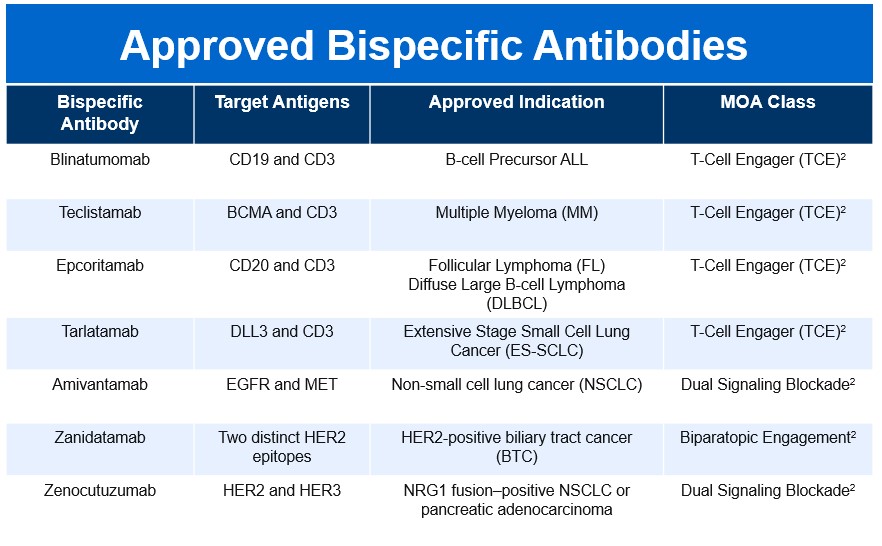
The BsAb landscape has rapidly expanded since the first approval of Blinatumomab in 2014, reflecting a growing therapeutic impact across multiple disease areas. As of late 2025, fifteen bispecific molecules have secured FDA approval, spanning both oncology and non-oncology indications. This surge underscores the versatility of BsAbs and their ability to address complex biological pathways through innovative mechanisms of action.

Approved-Bispecific-Antibodies

Limitations, Safety, and Risk Mitigation

  1. Manufacturing Challenges: The inherent complexity of BsAbs introduces challenges related to stability, manufacturability, and impurity control.1 The fusion of exogenous antigen-binding domains can decrease biophysical stability, and the complex assembly process frequently results in the formation of product-related impurities and mispaired species, which are difficult to remove during purification. These factors are not merely manufacturing hurdles; they directly influence the biological activity and, critically, the immunogenic potential of the final drug product.
  2. MOA-Specific Toxicity: The safety profile of BsAbs is highly dependent on their MOA
    • T-Cell Engager Toxicity: The highly potent, acute T-cell activation triggered by TCEs results in two major, distinct safety concerns. The first is Cytokine Release Syndrome (CRS), a serious acute toxicity caused by the mass release of systemic cytokines. CRS has been reported in up to 70% of patients receiving BsAbs, often necessitating hospitalization and precise management protocols. Severe cases (Grade ≥ 3) occur in 5–10% of patients.6 The second concern is Neurotoxicity (ICANS), which, while less frequent than CRS, affects 10–15% of patients and can range from mild confusion to cerebral edema.6 In addition, there is an Immune Regulation Paradox. Paradoxically, T-BsAb therapy can trigger the expansion and activation of inhibitory Regulatory T (Treg) cells in the tumor microenvironment, leading to the production of anti-inflammatory cytokines like IL-10. This critically inhibits the desired effector T-cell response, suggesting that combination strategies—such as transient Treg ablation—may be necessary to maximize efficacy.6
    • Pathway Blocker and Biparatopic Toxicity: These agents generally do not induce acute, systemic cytokine surges. Instead, their adverse event profiles reflect the targeted receptors. For example, the dual signaling blocker Amivantamab (targets EGFR/MET) exhibits EGFR-inhibition-related dermatologic toxicities, like paronychia, skin fissures, and pruritus, as well as infusion reactions. Dual checkpoint inhibitors can have classic IO toxicities. Biparatopic antibodies, like Zanidatamab, demonstrate a manageable profile but frequently cause gastrointestinal toxicities (such as diarrhea and nausea/vomiting) and infusion-related reactions (IRRs).9 Importantly, clinical data for Zanidatamab confirmed no reports of CRS.9
  3. Mitigating Immunogenicity Risk: The complex structures, engineered sequences, and immunostimulatory MOAs of oncology BsAbs contribute to an increased risk of immunogenicity compared to mAbs. Mitigation must begin at the engineering stage, utilizing in silico prediction and in vitro assays to guide the selection of low-risk antibody constructs through deimmunization and tolerization methods.

Future Directions

The BsAb pipeline remains robust, reflecting a continuous drive toward addressing current clinical limitations and expanding into novel biological territories. The future of BsAbs is characterized by a strategic shift toward overcoming the immunosuppressive tumor microenvironment (TME). Emerging candidates are now focused on targets that modulate the innate immune system and TME suppression, such as LILRB1/2 bispecific IgG1 antibodies for advanced solid tumors.10-11 Furthermore, BsAbs are expanding beyond simple blockade, with molecules like SAR446422 (CD28xOX40 bispecific) in trial for inflammatory indications, demonstrating the potential for BsAbs to achieve synergistic co-stimulatory agonism.10-11 The continuous innovation in structural design, focused now on minimizing impurity-driven immunogenicity and maximizing the therapeutic window, ensures that BsAbs are poised to become the standard for highly tailored, multifunctional therapeutic intervention across diverse and complex diseases. The future of BsAbs is very promising.10-11

References:

  1. Shan KS, Musleh Ud Din S, Dalal S, Gonzalez T, Dalal M, Ferraro P, Hussein A, Vulfovich M. Bispecific Antibodies in Solid Tumors: Advances and Challenges. International Journal of Molecular Sciences. 2025; 26(12):5838. https://doi.org/10.3390/ijms26125838.
  2. The Bispecific 2024 Landscape Review. Beacon Intelligence. 2024. https://beacon-intelligence.com/landscape-reviews/bispecific/. Accessed November 23, 2025.
  3. Ai Z, Wang B, Song Y, Cheng P, Liu X, Sun P. Prodrug-based bispecific antibodies for cancer therapy: advances and future directions. Front Immunol. 2025;16:1523693. Published 2025 Jan 22. doi:10.3389/fimmu.2025.1523693.
  4. Amash A, Volkers G, Farber P, et al. Developability considerations for bispecific and multispecific antibodies. MAbs. 2024;16(1):2394229. doi:10.1080/19420862.2024.2394229.
  5. Shui L, Wu D, Yang K, Sun C, Li Q, Yin R. Bispecific antibodies: unleashing a new era in oncology treatment. Mol Cancer. 2025;24(1):212. Published 2025 Aug 4. doi:10.1186/s12943-025-02390-y.
  6. Dewaele L, Fernandes RA. Bispecific T-cell engagers for the recruitment of T cells in solid tumors: a literature review. Immunother Adv. 2025;5(1):ltae005. Published 2025 Jan 27. doi:10.1093/immadv/ltae005.
  7. Kast F, Schwill M, Stüber JC, et al. Engineering an anti-HER2 biparatopic antibody with a multimodal mechanism of action. Nat Commun. 2021;12(1):3790. Published 2021 Jun 18. doi:10.1038/s41467-021-23948-6.
  8. Elimova E, Ajani J, Burris H, et al. Zanidatamab plus chemotherapy as first-line treatment for patients with HER2-positive advanced gastro-oesophageal adenocarcinoma: primary results of a multicentre, single-arm, phase 2 study. Lancet Oncol. 2025;26(7):847-859. doi:10.1016/S1470-2045(25)00287-6.
  9. Ziihera Safety Information. Ziihera HCP (Jazz Pharmaceuticals). https://www.ziiherahcp.com/safety. Accessed November 23, 2025.
  10. Wen J, Cui W, Yin X, et al. Application and future prospects of bispecific antibodies in the treatment of non-small cell lung cancer. Cancer Biol Med. 2025;22(4):348-375. doi:10.20892/j.issn.2095-3941.2024.0470.
  11. Engineering the Next Generation of Bispecific Antibodies. PEGS Europe 2024 Archive. https://www.pegsummiteurope.com/24/engineering-bispecifics. Accessed November 23, 2025