Therapeutic Prowess and Potential of Multifunctional Therapeutics: A Review of Bispecific Antibodies

Written by: Jaffer A. Ajani, MD, FASCO
This educational opportunity is sponsored by: Jazz Pharmaceuticals

Concept and Technology

Bispecific antibodies (BsAbs) transcend conventional limitations of therapeutic protein engineering by simultaneously engaging two distinct biological targets. Rooted in molecular cooperation, BsAbs combine two functional antigen-binding fragments (often Fab arms) into a single molecule.1 A considerable novelty over traditional monoclonal antibodies (mAbs), which target a single epitope, BsAbs lead to forced cellular proximity or receptor clustering.1–3  Technological challenges of manufacturing BsAbs for optimal pharmacokinetics (PK), stability, and purity remain. Yet, their dual-targeting allows BsAbs to mediate synergistic effects and intervene in complex, multi-factorial disease pathways—for example, in oncology, where we find multiple redundant receptors, ligands, and evasion mechanisms.1 The following review will review BsAb structures, mechanisms of action, safety profiles, and future directions.

Structural Variants

  1. Non-IgG-like (Fc-Silent) variants are characterized by a lack of the Fragment crystallizable (Fc) domain, resulting in small molecules that are rapidly cleared by the kidneys, necessitating frequent dosing. Their advantage is high potency and efficient tissue penetration.4 These include:
    • Bispecific T-Cell Engagers (BiTEs): Typically constructed as tandem single-chain variable fragments (scFv) that link a tumor-associated antigen (TAA) binder and a CD3 binder via a peptide linker.4 Blinatumomab is a well-known example that achieves potent cellular redirection.
    • Dual Affinity Re-targeting Molecules (DARTs): Similar to BiTEs, DARTs incorporate an additional disulfide bridge to improve structural stability.
    • Killer Cell Engagers (BiKEs/TriKEs): These target the innate immune system by engaging CD16 on NK cells. Trispecific Killer Engagers (TriKEs) feature a third component, such as an IL-15 crosslinker, to sustain NK cell proliferation and cytotoxicity.4
  2. IgG-like (Fc-Containing) formats retain the Y-shaped IgG structure, including the Fc domain, conferring prolonged serum half-life via FcRn recycling.4 However, assembling two different heavy chains and two different light chains into a functional heterodimer without forming undesirable mispaired byproducts demands intensive engineering—e.g., CrossMab and/or Knobs-into-Holes (KiH) technologies.4–6

Mechanisms of Action (MOA)

The therapeutic power of BsAbs lies in their ability to execute mechanisms categorized as acting in-trans or in-cis, based on their molecular or cellular target configuration.

  1. In-Trans Mechanisms: The core in-trans function is creating a physical linkage between two distinct molecular or cellular entities. These include:
    • Cellular Bridging (T-Cell Engagers; TCEs): This is the hallmark of oncology BsAbs. By simultaneously binding a TAA and CD3 on T cells, the BsAb forces a physical link, forming a cytolytic synapse.6 This mechanism bypasses the need for natural T-cell receptor (TCR) clustering and Major Histocompatibility Complex (MHC) presentation, allowing the T cell to attack regardless of the tumor’s MHC status.4,6
    • Co-factor Mimicry: Outside of cytotoxicity, BsAbs can direct components to form a functional complex. Emicizumab, approved for Hemophilia A, is an example.2–6
  2. In-Cis Mechanisms: Involve targeting components that reside on the same cell or act within the same signaling pathway. These include:
    • Dual Signaling Inhibition (Dual Blockade): Simultaneously blocks two different receptors or ligands to suppress synergistic pathways crucial for disease progression.
      • Examples: Targeting HER2/HER3 (Zenocutuzumab) or EGFR/MET (Amivantamab) to halt parallel proliferation cascades in cancer.1–6
    • Biparatopic Engagement: By binding two distinct, non-overlapping epitopes on the same antigen4,5, biparatopics intensify control over one oncogenic “addiction” pathway via geometry-driven clustering, internalization, and boosted Fc effector functions. Biparatopics enhance binding avidity and promote superior functional modulation of the target, such as forced receptor clustering and internalization, the latter being highly beneficial for Antibody-Drug Conjugates (ADCs). Biparatopic binding drives dense clustering of the same receptor, leading to “caps” on the cell surface, resulting in potent receptor internalization and degradation. This yields deeper and more durable signal blockade than a single monoclonal antibody or cocktail.7 The high local receptor and antibody density also enables multimodal effector functions, and helps overcome resistance within a single pathway by engaging distinct functional domains to block both ligand-dependent and ligand-independent signaling and interfere with heterodimerization (e.g., HER2/HER3). They also retain efficacy when tumors escape mono-epitope antibodies through epitope masking or mutation.
      • Example: Zanidatamab, which targets two distinct HER2 epitopes, and is unique in its ability to induce receptor clustering and “capping.”8-9

Clinical Landscape

The BsAb landscape has rapidly expanded since the first approval of Blinatumomab in 2014, reflecting a growing therapeutic impact across multiple disease areas. As of late 2025, fifteen bispecific molecules have secured FDA approval, spanning both oncology and non-oncology indications. This surge underscores the versatility of BsAbs and their ability to address complex biological pathways through innovative mechanisms of action.
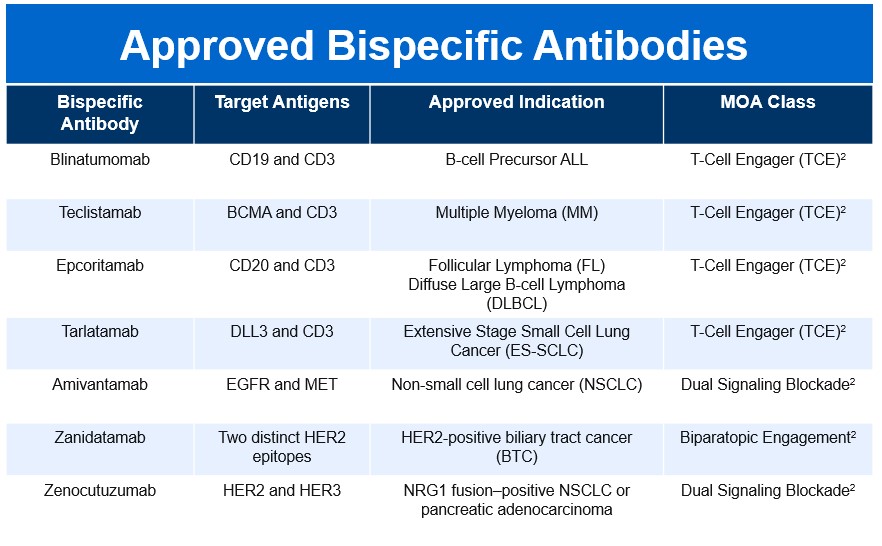
Approved-Bispecific-Antibodies

Limitations, Safety, and Risk Mitigation

  1. Manufacturing Challenges: The inherent complexity of BsAbs introduces challenges related to stability, manufacturability, and impurity control.1 The fusion of exogenous antigen-binding domains can decrease biophysical stability, and the complex assembly process frequently results in the formation of product-related impurities and mispaired species, which are difficult to remove during purification. These factors are not merely manufacturing hurdles; they directly influence the biological activity and, critically, the immunogenic potential of the final drug product.
  2. MOA-Specific Toxicity: The safety profile of BsAbs is highly dependent on their MOA
    • T-Cell Engager Toxicity: The highly potent, acute T-cell activation triggered by TCEs results in two major, distinct safety concerns. The first is Cytokine Release Syndrome (CRS), a serious acute toxicity caused by the mass release of systemic cytokines. CRS has been reported in up to 70% of patients receiving BsAbs, often necessitating hospitalization and precise management protocols. Severe cases (Grade ≥ 3) occur in 5–10% of patients.6 The second concern is Neurotoxicity (ICANS), which, while less frequent than CRS, affects 10–15% of patients and can range from mild confusion to cerebral edema.6 In addition, there is an Immune Regulation Paradox. Paradoxically, T-BsAb therapy can trigger the expansion and activation of inhibitory Regulatory T (Treg) cells in the tumor microenvironment, leading to the production of anti-inflammatory cytokines like IL-10. This critically inhibits the desired effector T-cell response, suggesting that combination strategies—such as transient Treg ablation—may be necessary to maximize efficacy.6
    • Pathway Blocker and Biparatopic Toxicity: These agents generally do not induce acute, systemic cytokine surges. Instead, their adverse event profiles reflect the targeted receptors. For example, the dual signaling blocker Amivantamab (targets EGFR/MET) exhibits EGFR-inhibition-related dermatologic toxicities, like paronychia, skin fissures, and pruritus, as well as infusion reactions. Dual checkpoint inhibitors can have classic IO toxicities. Biparatopic antibodies, like Zanidatamab, demonstrate a manageable profile but frequently cause gastrointestinal toxicities (such as diarrhea and nausea/vomiting) and infusion-related reactions (IRRs).9 Importantly, clinical data for Zanidatamab confirmed no reports of CRS.9
  3. Mitigating Immunogenicity Risk: The complex structures, engineered sequences, and immunostimulatory MOAs of oncology BsAbs contribute to an increased risk of immunogenicity compared to mAbs. Mitigation must begin at the engineering stage, utilizing in silico prediction and in vitro assays to guide the selection of low-risk antibody constructs through deimmunization and tolerization methods.

Future Directions

The BsAb pipeline remains robust, reflecting a continuous drive toward addressing current clinical limitations and expanding into novel biological territories. The future of BsAbs is characterized by a strategic shift toward overcoming the immunosuppressive tumor microenvironment (TME). Emerging candidates are now focused on targets that modulate the innate immune system and TME suppression, such as LILRB1/2 bispecific IgG1 antibodies for advanced solid tumors.10-11 Furthermore, BsAbs are expanding beyond simple blockade, with molecules like SAR446422 (CD28xOX40 bispecific) in trial for inflammatory indications, demonstrating the potential for BsAbs to achieve synergistic co-stimulatory agonism.10-11 The continuous innovation in structural design, focused now on minimizing impurity-driven immunogenicity and maximizing the therapeutic window, ensures that BsAbs are poised to become the standard for highly tailored, multifunctional therapeutic intervention across diverse and complex diseases. The future of BsAbs is very promising.10-11

References:

  1. Shan KS, Musleh Ud Din S, Dalal S, Gonzalez T, Dalal M, Ferraro P, Hussein A, Vulfovich M. Bispecific Antibodies in Solid Tumors: Advances and Challenges. International Journal of Molecular Sciences. 2025; 26(12):5838. https://doi.org/10.3390/ijms26125838.
  2. The Bispecific 2024 Landscape Review. Beacon Intelligence. 2024. https://beacon-intelligence.com/landscape-reviews/bispecific/. Accessed November 23, 2025.
  3. Ai Z, Wang B, Song Y, Cheng P, Liu X, Sun P. Prodrug-based bispecific antibodies for cancer therapy: advances and future directions. Front Immunol. 2025;16:1523693. Published 2025 Jan 22. doi:10.3389/fimmu.2025.1523693.
  4. Amash A, Volkers G, Farber P, et al. Developability considerations for bispecific and multispecific antibodies. MAbs. 2024;16(1):2394229. doi:10.1080/19420862.2024.2394229.
  5. Shui L, Wu D, Yang K, Sun C, Li Q, Yin R. Bispecific antibodies: unleashing a new era in oncology treatment. Mol Cancer. 2025;24(1):212. Published 2025 Aug 4. doi:10.1186/s12943-025-02390-y.
  6. Dewaele L, Fernandes RA. Bispecific T-cell engagers for the recruitment of T cells in solid tumors: a literature review. Immunother Adv. 2025;5(1):ltae005. Published 2025 Jan 27. doi:10.1093/immadv/ltae005.
  7. Kast F, Schwill M, Stüber JC, et al. Engineering an anti-HER2 biparatopic antibody with a multimodal mechanism of action. Nat Commun. 2021;12(1):3790. Published 2021 Jun 18. doi:10.1038/s41467-021-23948-6.
  8. Elimova E, Ajani J, Burris H, et al. Zanidatamab plus chemotherapy as first-line treatment for patients with HER2-positive advanced gastro-oesophageal adenocarcinoma: primary results of a multicentre, single-arm, phase 2 study. Lancet Oncol. 2025;26(7):847-859. doi:10.1016/S1470-2045(25)00287-6.
  9. Ziihera Safety Information. Ziihera HCP (Jazz Pharmaceuticals). https://www.ziiherahcp.com/safety. Accessed November 23, 2025.
  10. Wen J, Cui W, Yin X, et al. Application and future prospects of bispecific antibodies in the treatment of non-small cell lung cancer. Cancer Biol Med. 2025;22(4):348-375. doi:10.20892/j.issn.2095-3941.2024.0470.
  11. Engineering the Next Generation of Bispecific Antibodies. PEGS Europe 2024 Archive. https://www.pegsummiteurope.com/24/engineering-bispecifics. Accessed November 23, 2025

FDA Approves Niraparib with Abiraterone Acetate plus Prednisone for BRCA2-Mutated mCSPC

SUMMARY: The FDA on December 12, 2025, approved Niraparib and Abiraterone acetate (AKEEGA®) with prednisone for adults with deleterious or suspected deleterious BRCA2-mutated (BRCA2m) metastatic Castration-Sensitive Prostate Cancer (mCSPC), as determined by an FDA-approved test.

Prostate cancer is the most common cancer in American men with the exclusion of skin cancer, and 1 in 8 men will be diagnosed with prostate cancer during their lifetime. It is estimated that in the United States, about 313,780 new cases of prostate cancer will be diagnosed in 2025 and 35,770 men will die of the disease.

Metastatic Castration-Sensitive Prostate Cancer (mCSPC) is a heterogeneous disease. Despite therapeutic advances, outcomes vary significantly based on underlying tumor biology. Approximately 25% of patients with mCSPC harbor Homologous Recombination Repair (HRR) gene mutations, including BRCA1, BRCA2, CHEK2, CDK12, PALB2, and others. Among these, BRCA1/2 mutations account for nearly half of HRR alterations and are particularly associated with aggressive disease biology, resistance to Androgen Receptor Pathway Inhibitors (ARPIs), and shortened Progression-Free and Overall Survival. The integration of AR-pathway inhibitors such as Abiraterone Acetate plus Prednisone into first-line treatment has meaningfully improved outcomes in the general mCSPC population. However, patients with HRR mutations, especially those with BRCA1/2, derive significantly less benefit from these agents alone, highlighting a substantial unmet clinical need.

Rationale for PARP Inhibition in HRR-Altered Prostate Cancer
Cancer cells with HRR deficiencies are vulnerable to PARP (Poly ADP-Ribose Polymerase) inhibition, which blocks DNA repair pathways and induces synthetic lethality. Prior landmark trials, MAGNITUDE (Niraparib with Abiraterone Acetate plus Prednisone) and TALAPRO-2 (Talazoparib  plus Enzalutamide), demonstrated the value of combining PARP inhibitors with ARPIs in Castration-Resistant Prostate Cancer (mCRPC) with HRR mutations. However, whether such a combination could offer meaningful benefit earlier in the disease course, in the castration-sensitive setting, remained unknown, until now.

AMPLITUDE Trial Design and Methods

Study Overview
The AMPLITUDE trial (NCT04497844) is a global, Phase 3, randomized, double-blind, placebo-controlled trial designed to evaluate whether combining the PARP inhibitor Niraparib with Abiraterone Acetate plus Prednisone improves clinical outcomes in patients with mCSPC (metastatic Castration-Sensitive Prostate Cancer) and HRR gene alterations.

Patient Population

  • Total enrolled: 696 men with mCSPC and at least one HRR gene mutation (germline or somatic)
  • Mutation profile: BRCA1, BRCA2, BRIP1, CDK12, CHEK2, FANCA, PALB2, RAD51B, RAD54L
  • BRCA1/2 prevalence: 55.6% of enrolled patients
  • Metastatic disease burden: 78% were high-volume M1disease, 87% had de novo M1disease and 16% had prior therapy with Docetaxel.
  • Prior therapies allowed:
    • 6 months or less of Androgen Deprivation Therapy (ADT)
    • 6 cycles or less of Docetaxel
    • 45 days or less of prior Abiraterone and Prednisone

Randomization and Treatment Arms

Patients were randomized 1:1 to:

  • Experimental arm: Niraparib 200 mg once daily plus Abiraterone acetate 1000 mg daily and Prednisone 5 mg daily (N=348)
  • Control arm: Placebo plus Abiraterone acetate 1000 mg along with Prednisone 5 mg daily (N=348)
    All patients continued on ADT.

Endpoints

  • Primary: Radiographic Progression-Free Survival (rPFS), assessed by investigator
  • Secondary: Time to Symptomatic Progression (TSP), Overall Survival (OS), Safety/tolerability

Key Results and Interpretation

Efficacy Outcomes

Radiographic Progression-Free Survival (Primary Endpoint)

  • Median rPFS:
    • Niraparib plus Abiraterone and Prednisone: Not reached
    • Abiraterone and Prednisone alone: 5 months (95% CI, 25.8–NR)
  • Hazard ratio: 0.63 (P=0.0001)
  • BRCA1/2 subgroup: HR =0.52 (P<0.0001)

This translates into a 37% relative risk reduction in progression or death in the overall population, and a 48% reduction in the BRCA1/2 subgroup, indicating a clear therapeutic effect in genetically defined populations.

Time to Symptomatic Progression

  • HR (overall): 0.50 (P<0.0001)
  • BRCA1/2 subgroup: HR 0.44 (P=0.0001)

This is clinically meaningful, and delaying symptom onset can preserve quality of life and extend time before additional therapies are needed.

Overall Survival (Interim Analysis)

  • HR (overall): 0.79 (95% CI, 0.59–1.04; P=0.10)
  • BRCA1/2 subgroup: HR 0.75 (95% CI, 0.51–1.11; P=0.15)

In an exploratory analysis of 323 patients with BRCA2 mutations, the rPFS Hazard Ratio (HR) was 0.46 (95% CI: 0.32, 0.66) with median rPFS not estimable for Niraparib and Abiraterone acetate with prednisone compared with 26 months (95% CI: 18, 28) for placebo and Abiraterone acetate with prednisone.

In an exploratory analysis in 373 patients with non-BRCA2 mutations, the HR for rPFS was 0.88 (95% CI: 0.63, 1.24), indicating that the overall improvement was primarily attributed to the results seen in patients with BRCA2 mutations.

Although OS data are not yet mature, the trend suggests a potential survival benefit with longer follow-up.

Safety Profile
The safety of Niraparib plus Abiraterone and Prednisone was consistent with known profiles of both agents. Grade 3-4 AEs in the Niraparib plus Abiraterone and Prednisone was 75.2% versus 58.9% with Abiraterone and Prednisone alone, with the most common higher Grade 3-4 AEs  noted in the Niraparib plus Abiraterone and Prednisone group (Anemia: 29.1% vs 4.6% and Hypertension: 26.5% vs 18.4%). The discontinuation rates due to AEs in the Niraparib plus Abiraterone and Prednisone group was 11.0% vs 6.9% in the Abiraterone and Prednisone group. These AEs were manageable with appropriate monitoring. No new safety signals were identified.

Conclusion
The AMPLITUDE trial marks a milestone and provides robust evidence to support Niraparib plus Abiraterone and Prednisone as a new first-line option in mCSPC patients with BRCA1/2 or other HRR gene mutations. By demonstrating that Niraparib plus Abiraterone and Prednisone improves Progression-Free outcomes in HRR-altered mCSPC, especially those with BRCA mutations, it paves the way for a more personalized, biology-driven approach to therapy in this setting. Ongoing follow-up will determine whether this translates into improved survival, but the current data already support Niraparib plus Abiraterone and Prednisone as a new treatment benchmark for this high-risk subgroup.

Phase 3 AMPLITUDE trial: Niraparib (NIRA) and abiraterone acetate plus prednisone (AAP) for metastatic castration-sensitive prostate cancer (mCSPC) patients (pts) with alterations in homologous recombination repair (HRR) genes. Attard G, Agarwal N, Graff J, et al. J Clin Oncol 43, 2025 (suppl 17; abstr LBA5006)


HER2CLIMB-05: Redefining First-Line Maintenance Therapy in HER2-Positive Metastatic Breast Cancer

SUMMARY: Breast cancer is the most common cancer among women in the US and about 1 in 8 women (12%) will develop invasive breast cancer during their lifetime. It is estimated that in the US, approximately 316,950 new cases of female breast cancer will be diagnosed in 2025, and about 42,170 women will die of the disease, largely due to metastatic recurrence.

Approximately 15-20% of invasive breast cancers overexpress HER2/neu oncogene, which is a negative predictor of outcomes without systemic therapy. Patients with HER2-positive metastatic breast cancer are often treated with anti-HER2 targeted therapy along with chemotherapy, irrespective of hormone receptor status, and this has resulted in significantly improved treatment outcomes. With advances in systemic therapies for this patient population, the incidence of brain metastases as a sanctuary site has increased. Approximately 50% of patients with HER2-positive metastatic breast cancer develop brain metastases. However, systemic HER2-targeted agents, including Tyrosine Kinase Inhibitors, as well as chemotherapy have limited antitumor activity in the brain. Local therapeutic interventions for brain metastases include neurosurgical resection and Stereotactic or Whole-Brain Radiation Therapy. There is a high unmet need for systemic treatment options to treat established brain metastases and reduce the risk for progression in the Central Nervous System (CNS).

Expanding Options Beyond Standard Maintenance

Despite major advances in the management of Human Epidermal growth factor Receptor 2–positive (HER2+) metastatic breast cancer (MBC), disease progression during maintenance therapy remains a persistent challenge. The long-standing first-line (1L) standard of care, induction with Trastuzumab, Pertuzumab, and a Taxane followed by Trastuzumab plus Pertuzumab maintenance, has delivered durable benefit, yet most patients ultimately relapse within two years. This unmet need is particularly relevant in a modern population increasingly exposed to HER2-targeted therapy in the early-stage setting and enriched for de novo metastatic disease.

HER2CLIMB-05 was designed to test whether intensifying HER2 blockade during the maintenance phase, by adding the highly selective oral HER2 tyrosine kinase inhibitor (TKI) Tucatinib (TUKYSA®), could further delay disease progression while preserving tolerability and quality of life.

Study Design and Patient Population

HER2CLIMB-05 (NCT05132582) is a randomized, double-blind, placebo-controlled, International Phase 3 trial enrolling patients with centrally confirmed HER2+ unresectable locally advanced or metastatic breast cancer. Eligible patients had no evidence of disease progression following 4 to 8 cycles of standard 1L induction therapy with Trastuzumab, Pertuzumab, and a taxane, an ECOG performance status of 0 or 1, and no or asymptomatic brain metastases.

A total of 654 patients were randomized 1:1 to receive Tucatinib (300 mg PO twice daily) or placebo, in combination with Trastuzumab and Pertuzumab administered IV every 21 days. Randomization was stratified by de novo versus recurrent disease, Hormone Receptor (HR) status, and presence or history of brain metastases. Endocrine therapy was permitted for patients with HR-positive disease. The Primary endpoint was investigator-assessed Progression-Free Survival (PFS) per RECIST v1.1. Key Secondary endpoints included Overall Survival (OS), PFS by Blinded Independent Central Review (BICR), Central Nervous System (CNS) PFS, safety, and Patient-Reported Outcomes.

The enrolled population reflects current real-world patterns of HER2+ MBC. All patients were female, with a median age of 54 years. Nearly 70% presented with de novo metastatic disease, over half had HR-positive tumors, and 12.4% had a presence or history of brain metastases at baseline. Most patients had excellent performance status, with nearly two-thirds classified as ECOG 0.

Primary Endpoint Met: Significant and Clinically Meaningful PFS Improvement

At a median follow-up of approximately 23 months, HER2CLIMB-05 met its Primary endpoint. The addition of Tucatinib to Trastuzumab and Pertuzumab resulted in a statistically significant and clinically meaningful improvement in PFS compared with standard maintenance therapy alone. Median PFS was 24.9 months in the Tucatinib arm versus 16.3 months in the control arm, corresponding to a 36% reduction in the risk of disease progression or death (Hazard Ratio [HR], 0.64; P < 0.0001). Results from BICR were consistent, reinforcing the robustness of the primary analysis.

Importantly, the PFS benefit was observed across all prespecified subgroups, including patients with and without brain metastases and those with HR-positive or HR-negative disease. This consistency highlights the broad applicability of Tucatinib-based maintenance therapy in HER2+ MBC.

Early Signals in Overall Survival and CNS Outcomes

Overall Survival data remain immature, with approximately 20% of the required events observed at the time of this primary analysis. Median OS has not yet been reached in either arm, with no evidence of detriment associated with Tucatinib and a favorable trend observed.

While CNS-PFS was not reached in the overall population, patients with baseline brain metastases experienced a numerical improvement with Tucatinib, with median CNS-PFS nearly doubling compared with control (8.5 vs 4.3 months). Although preliminary, these findings align with prior HER2CLIMB data supporting Tucatinib’s activity in CNS disease.

Safety Profile: Consistent and Manageable

The safety profile of Tucatinib in combination with Trastuzumab and Pertuzumab was consistent with known toxicities of HER2-directed regimens. Diarrhea, nausea, and transaminase elevations were the most common treatment-emergent adverse events in the Tucatinib arm, the majority of which were low grade and manageable with supportive care and dose modifications.

Grade ≥3 adverse events were more frequent with Tucatinib, particularly elevated ALT and AST; however, hepatic events were generally asymptomatic, reversible, and occurred early in treatment. Discontinuation of Tucatinib due to adverse events occurred in 13.5% of patients, underscoring the importance of proactive monitoring and toxicity management in clinical practice. No new safety signals were identified.

Positioning HER2CLIMB-05 in an Evolving Treatment Landscape

HER2CLIMB-05 adds to a growing body of evidence supporting maintenance intensification strategies in HER2+ MBC. Alongside recent Phase 3 trials such as PATINA and DESTINY-Breast09, these data emphasize that meaningful improvements in disease control can be achieved beyond traditional chemotherapy-based induction regimens.

Unlike antibody–drug conjugate based approaches, Tucatinib-based maintenance offers a chemotherapy-free option that targets HER2 both extracellularly and intracellularly, with particular relevance for patients with brain metastases or those who may not be ideal candidates for prolonged cytotoxic therapy.

Clinical Implications

The HER2CLIMB-05 primary analysis demonstrates that adding Tucatinib to Trastuzumab and Pertuzumab as 1L maintenance therapy significantly prolongs PFS, extending disease control to more than two years in patients with HER2+ metastatic breast cancer. The benefit was consistent across key subgroups, including HR status and CNS involvement, and was achieved with a manageable and familiar safety profile.

As the HER2+ metastatic treatment paradigm continues to evolve, Tucatinib-based maintenance represents an important new option that may delay progression and postpone the need for subsequent cytotoxic therapy. Ongoing follow-up will clarify the impact on Overall Survival, CNS outcomes, and patient-reported Quality of Life, further informing individualized treatment decisions.

HER2CLIMB-05: A Phase 3 Study of Tucatinib Versus Placebo in Combination with Trastuzumab and Pertuzumab as First-line Maintenance Therapy for HER2+ Metastatic Breast Cancer. Dieras V, Curigliano G, Martin M, et al. on behalf of the HER2CLIMB-05 investigators. J Clin Oncol. DOI: 10.1200/JCO-25-02600

PHAROS: Long-Term Efficacy and Survival Outcomes with Encorafenib Plus Binimetinib in BRAF V600E–Mutant Metastatic NSCLC

SUMMARY: Lung cancer is the second most common cancer in both men and women and accounts for about 13% of all new cancers and 21% of all cancer deaths. The American Cancer Society estimates that for 2025, about 226,650 new cases of lung cancer will be diagnosed and 124,730 patients will die of the disease. Lung cancer is the leading cause of cancer-related mortality in the United States. Non-Small Cell Lung Cancer (NSCLC) accounts for approximately 85% of all lung cancers and Adenocarcinoma is now the most frequent histologic subtype of lung cancer.

BRAF V600E mutations occur in approximately 1% to 2% of patients with NSCLC and define a biologically distinct subset for which targeted therapy has become a cornerstone of treatment. Dual inhibition of the MAPK pathway with BRAF and MEK inhibitors is currently recommended by clinical guidelines as the preferred first-line approach for patients with BRAF V600E–mutant metastatic NSCLC (mNSCLC), with immunotherapy and chemotherapy-based regimens serving as alternative options.

The Phase II PHAROS study (NCT03915951) is an ongoing, open-label, single-arm, multicenter trial designed to evaluate the efficacy and safety of Encorafenib (BRAFTOVI®) in combination with Binimetinib (MEKTOVI®) in patients with BRAF V600E–mutant mNSCLC. Eligible patients included both treatment-naïve individuals and those with prior systemic therapy for metastatic disease. All patients received oral Encorafenib 450 mg once daily plus oral Binimetinib 45 mg twice daily, administered in continuous 28-day cycles until disease progression, unacceptable toxicity, or treatment discontinuation.

The Primary endpoint of PHAROS was Objective Response Rate (ORR) as assessed by Independent Radiology Review (IRR), with separate analyses prespecified for treatment-naïve and previously treated cohorts. Key Secondary endpoints included Duration of Response (DOR), Progression-Free Survival (PFS), Overall Survival (OS), Disease Control Rate, Safety, and Tolerability. Exploratory analyses evaluated efficacy across clinically relevant subgroups, including smoking history.

A total of 98 patients were enrolled and treated, including 59 treatment-naïve and 39 previously treated patients. At the March 14, 2025 data cutoff, a small proportion of patients in both cohorts remained on active treatment, reflecting durable disease control in a subset of patients. Median treatment duration was substantially longer in the frontline cohort compared with previously treated patients, with more than 40% of treatment-naïve patients receiving therapy for longer than two years.

PHAROS met its Primary endpoint in both cohorts.

In treatment-naïve patients, the confirmed ORR by IRR was 75%, with responses demonstrating marked durability. Median Duration of Response was 40.0 months, and median PFS reached 30.4 months. After a median follow-up of more than four years for overall survival, median OS was 47.6 months, with an estimated 4-year OS rate of 49%, underscoring the potential for prolonged survival with frontline targeted therapy.

In the previously treated cohort, Encorafenib plus Binimetinib also demonstrated clinically meaningful activity. The ORR was 49%, with a median Duration of Response of 16.7 months. Median PFS was 9.3 months, and median OS was 22.7 months after nearly four years of follow-up. The estimated 4-year OS rate in this cohort was 31%.

Post hoc subgroup analyses suggested that clinical benefit was generally consistent across baseline characteristics. Notably, both PFS and OS were numerically longer in patients without a smoking history compared with those with a history of smoking, a finding that may be related to pharmacokinetic effects on Binimetinib exposure and warrants further investigation.

The safety profile observed with extended follow-up was consistent with prior analyses and with known toxicities associated with BRAF and MEK inhibition. Most treatment-related adverse events were low grade and manageable, with gastrointestinal symptoms, fatigue, and nausea among the most frequently reported. Rates of dose modification and discontinuation were similar across treatment lines, and no new safety signals emerged with longer-term exposure.

Although cross-trial comparisons should be interpreted cautiously, the Overall Survival outcomes observed in PHAROS compare favorably with historical data for targeted therapy in this population. Given that a significant proportion of patients with metastatic NSCLC may not receive subsequent lines of therapy, these findings emphasize the importance of selecting the most effective treatment upfront.

In conclusion, updated results from the PHAROS study demonstrate durable responses and sustained long-term survival with Encorafenib plus Binimetinib in patients with BRAF V600E–mutant mNSCLC. The depth and durability of benefit, particularly in treatment-naïve patients, further support this combination as a preferred first-line targeted therapy option and reinforce its role in the evolving treatment landscape for this molecularly defined NSCLC subgroup.

Updated Overall Survival Analysis From the Phase II PHAROS Study of Encorafenib Plus Binimetinib in Patients With BRAF V600E-Mutant Metastatic Non–Small Cell Lung Cancer. Johnson ML, Smit EF, Felip E, et al. J Clin Oncol. 2025;43:3706-3713

Precision Medicine in Practice: Timely Use of Tumor NGS Remains Suboptimal in Common Cancers

SUMMARY: Next-generation sequencing (NGS) has revolutionized the management of advanced cancers by enabling identification of tumor-specific genomic alterations for which targeted therapies are now available. National guidelines recommend early and routine NGS testing for patients with advanced or metastatic solid tumors to inform treatment decisions. In the United States, the five most prevalent advanced or metastatic solid tumors include advanced Non-Small Cell Lung Cancer (aNSCLC), metastatic Breast Cancer (mBC), metastatic Prostate Cancer (mPC), advanced Colorectal Cancer (aCRC), and metastatic Pancreatic Cancer (mPanC). For these malignancies, the integration of NGS has become increasingly critical in guiding targeted therapy selection and improving survival outcomes. Despite the approval of multiple targeted therapies for these malignancies, real-world utilization of NGS remains inconsistent.

In this study presented at the 2025 ASCO Annual Meeting, Chehade and colleagues,  evaluated patterns in NGS testing and its timing, relative to patient mortality.

Study Overview: This retrospective analysis leveraged the Flatiron Health EHR-derived de-identified database across 280 cancer clinics, spanning data from 2011 onward. The study included patients with a diagnosis of aNSCLC, mBC, mPC, aCRC, or mPanC, all of whom had records of NGS testing and a documented date of death. The researchers identified 86,536 patients with advanced non-small cell lung cancer, 36,000 with metastatic breast cancer, 35,702 with advanced colorectal cancer, 24,105 with metastatic prostate cancer and 14,964 with metastatic pancreatic cancer. About a third of patients from each cancer group received NGS testing (NSCLC, 36.3%; breast cancer, 32.1%; colorectal cancer, 41%; prostate cancer, 30.9%; and pancreatic cancer, 35.4%).

Patients were categorized based on the interval between receipt of NGS results and death:

  • More than 3 months before death
  • Within 3 months of death
  • After death

Key Findings Across cancer types, only 30% to 40% of patients received NGS testing. Among those who were tested and had a recorded date of death, the timing of NGS was as follows:

Timing of First NGS aNSCLC (N=19,958) mBC (N=5,689) mPC (N=3,397) aCRC (N=8,553) mPanC (N=3,957)
>3 mo before death          72.3%        81.6%        85.4%        85.0%         71.1%
Within 3 mo of death          25.6%        16.9%        13.5%        13.7%         26.5%
After death          2.1%        1.5%        1.1%        1.3%         2.4%

Notably, up to one in four patients with NSCLC or pancreatic cancer received their first NGS results within 3 months of death, a timeframe often too late for actionable therapeutic intervention.

Interpretation and Implications Despite advances in molecularly targeted therapies and growing guideline support for comprehensive genomic profiling, real-world testing patterns remain suboptimal:

  • Low uptake: Only about a third of eligible patients undergo NGS testing.
  • Late testing: A substantial proportion of tested patients receive results within 3 months of death.
  • Missed opportunities: Many patients are never tested—or are tested too late to benefit from life-extending therapies.

These findings highlight ongoing gaps in precision oncology implementation, especially in community-based settings.

Next Steps & Recommendations To improve the utility of NGS in oncology, efforts should focus on:

  • Earlier testing: At diagnosis or at first progression of advanced disease.
  • Workflow integration: Embedding NGS into routine clinical pathways.
  • Education: Raising awareness among clinicians and patients about the benefits of timely testing.
  • Health system support: Addressing barriers such as reimbursement, turnaround times, and tissue availability.

Conclusion: Real-World Data from this large retrospective analysis reveal late-stage testing and underutilization of life-prolonging genomic profiling. This study underscores an urgent need to optimize the timing and uptake of NGS testing in patients with advanced solid tumors. Earlier and broader testing is essential to ensure patients have access to the most effective, personalized treatment strategies, and to avoid the missed potential of life-extending therapies.

Utilization and timing of first tumor next-generation sequencing testing (NGS) in patients (pts) with five most common cancers in the USA. Chehade CH, Jo Y, Ozay ZI, et al. Doi: 10.1200/JCO.2025.43.16_suppl.11014. Abstract # 11014. Presented at: ASCO Annual Meeting; May 30-June 3, 2025; Chicago.

Low Dose Aspirin Reduces Recurrence in Colorectal Cancer Patients with PI3K Pathway Alterations

SUMMARY: ColoRectal Cancer (CRC) is the third most common cancer diagnosed in both men and women in the United States. The American Cancer Society estimates that approximately 154,270 new cases of CRC will be diagnosed in the United States in 2025 and about 52,900 patients will die of the disease. The lifetime risk of developing CRC is about 1 in 23. Among patients with Stage II-III CRC, 20-40% will develop metastatic disease.

The majority of CRC cases (about 75 %) are sporadic whereas the remaining 25 % of the patients have a family history of the disease. Only 5-6 % of patients with CRC with a family history background are due to inherited mutations in major CRC genes, while the rest are the result of accumulation of both genetic mutations and epigenetic modifications of several genes. Colorectal Cancer is a heterogeneous disease classified by its genetics, and even though the diagnosis of Colorectal Cancer in the US is dropping among people 65 years and older, the incidence has been rising in the younger age groups, with 12% of Colorectal Cancer cases diagnosed in people under age 50.

Aspirin (AcetylSalicylic Acid) has been studied as a chemopreventive agent for several decades and the temporal relationship between systemic inflammation and cancer has been a topic of ongoing investigation. The US Preventive Services Task Force (USPSTF) found adequate evidence that Aspirin use reduces the incidence of CRC in adults after 5-10 years of use, and recommends initiating low-dose Aspirin use for the primary prevention of CardioVascular Disease (CVD) and CRC, in adults aged 50-69 years, who have a 10% or greater 10-year CVD risk, are not at increased risk for bleeding, have a life expectancy of at least 10 years, and are willing to take low-dose Aspirin daily for at least 10 years.

Aspirin has been shown to lower the incidence of adenomas and CRC in high-risk patients. Additionally, observational studies suggest that treatment with Aspirin following diagnosis improves Disease-Free Survival (DFS) in unselected populations. Furthermore, retrospective findings indicate that somatic PIK3CA mutations predict treatment response to Aspirin. However this has not been validated in randomized trials.

The ALASCCA trial was designed to find the impact of Aspirin, on the recurrence of CRC with PI3K pathway mutations. The ALASCCA trial is a randomized, double-blind, multicenter, placebo-controlled trial conducted across 33 hospitals in Sweden, Denmark, Finland, and Norway. Researchers screened 3,508 patients diagnosed with Stage II or III colon cancer or Stage I, II, or III rectal cancer and identified 1,103 individuals with PI3K pathway mutations. Participants were categorized into two groups:

Group A (N=515): Patients with a PIK3CA mutation in exon 9 and/or 20.
Group B (N=588): Patients with other PI3K mutations, including PIK3CA mutations outside exon 9/20 or mutations in PIK3R1 or PTEN genes.

Of the 626 patients (419 with colon cancer and 207 with rectal cancer) who continued participation in this trial, 157 and 156 patients in Groups A and B respectively, received Aspirin 160 mg daily for 3 years, whereas 157 and 156 patients in each respective group received placebo. The median age was 66 years, 52% of patients were female, and majority of patients were white. Fifty percent of patients with both rectal and colon cancer had received neoadjuvant therapy. The Primary end point was Time to CRC recurrence (TTR) in Group A patients. Secondary end points included Disease Free Survival (DFS) and Overall Survival (OS) in Group A, DFS and OS in Group B, and Safety.

The study met its Primary end point and demonstrated that Aspirin use significantly reduced the risk of CRC recurrence. After 3 years of follow up in Group A, patients taking Aspirin had a 51% lower recurrence risk compared to the placebo group (HR=0.49; P=0.044). In Group B, patients taking Aspirin experienced a 58% reduction in recurrence risk versus the placebo group (HR=0.42; P=0.013). Overall, across all groups, Aspirin was associated with a 55% reduced risk of recurrence compared to placebo. There was no statistically significant difference in 3-year DFS rates among those who received Aspirin versus placebo in Group A (88.5% versus 81.4%, respectively; HR=0.61; P =0.091). There was however significantly improved DFS rates in Group B with Aspirin use (89.1% versus 78.7%, respectively; HR=0.51; P=0.17). Severe side effects of daily Aspirin use were rare.

The researchers concluded that this landmark study provides compelling evidence for the role of low-dose Aspirin in reducing colorectal cancer recurrence in patients with PI3K pathway mutations. By integrating precision medicine with a widely available drug, the ALASCCA trial sets the stage for a new standard in colorectal cancer management.

Low-Dose Aspirin for PI3K-Altered Localized Colorectal Cancer. Martling A, Myrberg IH, Nilbert M, et al.,  for the ALASCCA Study Group. N Engl J Med 2025;393:1051-1064.

FDA Approves KOMZIFTI® for Relapsed or Refractory Acute Myeloid Leukemia with a NPM1 mutation

SUMMARY: The FDA on November 13, 2025, approved Ziftomenib (KOMZIFTI&reg;), a menin inhibitor, for adults with relapsed or refractory Acute Myeloid Leukemia (AML) with a susceptible Nucleophosmin 1 (NPM1) mutation who have no satisfactory alternative treatment options.

The American Cancer Society estimates that in 2025, 22,010 new cases of Acute Myeloid Leukemia (AML) will be diagnosed in the United States and 11,090 patients will die of the disease. AML is one of the most common types of leukemia in adults and can be considered as a group of molecularly heterogeneous diseases with different clinical behavior and outcomes. With the understanding of molecular pathology of AML, personalized and targeted therapies are becoming an important part of the AML treatment armamentarium.

NPM1 mutations present in up to 30% of newly diagnosed adult AML define a unique disease subset recognized by both the WHO and the International Consensus Classification. Although NPM1-mutated AML often responds well to initial intensive therapy, outcomes deteriorate sharply after relapse or refractory disease. Patients in this setting frequently face limited therapeutic options and dismal response rates with conventional salvage strategies.

Mounting evidence shows that NPM1-mutated and KMT2A-rearranged (KMT2A-r) leukemias rely on an aberrant transcriptional program maintained through the interaction between menin and KMT2A. This dependency includes pathologic overexpression of HOX and MEIS1, which reinforce leukemic self-renewal and block differentiation. Inhibiting the menin–KMT2A complex has therefore emerged as a compelling therapeutic strategy capable of reversing leukemic transcriptional programs.

Ziftomenib, a potent and selective oral menin inhibitor, disrupts this interaction and restores myeloid differentiation in preclinical models. The registrational Phase II portion of the KOMET-001 study provides the most definitive evidence to date of its clinical potential in relapsed/refractory NPM1-mutated AML, and was used for the primary efficacy analysis and formed the basis for the FDA approval.

Mechanistic Rationale for Menin Inhibition

Menin serves as a scaffold protein essential for recruitment of the KMT2A/MLL methyltransferase complex to chromatin. This interaction drives leukemogenic transcriptional circuits in both KMT2A-r and NPM1-mutated AML, promoting expression of HOXA9, MEIS1, PBX3, and downstream effectors such as FLT3 and BCL2.

Key mechanistic insights include:

  • Menin–KMT2A blockade releases mutant NPM1 from chromatin, reducing HOX/MEIS1 signaling and triggering differentiation.
  • Ziftomenib promotes terminal maturation of AML blasts, rather than direct cytotoxicity, consistent with its differentiation-based mechanism.
  • NPM1 cytoplasmic mislocalization, a hallmark of the mutation, creates vulnerabilities that can be exploited through menin inhibition and related targeted approaches.

This biology underpins the therapeutic activity observed in KOMET-001 and supports the broader pursuit of menin inhibition across multiple AML subtypes.

KOMET-001 Trial Overview

KOMET-001 is a global, multicenter Phase I/II study evaluating single-agent Ziftomenib in adults with relapsed/refractory NPM1-mutated or KMT2A-rearranged AML. The Phase II portion which serves as the registrational dataset, focused on patients with relapsed/refractory NPM1-mutated disease treated at the recommended monotherapy dose of Ziftomenib 600 mg once daily.

Among the 92 patients with relapsed/refractory NPM1-mutated AML included in Phase II:

  • Median age: 69 years (range 33–84); 64% were ≥65 years
  • Median prior therapies: 2 lines (range 1–7)
  • Prior venetoclax exposure: 59%
  • Prior allogeneic transplantation: 24%
  • Common co-mutations: FLT3 (56%), IDH1/2 (33%)
  • ECOG 0–1: 83%

Efficacy was established based on the rate of Complete Remission (CR) plus CR with partial hematological recovery (CRh), the duration of CR plus CRh, and the rate of conversion from transfusion dependence to transfusion independence. The median follow-up was 4.2 months.

This heavily pretreated population reflects real-world patients with few remaining therapeutic options and particularly poor expected outcomes.

Efficacy Findings

Ziftomenib met its Primary endpoint with a CR/CRh rate of 22% (95% CI 14–32; P=0.0058), exceeding the historical 12% benchmark for this setting.

Key efficacy results:

  • CR/CRh rate: 22% (14% CR; 8% CRh)
  • Composite CR rate: 26%
  • Overall Response Rate (ORR): 33%
  • Median time to first response: 1.9 months
  • Median duration of response: 4.6 months
  • MRD negativity: 61% of evaluable CR/CRh responders
  • Median Overall Survival (OS): 6.6 months
  • Median OS among responders: 18.4 months

Two responders were successfully bridged to allogeneic stem cell transplantation and resumed Ziftomenib maintenance afterwards.

Efficacy was maintained across clinically relevant subgroups:

  • Age <65 vs ≥65: 21% vs 22% CR/CRh
  • Prior venetoclax exposure: 22% CR/CRh
  • Prior HSCT: 23% CR/CRh
  • FLT3 co-mutations: 13% (ITD), 33% (TKD)
  • IDH1/2 co-mutations: 50% and 31%, respectively

The activity in Venetoclax-exposed patients is particularly noteworthy given real-world salvage CR rates as low as 4% in this population.

Transfusion Independence

  • RBC independence conversion: 23%
  • Platelet independence conversion: 15%
  • Overall transfusion independence conversion: 20%

These improvements reflect meaningful clinical benefit and enhanced quality of life.

Safety and Tolerability

Ziftomenib demonstrated a favorable safety profile with low rates of treatment-related discontinuation (3%). Most adverse events were consistent with underlying AML or expected from differentiation-based therapies. Common Grade ≥3 TEAEs included febrile neutropenia (26%), anemia (20%) and thrombocytopenia (20%). Differentiation Syndrome occurred in 25% (15% grade 3; none grade 4–5) managed effectively using protocol-defined measures including cytoreduction and steroid prophylaxis, reinforcing the necessity of early recognition and continued therapy through differentiation-associated changes. Overall, ziftomenib showed no clear intrinsic myelosuppression, minimal cardiac toxicity, and a manageable safety profile appropriate for a predominantly older patient population.

Clinical Implications

The KOMET-001 data establish Ziftomenib as a meaningful therapeutic advance for patients with relapsed/refractory NPM1-mutated AML, an area historically characterized by low response rates and short survival. The durability of responses, high rate of MRD clearance, and consistent efficacy across age groups, co-mutational backgrounds, and prior therapies position Ziftomenib as a valuable monotherapy option and a potential bridge to curative transplantation. These results also strengthen the biological rationale for integrating menin inhibitors earlier in the treatment course. Ongoing frontline trials including the global Phase III KOMET-017 study will clarify the role of Ziftomenib-based combinations in newly diagnosed fit and unfit patients with NPM1-mutated or KMT2A-rearranged AML.

Conclusion

Ziftomenib, a first-in-class oral menin inhibitor, demonstrated clinically meaningful activity and durable responses in heavily pretreated relapsed/refractory NPM1-mutated AML, meeting its registrational Phase II endpoint. With a manageable safety profile including low myelosuppression, minimal QTc effects, and predictable differentiation syndrome, Ziftomenib represents an important new targeted therapy for a genetically defined AML subset.

The KOMET-001 results mark a significant step forward in addressing an area of profound unmet need, and they lay the foundation for expanding menin inhibition into earlier lines of therapy with the goal of transforming long-term outcomes for patients with NPM1-mutated AML.

Ziftomenib in Relapsed or Refractory NPM1-Mutated AML. Wang ES, Montesinos P, Foran J, et al. J Clin Oncol. 2025;43:3381-3390

Amivantamab–Lazertinib Combination Improves Overall Survival in EGFR-Mutated Advanced NSCLC

SUMMARY: Lung cancer is the second most common cancer in both men and women and accounts for about 13% of all new cancers and 21% of all cancer deaths. The American Cancer Society estimates that for 2025, about 226,650 new cases of lung cancer will be diagnosed and 124,730 patients will die of the disease. Lung cancer is the leading cause of cancer-related mortality in the United States. Non-Small Cell Lung Cancer (NSCLC) accounts for approximately 85% of all lung cancers and Adenocarcinoma is now the most frequent histologic subtype of lung cancer. Approximately 10-15% of Caucasian patients and 35-50% of Asian patients with Adenocarcinomas, harbor activating EGFR mutations, and 90% of these mutations are either exon 19 deletions or L858R substitution mutation in exon 21.

Epidermal Growth Factor Receptor (EGFR) plays an important role in regulating cell proliferation, survival and differentiation, and is overexpressed in a variety of epithelial malignancies. EGFR targeted Tyrosine Kinase Inhibitors (TKIs) such as Gefitinib, Erlotinib, Afatinib, Dacomitinib and Osimertinib (TAGRISSO®) target the EGFR signaling cascade. However, patients eventually develop drug resistance due to new EGFR mutations. Another important cause of drug resistance to TKIs is due to the activation of parallel RTK (Receptor Tyrosine Kinase) pathways such as Hepatocyte Growth Factor/Mesenchymal-Epithelial Transition factor (HGF/MET) pathway, thereby bypassing EGFR TKI inhibitors. These patients are often treated with platinum-based chemotherapy as the next line of therapy, resulting in a median Progression Free Survival of about 5 months.

Amivantamab (RYBREVANT®) is a fully human bispecific antibody directed against EGFR and MET receptors. Amivantamab binds extracellularly and simultaneously blocks ligand-induced phosphorylation of EGFR and c-MET, inhibiting tumor growth and promoting tumor cell death. Further, Amivantamab down regulates receptor expression on tumor cells thus preventing drug resistance mediated by new emerging mutations of EGFR or c-MET. By binding to the extracellular domain of the receptor protein, Amivantamab can bypass primary and secondary TKI resistance at the active site. Amivantamab also engages effector cells such as Natural Killer cells, monocytes, and macrophages via its optimized Fc domain. Amivantamab demonstrated activity against a wide range of activating and resistance mutations in EGFR-mutated NSCLC, and in patients with MET exon 14 skip mutations, as well as patients with EGFR exon 20 insertion mutations, whose disease progressed on or after platinum-based chemotherapy.

Lazertinib (LAZCLUZE®) is a highly selective, third-generation TKI that penetrates the CNS, with demonstrated efficacy in activating EGFR mutations and acquired T790M “gatekeeper” point mutation. Combining Amivantamab with Lazertinib has been shown to provide a synergistic benefit by targeting the extracellular and catalytic EGFR domains. The combination of Amivantamab plus Lazertinib has shown clinically meaningful and durable antitumor activity in patients with previously untreated or Osimertinib-pretreated EGFR-mutated advanced NSCLC, with clinical activity against a broad spectrum of secondary EGFR and MET molecular alterations and even in tumors of patients without an identified resistance mechanism.

The MARIPOSA trial is an international, randomized Phase 3 study, conducted to assess the efficacy and safety of a combination of Amivantamab and Lazertinib as compared with Osimertinib alone, as first-line treatment in patients with EGFR-mutated advanced NSCLC. In this study, a third arm evaluated Lazertinib monotherapy, to dissect the individual contributions of each component in the combination. This study included 1074 patients (N=1074) with untreated EGFR-mutated advanced NSCLC who were randomly assigned in a 2:2:1 ratio to receive Amivantamab plus Lazertinib (N=429), Osimertinib monotherapy (N=429), or Lazertinib monotherapy (N=216). Amivantamab was administered weekly at a dose of 1050 mg IV (or 1400 mg IV in patients with a body weight of 80 kg or more) for the first 4 weeks (cycle 1), with the first infusion split over a period of 2 days (with 350 mg given on cycle 1, day 1, and the remainder given on cycle 1, day 2). Starting at cycle 2, the same Amivantamab dose was administered every 2 weeks. Osimertinib 80 mg and Lazertinib 240 mg were taken orally daily respectively. The median age was 63 years, majority of patients were Asian women or White and had never smoked. Approximately 60% had EGFR exon 19 deletions and 40% had exon 21 L858R mutations. Randomization was stratified according to EGFR mutation type (ex19del or L858R), Asian race (yes or no), and history of brain metastases (yes or no). Crossover was not included in this trial design. The Primary end point was Progression-Free Survival (PFS) in the Amivantamab plus Lazertinib group as compared with the Osimertinib group, as assessed by Blinded Independent Central Review. Secondary end points included Overall Survival (OS), Objective Response (defined as a Complete or Partial Response), Duration of Response, and Safety.

The authors previously reported that the median PFS (Primary endpoint), was significantly longer in the Amivantamab plus Lazertinib group at 23.7 months compared to 16.6 months in the Osimertinib group ((HR for progression or death = 0.70; P<0.001).

The researchers in this publication reported the results of the protocol-specified final Overall Survival analysis.

The combination of Amivantamab plus Lazertinib demonstrated a significant Overall Survival (OS) advantage over Osimertinib in patients with previously untreated, EGFR-mutated advanced NSCLC. After a median follow-up of 37.8 months, treatment with Amivantamab–Lazertinib reduced the risk of death by 25% compared with Osimertinib (HR=0.75; 95% CI, 0.61–0.92; P=0.005). Estimated 3-year OS rates were 60% with the combination versus 51% with Osimertinib, while 24-month OS was 75% and 70%, respectively. These findings were supported by multiple parametric modeling approaches, indicating a projected survival benefit exceeding one year.

A greater proportion of patients in the Amivantamab–Lazertinib arm remained on treatment at data cutoff (38% vs 28%). The combination also prolonged time to symptomatic progression, time to treatment discontinuation, and time to next therapy relative to Osimertinib. Notably, most patients in both groups who discontinued study therapy received subsequent anticancer treatment, primarily chemotherapy-based regimens.

The superior outcomes observed with Amivantamab–Lazertinib are thought to stem from its dual targeting of EGFR and MET pathways, enabling proactive suppression of key resistance mechanisms. This regimen was also associated with a lower frequency of complex acquired resistance (28% vs 43%) and potentially beneficial immune-mediated activity.

Among participants with baseline brain metastases (approximately 40% in each group), intracranial outcomes favored Amivantamab–Lazertinib and were consistent with those from the MARIPOSA-2 trial, supporting its efficacy in CNS disease.

As expected, Grade ≥3 adverse events were more frequent with Amivantamab–Lazertinib (80% vs 52%), most commonly dermatologic reactions, venous thromboembolism, and infusion-related events. However, no new safety signals emerged. Emerging evidence from other studies, such as COCOON, suggests that prophylactic strategies (enhanced dermatologic care, anticoagulation, and optimized infusion protocols) can substantially reduce these toxicities. Furthermore, a newly approved subcutaneous formulation of Amivantamab markedly lowers infusion-related reactions (13% vs 66%) and reduces administration time from hours to minutes while maintaining efficacy.

Overall, the MARIPOSA trial establishes Amivantamab–Lazertinib as a superior first-line, chemotherapy-free option for patients with EGFR-mutated advanced NSCLC, offering meaningful improvements in both Progression-Free and Overall Survival compared with Osimertinib.

Overall Survival with Amivantamab–Lazertinib in EGFR-Mutated Advanced NSCLC. Yang JC, Lu S, Hayashi H, et al. for the MARIPOSA Investigators. N Engl J Med 2025;393:1681-1693.


Precision Medicine in Practice: Timely Use of Tumor NGS Remains Suboptimal in Common Cancers

SUMMARY: Next-generation sequencing (NGS) has revolutionized the management of advanced cancers by enabling identification of tumor-specific genomic alterations for which targeted therapies are now available. National guidelines recommend early and routine NGS testing for patients with advanced or metastatic solid tumors to inform treatment decisions. In the United States, the five most prevalent advanced or metastatic solid tumors include advanced Non-Small Cell Lung Cancer (aNSCLC), metastatic Breast Cancer (mBC), metastatic Prostate Cancer (mPC), advanced Colorectal Cancer (aCRC), and metastatic Pancreatic Cancer (mPanC). For these malignancies, the integration of NGS has become increasingly critical in guiding targeted therapy selection and improving survival outcomes. Despite the approval of multiple targeted therapies for these malignancies, real-world utilization of NGS remains inconsistent.

In this study presented at the 2025 ASCO Annual Meeting, Chehade and colleagues,  evaluated patterns in NGS testing and its timing, relative to patient mortality.

Study Overview: This retrospective analysis leveraged the Flatiron Health EHR-derived de-identified database across 280 cancer clinics, spanning data from 2011 onward. The study included patients with a diagnosis of aNSCLC, mBC, mPC, aCRC, or mPanC, all of whom had records of NGS testing and a documented date of death. The researchers identified 86,536 patients with advanced non-small cell lung cancer, 36,000 with metastatic breast cancer, 35,702 with advanced colorectal cancer, 24,105 with metastatic prostate cancer and 14,964 with metastatic pancreatic cancer. About a third of patients from each cancer group received NGS testing (NSCLC, 36.3%; breast cancer, 32.1%; colorectal cancer, 41%; prostate cancer, 30.9%; and pancreatic cancer, 35.4%).

Patients were categorized based on the interval between receipt of NGS results and death:

  • More than 3 months before death
  • Within 3 months of death
  • After death

Key Findings Across cancer types, only 30% to 40% of patients received NGS testing. Among those who were tested and had a recorded date of death, the timing of NGS was as follows:

Timing of First NGS aNSCLC (N=19,958) mBC (N=5,689) mPC (N=3,397) aCRC (N=8,553) mPanC (N=3,957)
>3 mo before death          72.3%        81.6%        85.4%        85.0%         71.1%
Within 3 mo of death          25.6%        16.9%        13.5%        13.7%         26.5%
After death          2.1%        1.5%        1.1%        1.3%         2.4%

Notably, up to one in four patients with NSCLC or pancreatic cancer received their first NGS results within 3 months of death, a timeframe often too late for actionable therapeutic intervention.

Interpretation and Implications Despite advances in molecularly targeted therapies and growing guideline support for comprehensive genomic profiling, real-world testing patterns remain suboptimal:

  • Low uptake: Only about a third of eligible patients undergo NGS testing.
  • Late testing: A substantial proportion of tested patients receive results within 3 months of death.
  • Missed opportunities: Many patients are never tested—or are tested too late to benefit from life-extending therapies.

These findings highlight ongoing gaps in precision oncology implementation, especially in community-based settings.

Next Steps & Recommendations To improve the utility of NGS in oncology, efforts should focus on:

  • Earlier testing: At diagnosis or at first progression of advanced disease.
  • Workflow integration: Embedding NGS into routine clinical pathways.
  • Education: Raising awareness among clinicians and patients about the benefits of timely testing.
  • Health system support: Addressing barriers such as reimbursement, turnaround times, and tissue availability.

Conclusion: Real-World Data from this large retrospective analysis reveal late-stage testing and underutilization of life-prolonging genomic profiling. This study underscores an urgent need to optimize the timing and uptake of NGS testing in patients with advanced solid tumors. Earlier and broader testing is essential to ensure patients have access to the most effective, personalized treatment strategies, and to avoid the missed potential of life-extending therapies.

Utilization and timing of first tumor next-generation sequencing testing (NGS) in patients (pts) with five most common cancers in the USA. Chehade CH, Jo Y, Ozay ZI, et al. Doi: 10.1200/JCO.2025.43.16_suppl.11014. Abstract # 11014. Presented at: ASCO Annual Meeting; May 30-June 3, 2025; Chicago.

FDA Approval of INLURIYO® for ESR1-Mutated ER-positive, HER2-negative Metastatic Breast Cancer: Insights from EMBER-3

SUMMARY: The FDA on September 25, 2025, approved Imlunestrant (INLURIYO®), an Estrogen Receptor antagonist, for adults with Estrogen Receptor (ER)-positive, Human Epidermal growth factor Receptor 2 (HER2)-negative, ESR1-mutated advanced or metastatic breast cancer with disease progression following at least one line of endocrine therapy. FDA also approved the Guardant360 CDx assay as a companion diagnostic device to identify patients with breast cancer with ESR1 mutations for treatment with Imlunestrant.

Breast cancer is the most common cancer among women in the US and about 1 in 8 women (12%) will develop invasive breast cancer during their lifetime. It is estimated that in the US, approximately 316,950 new cases of female breast cancer will be diagnosed in 2025, and about 42,170 women will die of the disease, largely due to metastatic recurrence.

Approximately 70% of breast tumors express Estrogen Receptors and/or Progesterone Receptors. The most common subtype of metastatic breast cancer is Hormone Receptor-positive (HR-positive), HER2-negative breast cancer (65% of all metastatic breast tumors), and these patients are often treated with anti-estrogen therapy as first line treatment. However, resistance to hormonal therapy occurs in a majority of the patients, with a median Overall Survival (OS) of 36 months. With the development of Cyclin Dependent Kinases (CDK) 4/6 inhibitors, endocrine therapy plus a CDK4/6 inhibitor is the mainstay, for the management of ER+/HER2-negative metastatic breast cancer, as first line therapy. Even with this therapeutic combination, most patients will eventually experience disease progression, with up to 50% of patients acquiring ESR1 (Estrogen Receptor gene alpha) mutations after exposure to prior endocrine therapy in combination with CDK4/6 inhibitors. These mutations enable constitutive activation of the estrogen receptor, rendering tumors less responsive to traditional endocrine agents. Although Selective Estrogen Receptor Degraders (SERDs) such as Fulvestrant are often used in this setting, their clinical activity is modest and limited by pharmacokinetic and mechanistic constraints, especially in heavily pretreated, endocrine-resistant disease.

Imlunestrant: A Next-Generation ER Antagonist
Imlunestrant is an oral selective estrogen receptor antagonist and degrader designed to provide continuous ER inhibition, including in ESR1-mutated cancers. By binding, blocking, and promoting degradation of the receptor, Imlunestrant aims to suppress ER-driven tumor growth beyond the limits of standard endocrine therapy. Further, Imlunestrant crosses the blood-brain barrier.

The EMBER-3 Trial: Pivotal Data Supporting Approval
The efficacy and safety of Imlunestrant were evaluated in the Phase 3 EMBER-3 trial (NCT04975308), an open-label randomized study that enrolled 874 patients with ER-positive, HER2-negative locally advanced or metastatic breast cancer. All participants had received prior treatment with an aromatase inhibitor, either as monotherapy or in combination with a CDK4/6 inhibitor, but were ineligible for PARP inhibitor therapy.

Patients were randomized (1:1:1) to one of three arms:

  • Arm A: Imlunestrant monotherapy 400 mg orally once daily (N=331)
  • Arm B: Investigators choice of Fulvestrant or Exemestane (N=330)
  • Arm C: Imlunestrant plus Abemaciclib (N=213, investigational)

Randomization was stratified by prior CDK4/6 inhibitor exposure, visceral disease status, and geographic region. ESR1 mutation status was determined via ctDNA analysis using the Guardant360 CDx assay, restricted to defined ligand-binding domain mutations.

The FDA approval was specifically based on results in the ESR1-mutated cohort (N=256). In this subgroup, 21% received therapy as first-line treatment for metastatic breast cancer (following recurrence on adjuvant Aromatase Inhibitor-AI) and 79% as second-line treatment (post-progression on AI, with or without prior CDK4/6 inhibitor).

Efficacy Outcomes

  • Primary endpoint (PFS): Median Progression-Free Survival was 5.5 months with Imlunestrant vs. 3.8 months with standard endocrine therapy (HR 0.62; 95% CI: 0.46–0.82; P=0.0008).
  • Objective Response Rate (ORR): 14.3% with Imlunestrant vs. 7.7% with investigator’s choice.
  • Overall Survival (OS): Data remain immature, with 31% of deaths reported at the time of analysis.

These findings demonstrate a statistically and clinically meaningful improvement in PFS for patients with ESR1-mutant disease, a group with limited therapeutic options following resistance to aromatase inhibitors.

Safety Profile
The safety profile of Imlunestrant was consistent with ER-targeting strategies. Common adverse events (≥10%) included hematologic abnormalities (decreased hemoglobin, neutrophils, platelets), musculoskeletal pain, fatigue, gastrointestinal effects (diarrhea, nausea, constipation, abdominal pain), and laboratory changes such as elevated liver enzymes, triglycerides, or cholesterol.

Looking Ahead: Ongoing EMBER Program
Beyond metastatic disease, Imlunestrant is being studied in earlier disease settings. The EMBER-4 trial is enrolling about 8,000 patients worldwide to evaluate Imlunestrant in the adjuvant treatment of ER-positive, HER2-negative early breast cancer, at elevated risk of recurrence. Combination strategies, including Imlunestrant plus Abemaciclib, are also under active investigation to further enhance ER pathway blockade.

Clinical Perspective
The approval of Imlunestran marks an important advance in precision endocrine therapy, particularly for patients with ESR1-mutated metastatic breast cancer, a population historically limited to suboptimal options after progression on aromatase inhibitors. By offering a targeted, oral agent with meaningful PFS benefit, Imlunestran provides oncologists with a new tool to extend disease control in a challenging clinical context.

Imlunestrant with or without Abemaciclib in Advanced Breast Cancer. Jhaveri KL, Neven P, Casalnuovo ML, et al. for the EMBER-3 Study Group. N Engl J Med 2025;392:1189-1202