FDA Approves Zongertinib for NSCLC with HER2 TKD activating mutations

SUMMARY: The FDA on August 8, 2025, granted accelerated approval to Zongertinib (HERNEXEOS®), a kinase inhibitor, for adults with unresectable or metastatic non-squamous Non-Small Cell Lung Cancer (NSCLC) whose tumors have HER2 (ERBB2) Tyrosine Kinase Domain (TKD) activating mutations, as detected by an FDA-approved test, and who have received prior systemic therapy. FDA also approved the Oncomine Dx Target Test (Life Technologies Corporation) as a companion diagnostic device to aid in detecting HER2 (ERBB2) TKD activating mutations in patients with non-squamous NSCLC who may be eligible for treatment with Zongertinib.

The American Cancer Society estimates that for 2025, about 226,650 new cases of lung cancer will be diagnosed and 124,730 patients will die of the disease. Lung cancer is the leading cause of cancer-related mortality in the United States. Non-Small Cell Lung Cancer (NSCLC) accounts for approximately 85% of all lung cancers and Adenocarcinoma is now the most frequent histologic subtype of lung cancer.

The HER or erbB family of receptors consist of HER1, HER2, HER3 and HER4. HER2 is a Tyrosine Kinase Receptor expressed on the surface of several tumor types including Breast, Gastric, Lung and Colorectal cancers. It is a growth-promoting protein, and HER2 overexpression/HER2 gene amplification is often associated with aggressive disease and poor prognosis in certain tumor types.

HER2 mutations unlike HER2 overexpression and gene amplification are oncogenic drivers and are detected in 2 to 4% of NSCLCs. They are more often detected in younger, female and never-smokers, and almost exclusively in Adenocarcinomas. Next-generation sequencing is used to identify HER2 mutations. Majority of HER2 mutations (80-90%) occur in exon 20, as either a duplication or an insertion of 12 nucleotides, resulting in the addition of four amino acids (YVMA) at codon 775 in the kinase domain. This distinct molecular entity is characterized by specific pathological and clinical behavior. These acquired HER2 gene mutations have been independently associated with cancer cell growth, aggressive form of disease and poor prognosis, and with an increased incidence of brain metastases.

The FDA in 2022 granted accelerated approval to ENHERTU® (Trastuzumab deruxtecan), for adult patients with unresectable or metastatic NSCLC whose tumors have HER2 (ERBB2) mutations. This is the first drug approved for HER2-mutant NSCLC. Trastuzumab deruxtecan, however, can be associated with toxicities including Interstitial Lung Disease (ILD). Similarly, Pan-HER TKIs such as Poziotinib and Pyrotinib have shown limited efficacy and are frequently associated with EGFR-related adverse events, underscoring the urgent need for more targeted, better-tolerated therapies.

Zongertinib is a novel, oral, irreversible Tyrosine Kinase Inhibitor designed to selectively target HER2 while sparing EGFR, thus minimizing common toxicities such as rash and diarrhea.

Beamion LUNG-1 is an ongoing Phase 1a/1b trial evaluating Zongertinib in previously treated patients with HER2-altered advanced or metastatic solid tumors (Phase 1a) and those with HER2-mutant advanced or metastatic NSCLC across multiple clinically relevant patient cohorts (Phase 1b). In the Phase 1a dose-escalation trial, Zongertinib showed encouraging preliminary activity at the recommended expansion doses of 120 mg and 240 mg once daily, with a low incidence of Grade 3 or higher adverse events.

The Phase 1b portion of the study evaluated Zongertinib in three key populations:

  • Cohort 1: Pretreated NSCLC patients with tumors harboring HER2 mutations in the TKD (Tyrosine Kinase Domain), the most common category of HER2 mutations encountered in the clinic.
  • Cohort 5: NSCLC patients whose tumors had HER2 mutations within the TKD and had previously received HER2-directed ADCs, including Trastuzumab deruxtecan.
  • Cohort 3: NSCLC patients whose tumor had HER2 mutations outside the TKD.

Patients were initially treated at 120 mg or 240 mg daily and following interim analysis, 120 mg was selected as the optimal dose based on a favorable efficacy and safety balance. The median age in Cohort 1 was 62 yrs. The Primary end point was an Objective Response Rate (ORR) assessed by Blinded Independent Central Review (Cohorts 1 and 5) or by Investigator Review (Cohort 3). Secondary end points included the Duration of Response and Progression-Free Survival (PFS).

Efficacy Outcomes
The median follow-up was 11.3 months at the data-cutoff date. Zongertinib demonstrated robust and durable activity, particularly in Cohort 1:

  • Cohort 1 (N=75 at 120 mg daily dose):
    • Objective response rate (ORR): 71% (P<0.001)
    • Median Duration of Response (DoR): 14.1 months
    • Median progression-free survival (PFS): 12.4 months

Importantly, responses were consistent across subgroups, including patients with brain metastases (ORR: 64%) and common TKD insertion subtypes such as A775_G776insYVMA (ORR: 81%).

  • Cohort 5 (N=31):
    • ORR: 48%, including patients previously treated with Trastuzumab deruxtecan (ORR: 42%)
    • Median Duration of Response: 27% had a DOR ≥ 6 months
  • Cohort 3 (N=20):
    • ORR: 30%
    • Activity observed across several non-TKD mutations (e.g., S310X, V659E)

These findings suggest that Zongertinib may offer a viable treatment option even in patients who have progressed on ADCs or harbor atypical HER2 alterations.

Safety and Tolerability
Zongertinib was well tolerated across all cohorts:

  • Grade ≥3 drug-related adverse events occurred in:
    • 17% of patients in Cohort 1
    • 3% in Cohort 5
    • 25% in Cohort 3
  • No cases of drug-related interstitial lung disease were observed
  • Most common adverse event was diarrhea (any grade: 56%; grade ≥3: 1%), followed by rash (all grade ≤2)

The safety profile compares favorably with existing HER2-targeted agents, including Trastuzumab deruxtecan, which has reported interstitial lung disease rates of up to 26% in earlier trials.

Clinical Context and Future Directions
Compared with other HER2-targeted agents including Trastuzumab deruxtecan and investigational pan-HER TKIs, Zongertinib stands out for its high response rates, durability, and manageable toxicity. While cross-study comparisons have inherent limitations, these results support Zongertinib as a promising, HER2-selective oral agent for patients with HER2-mutant NSCLC. The ongoing Phase 3 Beamion LUNG-2 trial (NCT06151574) will further assess Zongertinib in the first-line setting, providing critical data on its role relative to current standard-of-care therapies.

Conclusion
Zongertinib has emerged as a strong candidate in the evolving landscape of HER2-mutant NSCLC. With high response rates, durable outcomes, and a favorable safety profile, it may soon offer oncologists a powerful new tool for treating this difficult-to-manage patient population.

Zongertinib in Previously Treated HER2-Mutant Non–Small-Cell Lung Cancer. Heymach JV, Ruiter G, Ahn M-J, et al. for the Beamion LUNG-1 Investigators. N Engl J Med 2025;392:2321-2333.

Adjuvant Atezolizumab in Resected NSCLC: Five-Year Outcomes from IMpower010

SUMMARY: Lung cancer is the second most common cancer in both men and women and the American Cancer Society estimates that for 2025, about 226,650 new cases of lung cancer will be diagnosed and 124,730 patients will die of the disease. Lung cancer is the leading cause of cancer-related mortality in the United States. Non-Small Cell Lung Cancer (NSCLC) accounts for approximately 85% of all lung cancers and Adenocarcinoma is now the most frequent histologic subtype of lung cancer. Of the three main subtypes of NSCLC, 30% are Squamous Cell Carcinomas (SCC), 40% are Adenocarcinomas and 10% are Large Cell Carcinomas. With changes in the cigarette composition and decline in tobacco consumption over the past several decades, Adenocarcinoma now is the most frequent histologic subtype of lung cancer.

Surgical resection is the primary treatment for approximately 30% of patients with NSCLC who present with early stage (I–IIIA) disease. These patients are often treated with platinum-based adjuvant chemotherapy to decrease the risk of recurrence. Nonetheless, 45-75% of these patients develop recurrent disease. There is therefore an unmet need for this patient population.

Atezolizumab (TECENTRIQ®) is an anti PD-L1 monoclonal antibody, designed to directly bind to PD-L1 expressed on tumor cells and tumor-infiltrating immune cells, thereby blocking its interactions with PD-1 and B7.1 receptors expressed on activated T cells. PD-L1 inhibition may prevent T-cell deactivation and further enable the activation of T cells.

IMpower 010 is a global, multicentre, open-label, randomized Phase III study evaluating the efficacy and safety of Atezolizumab compared with Best Supportive Care (BSC), in patients with stage IB-IIIA NSCLC, following surgical resection and up to 4 cycles of adjuvant Cisplatin-based chemotherapy. In this study, 1005 patients were randomized 1:1 to receive Atezolizumab 1200 mg IV every 3 weeks for 16 cycles, or BSC. Both study groups were well balanced and eligible patients had an ECOG PS of 0-1. The Primary endpoint was Disease Free Survival (DFS) in the PD-L1-positive (1% or more) stage II-IIIA patients, all randomized stage II-IIIA patients and Intent to Treat (ITT) stage IB-IIIA populations. Key Secondary endpoints included Overall Survival (OS) in the overall study population and ITT stage IB-IIIA NSCLC patients.

Initial DFS Results at a Median Follow-Up of 32.2 Months
Adjuvant Atezolizumab demonstrated a clinically meaningful DFS advantage:

  • Stage II–IIIA, PD-L1 1% or more: 34% reduction in risk of recurrence or death vs. BSC (HR 0.66; P=0.0039); median DFS not reached vs. 35.3 months for BSC
  • Stage II–IIIA, PD-L1 50% or more: 57% risk reduction (HR 0.43)
  • All stage II–IIIA: HR 0.79 (P=0.02), median DFS gain of 7 months
  • No statistically significant DFS improvement in the ITT population
  • OS data immature at this stage

These findings led to regulatory approval of adjuvant Atezolizumab in resected stage II–IIIA PD-L1–positive NSCLC following chemotherapy.

Updated 5-Year Outcomes
Final DFS analysis and second OS interim analysis were reported with an additional 36 and 21 months of follow-up, respectively (clinical cutoff: January 26, 2024).

Disease-Free Survival:

  • Stage II–IIIA, PD-L1 ≥1% (N=476): HR 0.70 (95% CI, 0.55–0.91) – More than 30-month median DFS difference between arms
  • Stage II–IIIA, PD-L1 ≥50% (N=229): HR 0.48 (95% CI, 0.32–0.72)
  • All stage II–IIIA (N=882): HR 0.83 (95% CI, 0.69–1.00)
  • ITT (N=1005): HR 0.85 (95% CI, 0.71–1.01; P=0.07) – numerical improvement, not statistically significant
  • All randomized Stage II–IIIA (N=882): HR 0.83 (95% CI, 0.69–1.00)
  • PD-L1 ≥50% without EGFR/ALK alterations (N=209): HR 0.49 (95% CI, 0.32–0.75)

Overall Survival:

  • ITT: HR 0.97 (95% CI, 0.78–1.22)
  • Stage II–IIIA: HR 0.94 (95% CI, 0.75–1.19)
  • PD-L1 ≥1%: HR 0.77 (95% CI, 0.56–1.06)
  • PD-L1 ≥50%: HR 0.47 (95% CI, 0.28–0.77)

Since DFS in the ITT population did not cross the statistical significance boundary, formal OS testing was not conducted. OS data remain immature given a low event-to-patient ratio (~31%).

Clinical Perspective
IMpower010 remains the only Phase III trial with more than 5-year follow-up evaluating a checkpoint inhibitor as adjuvant therapy in resectable stage II–IIIA NSCLC. The most pronounced and durable benefits continue to be seen in PD-L1–selected populations, particularly those with PD-L1 50% or more and without EGFR/ALK alterations. These findings reinforce PD-L1 testing as a critical step in the adjuvant treatment algorithm for NSCLC, and they differentiate Atezolizumab from other checkpoint inhibitors evaluated in similar settings, where results have varied (e.g., KEYNOTE-091, BR.31)

Key Takeaways for Oncology Practice

  • Patient selection matters – Benefit is greatest in PD-L1–positive, especially PD-L1 50% or more
  • Durable effect – DFS benefit persists beyond 5 years in high PD-L1 subgroups
  • Ongoing OS follow-up – OS data are still maturing; future analyses may clarify survival impact
  • Safety reassurance – No new safety concerns after extended follow-up

Five-Year Survival Outcomes With Atezolizumab After Chemotherapy in Resected Stage IB-IIIA Non–Small Cell Lung Cancer (IMpower010): An Open-Label, Randomized, Phase III Trial. Felip E, Altorki N, Zhou C, et al. J Clin Oncol. 2025;43:2343-2349. 

Precision Approaches in Stage III NSCLC: A New Standard of Care

SUMMARY: The American Cancer Society estimates that for 2025, about 226,650 new cases of lung cancer will be diagnosed and 124,730 patients will die of the disease. Lung cancer is the leading cause of cancer-related mortality in the United States. Non-Small Cell Lung Cancer (NSCLC) accounts for approximately 85% of all lung cancers and Adenocarcinoma is now the most frequent histologic subtype of lung cancer.

Stage III NSCLC represents a diverse and complex clinical scenario, historically guided by resectability and nodal involvement. Approximately one third of all patients with NSCLC have Stage III, locally advanced disease at the time of initial presentation and 60 to 90% of these patients have unresectable disease. However, recent ASCO guideline updates emphasize the integration of biomarker testing and precision medicine to improve outcomes across both resectable and unresectable disease.

Unresectable Stage III NSCLC with EGFR Mutation: Osimertinib Now Preferred

The Phase III LAURA trial established a new benchmark for patients with unresectable Stage III NSCLC harboring common EGFR mutations (exon 19 deletion or exon 21 L858R mutation). Osimertinib (TAGRISSO®), administered after completion of definitive chemoradiotherapy, led to a nearly 7-fold improvement in median Progression-Free Survival (39.1 vs 5.6 months; HR 0.16, P<0.001) compared with placebo. The incidence of brain metastases was also significantly reduced (8% vs 29%).

Given this magnitude of benefit and the modest toxicity profile (Grade ≥3 adverse events in 35%, including low rates of severe pneumonitis), Osimertinib is now considered the preferred consolidation therapy in this setting. Immune checkpoint inhibitors (ICIs), commonly used in other NSCLC populations, should be avoided in EGFR-mutated cases due to lack of efficacy and potential toxicity with sequential therapy.

Resected Stage III NSCLC: Targeted Adjuvant Therapies Lead the Way

EGFR-Mutated Disease – Adjuvant Osimertinib

Updated results from the Phase III ADAURA trial confirmed that adjuvant Osimertinib for 3 years significantly improves both Disease-Free Survival (DFS) and Overall Survival (OS) in patients with completely resected Stage IB–IIIA EGFR-mutated (exon 19 deletion or exon 21 L858R mutation) NSCLC. For patients with Stage IIIA, the DFS was extended to 55.1 months vs 14.4 months (HR=0.22), and 5-year OS rates reached 85% with Osimertinib compared to 67% with placebo (HR=0.37). There was greater DFS and OS benefit with adjuvant Osimertinib among patients with Stage III disease than that observed for Stage II or IB.

Platinum-based chemotherapy remains recommended before initiating Osimertinib, despite its non-mandatory use in ADAURA trial. Clinicians should counsel patients on the 3-year treatment duration plan with Osimertinib, cost considerations, and manageable toxicity profile.

ALK-Positive Disease – Adjuvant Alectinib

The Phase III ALINA trial established that 2 years of adjuvant Alectinib (ALECENSA®) as a superior alternative to chemotherapy in completely resected stage II–IIIA ALK-rearranged NSCLC. Two-year DFS was 93.8% with alectinib versus 63.0% with chemotherapy (HR=0.24; P<0.001). Alectinib also significantly reduced CNS relapse risk. While the trial did not include chemotherapy in the Alectinib arm, many experts still recommend preceding adjuvant Alectinib with four cycles of platinum–Pemetrexed doublet chemotherapy, based on known chemosensitivity in ALK-positive tumors.

Targeted Therapy for Rare Driver Mutations: Proceed with Caution

Although actionable mutations like ROS1 and RET are increasingly identified, there is limited evidence to guide adjuvant or consolidation therapy in Stage III NSCLC for these alterations. Clinicians should be cautious when extrapolating data from EGFR or ALK trials, given the lack of prospective data in this setting.

Immunotherapy in the Perioperative Setting: Expanding Options for Resectable Stage III NSCLC

Emerging data support the use of neoadjuvant and perioperative chemoimmunotherapy in resectable Stage III NSCLC without EGFR or ALK alterations. Trials such as CheckMate-816 (Nivolumab), KEYNOTE-671 (Pembrolizumab), AEGEAN (Durvalumab), and CheckMate-77T showed improvements in pathological Complete Response and Event-Free Survival when Immune Checkpoint Inhibitors (ICIs) were added to neoadjuvant chemotherapy.

These studies typically continued ICI therapy for up to one year post-surgery. Although overall survival data remain immature, perioperative immunotherapy has become a viable treatment paradigm in patients with PD-L1-positive, driver mutation-negative disease. Conversely, patients with EGFR or ALK alterations should not be offered ICIs in the adjuvant or consolidation setting.

Take-Home Message

ASCO’s guideline update underscores a paradigm shift in Stage III NSCLC, integrating molecular profiling and personalized treatment strategies. Key recommendations include:

  • Osimertinib for unresectable EGFR-mutant NSCLC post-chemoradiotherapy
  • Adjuvant Osimertinib or Alectinib in resected Stage III disease with EGFR or ALK alterations, respectively
  • Chemoimmunotherapy in resectable, driver mutation-negative Stage III NSCLC

As the treatment landscape rapidly evolves, multidisciplinary collaboration and upfront biomarker testing are essential to optimize outcomes.

Management of Stage III Non–Small Cell Lung Cancer: ASCO Guideline Rapid Recommendation Update Clinical Insights. Singh N, Früh M, Gubens MA, et al. JCO Oncol Pract. 2024;21:463-466

FDA Grants Accelerated Approval to EMRELIS® for NSCLC with High c-Met Overexpression

SUMMARY: The FDA on May 14, 2025, granted accelerated approval to Telisotuzumab vedotin-tllv (EMRELIS®), a c-Met-directed antibody and microtubule inhibitor conjugate, for adults with locally advanced or metastatic, non-squamous Non-Small Cell Lung Cancer (NSCLC) with high c-Met protein overexpression [≥50% of tumor cells with strong (3+) staining], as determined by an FDA-approved test, who have received a prior systemic therapy. FDA also approved the VENTANA MET (SP44) RxDx Assay as a companion diagnostic test to aid in detecting c-Met protein overexpression in patients with non-squamous NSCLC who may be eligible for treatment with Telisotuzumab vedotin.

The American Cancer Society estimates that for 2025, about 226,650 new cases of lung cancer will be diagnosed and 124,730 patients will die of the disease. Lung cancer is the leading cause of cancer-related mortality in the United States. Non-Small Cell Lung Cancer (NSCLC) accounts for approximately 85% of all lung cancers and Adenocarcinoma is now the most frequent histologic subtype of lung cancer.

The MET proto-oncogene encodes c-Met, a receptor tyrosine kinase also known as the Hepatocyte Growth Factor (HGF) receptor, that plays a central role in regulating cellular processes such as proliferation, survival, and angiogenesis. Aberrations in the MET pathway, including gene amplification or exon 14 skipping mutations, are implicated in a subset of non–small cell lung cancer (NSCLC) cases. Approximately 5% of patients harbor MET amplification and 2-4% carry MET mutations, making this an increasingly relevant therapeutic target. While MET tyrosine kinase inhibitors (TKIs) are approved for MET exon 14 skipping mutations and are under investigation for amplification, no targeted therapies are currently available for MET protein overexpression, a phenomenon observed in roughly 25-39% of NSCLCs and associated with poor prognosis.

Telisotuzumab vedotin is a first-in-class Antibody-Drug Conjugate directed against c-Met. It combines a monoclonal antibody targeting c-Met with the cytotoxic agent MonoMethyl Auristatin E (MMAE). Telisotuzumab uses c-Met protein overexpression as a biomarker to deliver its cytotoxic payload selectively to tumor cells, distinguishing it from therapies that rely on genomic alterations alone. In early-phase studies, it demonstrated encouraging antitumor activity and manageable toxicity in c-Met–overexpressing NSCLC.

LUMINOSITY Trial Design
The Phase II LUMINOSITY trial evaluated Telisotuzumab in patients with locally advanced or metastatic c-Met–overexpressing NSCLC who had received ≤2 prior lines of systemic therapy. Stage I of this study enrolled three cohorts based on tumor histology and EGFR status:

  1. Nonsquamous EGFR-wildtype
  2. Nonsquamous EGFR-mutant
  3. Squamous NSCLC

Stage II of this trial focused on the nonsquamous EGFR-wildtype cohort, which showed the most promise in Stage I part of the study. c-Met overexpression was determined by immunohistochemistry (IHC), with high expression defined as ≥50% of tumor cells showing 3+ membrane staining, and intermediate expression as ≥25% to <50%. Telisotuzumab was administered at a dose of 1.9 mg/kg IV every two weeks. The Primary endpoint was Overall Response Rate (ORR) as assessed by Independent Central Review using RECIST v1.1 criteria. Secondary endpoints included Duration of Response (DOR), Disease Control Rate (DCR), Progression-Free Survival (PFS), and Overall Survival (OS).

Efficacy Outcomes
Among 172 patients with nonsquamous EGFR wild-type NSCLC treated at the 1.9 mg/kg dose, 161 were evaluable for efficacy. This group included 84 patients with high c-Met expression and 84 with intermediate expression. The ORR in the total c-Met overexpression group was 28.6% (95% CI, 21.7–36.2). When stratified, ORRs were higher in the c-Met high group at 34.6% (95% CI, 24.2–46.2) compared to 22.9% (95% CI, 14.4–33.4) in the intermediate group.

The median time to response was 1.41 months. Duration of response was also encouraging, with medians of 9.0 months in the high-expression group and 7.2 months in the intermediate group. Median PFS across all c-Met–overexpressing patients was 5.7 months, with similar figures for the high and intermediate groups. Median OS was 14.5 months overall and nearly identical across subgroups.

Safety Profile
Telisotuzumab was generally well tolerated. The most common treatment-related Adverse Events (AEs) were peripheral sensory neuropathy (30%), peripheral edema (16%), and fatigue (14%). Grade ≥3 AEs were infrequent, with peripheral sensory neuropathy being the most common (7%).

Conclusion
Telisotuzumab demonstrated durable antitumor activity and manageable toxicity in patients with c-Met protein–overexpressing, nonsquamous EGFR-wildtype NSCLC, especially those with high c-Met expression. Although the LUMINOSITY trial lacked a comparator arm, the results support further evaluation of Telisotuzumab in this population. A randomized phase III trial is ongoing and will compare Telisotuzumab monotherapy with Docetaxel in previously treated patients. Given the unmet need and lack of approved therapies targeting c-Met protein overexpression, Telisotuzumab represents a promising therapeutic advance in NSCLC.

 Telisotuzumab Vedotin Monotherapy in Patients With Previously Treated c-Met Protein–Overexpressing Advanced Nonsquamous EGFR-Wildtype Non–Small Cell Lung Cancer in the Phase II LUMINOSITY Trial. Camidge DR, Bar J, Horinouchi H, et al.  J Clin Oncol 42:3000-3011, 2024


EMRELIS® (Telisotuzumab vedotin-tllv)

The FDA on May 14, 2025, granted accelerated approval to EMRELIS®, a c-Met-directed antibody and microtubule inhibitor conjugate, for adults with locally advanced or metastatic, non-squamous Non-Small Cell Lung Cancer (NSCLC) with high c-Met protein overexpression [≥50% of tumor cells with strong (3+) staining], as determined by an FDA-approved test, who have received a prior systemic therapy. EMRELIS® is a product of AbbVie Inc.

Pregnancy-Specific Glycoproteins Linked to Poorer Prognosis in Female Lung Adenocarcinoma Patients

SUMMARY: Pregnancy-Specific Glycoproteins (PSGs), traditionally known for their role in fetal development and maternal immune tolerance, are emerging as unexpected contributors to oncologic processes. These placental proteins, members of the CarcinoEmbryonic Antigen Cell Adhesion Molecule (CEACAM) family and the broader immunoglobulin superfamily, are produced by trophoblasts and secreted into maternal circulation during pregnancy in high concentrations and act as immunomodulators, facilitating maternal-fetal tolerance and vascular remodeling. However, recent evidence suggests that these proteins may be aberrantly expressed in several malignancies, including lung cancer, with potentially detrimental effects, particularly among female patients.

Background and Rationale
While PSGs are primarily restricted to the placenta under normal physiological conditions, prior research has revealed their ectopic expression in various cancers such as breast, ovarian, uterine, and colon tumors. Their expression in these settings has been correlated with poorer overall survival. Yet the mechanisms and potential sex-specific effects remained unclear. Recognizing the immunological parallels between pregnancy and tumor immune evasion, researchers hypothesized that PSGs might confer a selective disadvantage in cancers by modulating the tumor microenvironment in a sex-dependent manner.

Study Design and Methodology
To explore this hypothesis, investigators conducted a sex-stratified analysis of PSG expression and survival outcomes using two independent transcriptomic datasets: The Cancer Genome Atlas (TCGA), encompassing 235 male and 271 female Lung Adenocarcinoma patients, and the Clinical Proteomic Tumor Analysis Consortium (CPTAC), including 70 male and 36 female patients. PSG mRNA expression profiles were integrated into machine learning models to assess their prognostic value. Key PSG family members, PSG3, PSG7, and PSG8 were specifically examined for their association with survival outcomes.

Key Findings
This analysis revealed a striking sex-specific prognostic disparity in Lung Adenocarcinoma. Female patients with elevated PSG expression exhibited significantly worse Overall Survival compared to their PSG-negative counterparts, a trend not observed in male patients. Notably, a combined expression signature of PSG3, PSG7, and PSG8 identified a high-risk subgroup encompassing approximately 30% of female patients. This signature was significantly associated with poor prognosis.

Pathway enrichment analysis further uncovered that PSG-expressing female Lung Adenocarcinoma tumors showed upregulation of the “KRAS Signaling Down” pathway, suggesting a potential mechanistic link. Incorporating KRAS pathway activity into the predictive model improved its prognostic performance in female patients, reinforcing the notion that PSGs may interface with oncogenic KRAS signaling in a sex-dependent fashion.

Clinical Implications
These findings underscore a previously unrecognized, sex-specific role for PSGs in modulating lung cancer outcomes. The ectopic expression of PSGs appears to mimic their immune-regulatory function during pregnancy, potentially allowing tumors to evade immune surveillance, particularly in female patients. As a result, PSG expression may serve as a prognostic biomarker and a novel therapeutic target in Lung Adenocarcinoma.

The research team is now investigating the development of antibody-based therapeutics aimed at inhibiting PSG expression, with the goal of improving outcomes in this vulnerable subgroup of female Lung Adenocarcinoma patients. Given that PSGs are typically silenced outside of pregnancy, targeting them may provide a tumor-specific strategy with minimal off-target effects.

Future Directions
Further investigations are planned to delineate the interplay between PSG expression, pregnancy history, and hormone-related gene activity. Such studies could elucidate whether reproductive history or endocrine factors influence the reactivation of PSG genes in female tumors, potentially refining risk stratification and therapeutic approaches.

Conclusion
This research highlights the adaptive reuse of fetal tolerance mechanisms by tumors and reveals PSGs as key contributors to sex-specific disparities in Lung Adenocarcinoma prognosis. By integrating transcriptomic profiling with clinical outcomes and pathway analysis, this study provides a compelling rationale for the clinical development of PSG-targeted therapies in female Lung Adenocarcinoma.

Pregnancy-specific glycoproteins in tumors are strong predictors of outcome in female lung adenocarcinoma patients. Oh JH, Rizzuto G, Elkin R, et al. Presented on April 28, 2025: AACR Annual Meeting 2025.

Zongertinib Shows Promising Efficacy and Safety in HER2-Mutant NSCLC: Insights from the Beamion LUNG-1 Trial

SUMMARY: The American Cancer Society estimates that for 2025, about 226,650 new cases of lung cancer will be diagnosed and 124,730 patients will die of the disease. Lung cancer is the leading cause of cancer-related mortality in the United States. Non-Small Cell Lung Cancer (NSCLC) accounts for approximately 85% of all lung cancers and Adenocarcinoma is now the most frequent histologic subtype of lung cancer.

The HER or erbB family of receptors consist of HER1, HER2, HER3 and HER4. HER2 is a Tyrosine Kinase Receptor expressed on the surface of several tumor types including Breast, Gastric, Lung and Colorectal cancers. It is a growth-promoting protein, and HER2 overexpression/HER2 gene amplification is often associated with aggressive disease and poor prognosis in certain tumor types.

HER2 mutations unlike HER2 overexpression and gene amplification are oncogenic drivers and are detected in 2 to 4% of NSCLCs. They are more often detected in younger, female and never-smokers, and almost exclusively in Adenocarcinomas. Next-generation sequencing is used to identify HER2 mutations. Majority of HER2 mutations (80-90%) occur in exon 20, as either a duplication or an insertion of 12 nucleotides, resulting in the addition of four amino acids (YVMA) at codon 775 in the kinase domain. This distinct molecular entity is characterized by specific pathological and clinical behavior. These acquired HER2 gene mutations have been independently associated with cancer cell growth, aggressive form of disease and poor prognosis, and with an increased incidence of brain metastases.

The FDA in 2022 granted accelerated approval to ENHERTU&reg; (Trastuzumab deruxtecan), for adult patients with unresectable or metastatic NSCLC whose tumors have HER2 (ERBB2) mutations. This is the first drug approved for HER2-mutant NSCLC. Trastuzumab deruxtecan however can be associated with toxicities including Interstitial Lung Disease (ILD). Similarly, pan-HER TKIs such as Poziotinib and Pyrotinib have shown limited efficacy and are frequently associated with EGFR-related adverse events, underscoring the urgent need for more targeted, better-tolerated therapies.

Zongertinib is a novel, oral, irreversible Tyrosine Kinase Inhibitor designed to selectively target HER2 while sparing EGFR, thus minimizing common toxicities such as rash and diarrhea.

Beamion LUNG-1 is an ongoing Phase 1a/1b trial evaluating Zongertinib in previously treated patients with HER2-altered advanced or metastatic solid tumors (Phase 1a) and those with HER2-mutant advanced or metastatic NSCLC across multiple clinically relevant patient cohorts (Phase 1b). In the Phase 1a dose-escalation trial, Zongertinib showed encouraging preliminary activity at the recommended expansion doses of 120 mg and 240 mg once daily, with a low incidence of Grade 3 or higher adverse events.

The Phase 1b portion of the study evaluated Zongertinib in three key populations:

  • Cohort 1: Patients with tumors harboring HER2 mutations in the TKD (Tyrosine Kinase Domain), the most common category of HER2 mutations encountered in the clinic.
  • Cohort 5: Patients whose tumors had HER2 mutations within the TKD and had previously received HER2-directed ADCs, including Trastuzumab deruxtecan.
  • Cohort 3: Patients whose tumor had HER2 mutations outside the TKD.

Patients were initially treated at 120 mg or 240 mg daily and following interim analysis, 120 mg was selected as the optimal dose based on a favorable efficacy and safety balance. The median age in Cohort 1 was 62 yrs. The Primary end point was an Objective Response Rate (ORR) assessed by Blinded Independent Central Review (Cohorts 1 and 5) or by Investigator Review (Cohort 3). Secondary end points included the Duration of Response and Progression-Free Survival (PFS).

Efficacy Outcomes
The median follow-up was 11.3 months at the data-cutoff date. Zongertinib demonstrated robust and durable activity, particularly in Cohort 1:

  • Cohort 1 (N=75 at 120 mg daily dose):
    • Objective response rate (ORR): 71% (P<0.001)
    • Median Duration of Response (DoR): 14.1 months
    • Median progression-free survival (PFS): 12.4 months

Importantly, responses were consistent across subgroups, including patients with brain metastases (ORR: 64%) and common TKD insertion subtypes such as A775_G776insYVMA (ORR: 81%).

  • Cohort 5 (N=31):
    • ORR: 48%, including patients previously treated with Trastuzumab deruxtecan (ORR: 42%)
  • Cohort 3 (N=20):
    • ORR: 30%
    • Activity observed across several non-TKD mutations (e.g., S310X, V659E)

These findings suggest that Zongertinib may offer a viable treatment option even in patients who have progressed on ADCs or harbor atypical HER2 alterations.

Safety and Tolerability
Zongertinib was well tolerated across all cohorts:

  • Grade ≥3 drug-related adverse events occurred in:
    • 17% of patients in Cohort 1
    • 3% in Cohort 5
    • 25% in Cohort 3
  • No cases of drug-related interstitial lung disease were observed
  • Most common adverse event was diarrhea (any grade: 56%; grade ≥3: 1%), followed by rash (all grade ≤2)

The safety profile compares favorably with existing HER2-targeted agents, including Trastuzumab deruxtecan, which has reported interstitial lung disease rates of up to 26% in earlier trials.

Clinical Context and Future Directions
Compared with other HER2-targeted agents including Trastuzumab deruxtecan and investigational pan-HER TKIs, Zongertinib stands out for its high response rates, durability, and manageable toxicity. While cross-study comparisons have inherent limitations, these results support Zongertinib as a promising, HER2-selective oral agent for patients with HER2-mutant NSCLC. The ongoing Phase 3 Beamion LUNG-2 trial (NCT06151574) will further assess Zongertinib in the first-line setting, providing critical data on its role relative to current standard-of-care therapies.

Conclusion
Zongertinib has emerged as a strong candidate in the evolving landscape of HER2-mutant NSCLC. With high response rates, durable outcomes, and a favorable safety profile, it may soon offer oncologists a powerful new tool for treating this difficult-to-manage patient population.

Zongertinib in Previously Treated HER2-Mutant Non–Small-Cell Lung Cancer. Heymach JV, Ruiter G, Ahn M-J, et al. for the Beamion LUNG-1 Investigators. Published April 28, 2025. DOI: 10.1056/NEJMoa2503704

BIZENGRI® for Non Small Cell Lung Cancer and Pancreatic Adenocarcinoma

SUMMARY: The FDA granted accelerated approval to Zenocutuzumab-zbco (BIZENGRI®) for adults with advanced, unresectable, or metastatic Non-Small Cell Lung Cancer (NSCLC) harboring a neuregulin 1 (NRG1) gene fusion with disease progression on or after prior systemic therapy, or advanced, unresectable, or metastatic pancreatic adenocarcinoma harboring a NRG1 gene fusion with disease progression on or after prior systemic therapy. This represents the first FDA approval of a systemic therapy for patients with NSCLC or pancreatic adenocarcinoma harboring an NRG1 gene fusion.

Genomic rearrangements involving the neuregulin 1 (NRG1) gene have been implicated in a variety of solid tumors, including lung, breast, pancreas, ovarian, and prostate cancers. NRG1 fusions are rare oncogenic drivers occurring in less than 1% of solid tumors, highly enriched in KRAS-wild-type pancreatic adenocarcinoma and invasive mucinous adenocarcinoma of the lung. NRG1 fusions produce chimeric ligands that activate the ERBB Receptor Tyrosine Kinase (RTK) family, a group of proteins frequently exploited by cancer cells to promote tumor growth. In lung cancer, NRG1 fusions are associated with poor prognosis in patients with lung cancer, with low Response Rates to standard chemotherapy and immunotherapy, and a short Overall Survival.

The ERBB RTK family includes EGFR (ERBB1), HER2 (ERBB2), HER3 (ERBB3), and HER4 (ERBB4). These proteins mediate crucial cell signaling pathways that regulate growth and survival. They can be oncogenically activated by ligand stimulation such as NRG1 fusion proteins binding to HER3 or HER4, mutations and translocations that may confer constitutive enzymatic activity, such as EGFR kinase domain mutations, the EGFRvIII variant (where the extracellular region of EGFR is deleted), EGFR fusions or gene amplification, or protein overexpression resulting in increasing receptor abundance on cell surfaces to amplify signaling.

NRG1 preferentially binds to HER3 and HER4, promoting their heterodimerization with other ERBB family members like HER2 and EGFR. This interaction is critical because HER3, a pseudokinase, lacks intrinsic enzymatic activity and depends on phosphorylation by its heterodimer partners. The activated HER3 forms docking sites for SH2-domain proteins, triggering multiple downstream signal transduction pathways like the PI3K pathway, which drive proliferation and survival.

Zenocutuzumab is a bispecific humanized immunoglobulin G1 (IgG1) containing two different Fab arms targeting the extracellular domains of HER2 and HER3. The HER2-targeting arm binds HER2, concentrating the antibody locally and positioning it (Dock) to block NRG1 binding to HER3 (Dock-and-block mechanism). The HER3-targeting arm prevents HER3 from undergoing the conformational changes necessary for heterodimerization with HER2 and EGFR. This dual targeting halts HER3 phosphorylation, disrupting downstream oncogenic signaling. Moreover, the glycoengineered IgG1 backbone of Zenocutuzumab enhances its affinity for Fc receptors, boosting Antibody-Dependent Cellular Cytotoxicity (ADCC)-a mechanism by which immune cells destroy antibody-coated tumor cells.

eNRGy is a Phase 2 part of an open-label, multicenter, multicohort, registrational, Phase 1–2 clinical study of Zenocutuzumab, in patients with solid tumors with a NRG1 fusion. A total of 204 patients (N=204) with 12 tumor types were enrolled and patients had a median of one prior line of therapy, including platinum chemotherapy (72%) and Afatinib (11%). The median patient age was 62 years and most were female (60%), and 35% were Asian. The most common NRG1 fusion partners were CD74 (35%), SLC3A2 (14%), ATP1B1 (11%), SDC4/7 (7%), and CDH1/2 (3%). The most common fusion partners among patients with NSCLC were CD74 (in 56%) and SLC3A2 (in 23%), and the most common fusion partner among those with pancreatic cancer was ATP1B1 (in 44%). Most NRG1 fusions were identified by RNA sequencing (81%), followed by DNA sequencing (14%). Patients received Zenocutuzumab 750 mg IV every 2 weeks until disease progression. The Primary efficacy outcome measure was confirmed Overall Response Rate (ORR) and Secondary end points included Duration of Response (DOR), Progression Free Survival (PFS) and Safety. 

Among 158 patients who had measurable disease, the ORR among patients with NSCLC was 29% and median DOR was 12.7 months. The ORR among pancreatic adenocarcinoma patients was 42% and the DOR was 7.4 months. Responses were noted across multiple NRG1 fusion partners. In the pooled safety population, the most common adverse reactions were diarrhea, musculoskeletal pain, fatigue, nausea, infusion-related reactions, dyspnea, rash, constipation, vomiting, abdominal pain, and edema. The most common Grade 3 or 4 laboratory abnormalities were increased gamma-glutamyl transferase, anemia, thrombocytopenia and hyponatremia.

It was concluded from this analysis that Zenocutuzumab provided robust and durable efficacy in advanced NRG1 positive NSCLC and pancreatic adenocarcinoma, with a well-tolerated safety profile, and represents a potential first and best-in-class therapy for patients with NRG1 fusion solid tumors.

Efficacy of Zenocutuzumab in NRG1 Fusion–Positive Cancer. Schram AM, Goto K,  Kim D-W, et al. for the eNRGy Investigators. N Engl J Med 2025;392:566-576

Superior Overall Survival with Lobectomy Compared to Wedge Resection in Early Stage Lung Cancer

SUMMARY: The American Cancer Society estimates that for 2025, about 226,650 new cases of lung cancer will be diagnosed and 124,730 patients will die of the disease. Lung cancer is the leading cause of cancer-related mortality in the United States. Non-Small Cell Lung Cancer (NSCLC) accounts for approximately 85% of all lung cancers and Adenocarcinoma now is the most frequent histologic subtype of lung cancer.

For patients with early-stage resectable NSCLC, surgery remains the cornerstone of treatment. The primary surgical options are lobectomy which involves the removal of an entire lobe of the lung and is commonly recommended for early-stage disease. In contrast, pneumonectomy involves the removal of an entire lung and is rarely performed due to its high mortality rate. An alternative to lobectomy is sublobar resection, which includes wedge resection and segmentectomy. These procedures are often considered when a patient is deemed high-risk or when the tumor is particularly small. Sublobar resections are viewed as “compromise operations” in patients who might not tolerate a more extensive lobectomy. Wedge resection removes the tumor along with a margin of healthy tissue but does not follow the natural anatomical structure of the lung. Segmentectomy, unlike wedge resection, is considered an anatomical resection. This means it involves removing a whole lung segment (one of the distinct anatomical divisions of the lung), along with any potentially involved lymph nodes in the hilum and mediastinum. Segmentectomy is more extensive than wedge resection but less so than lobectomy. Implementation of lung cancer screening programs for high-risk individuals have led to an increase in the detection of small tumors, which has, in turn, resulted in an uptick in sublobar resections, even among patients with low surgical risks.

The Society of Thoracic Surgeons (STS) General Thoracic Surgery Database (GTSD) is a comprehensive national database that captures extensive data on lung cancer and esophageal cancer surgeries performed across the United States. This invaluable resource provides a benchmark for assessing patient characteristics, surgical procedures and outcomes, making it a crucial tool for guiding clinical practice and patient care. The study in question leverages the Real-World Data from this database to provide new insights into the long-term survival outcomes of various surgical approaches for patients with early-stage NSCLC, specifically Stage IA tumors (2 cm or less).

This study presented at the 2025 Society of Thoracic Surgeons Annual Meeting included 32,340 patients who underwent surgery for Stage IA NSCLC. The following was the breakdown-Lobectomy (N=19,778), Wedge resection (N=8,283) and Segmentectomy (N=4,279). The study sought to evaluate long-term survival, with a focus on 10-year Overall Survival (OS) and 7-year Lung Cancer-Specific Survival (LCSS). By analyzing these outcomes, the researchers aimed to determine which surgical approach provided the best prognosis for these patients.

Lobectomy as expected emerged as the procedure with the highest long-term survival rates, with a 5-year OS rate of 71.9% and a 10-year OS rate of 44.8%. Segmentectomy which is a more extensive procedure than Wedge resection but less so than Lobectomy, showed promising results. The 5-year OS was 69.6%, and the 10-year OS was 44.2%. Wedge resection which is less anatomically precise and typically used in higher-risk patients, had lower survival outcomes, with a 5-year OS of 66.3% and a 10-year OS of 41.4%. Lobectomy was associated with the best overall and cancer-specific survival rates when compared to Wedge resection, while Segmentectomy also demonstrated favorable survival outcomes, though not as robust as Lobectomy.

One of the significant contributions of this study is its ability to highlight the value of Real-World Data in understanding patient outcomes, particularly in situations where randomized controlled trials may fall short. This study emphasizes that in real-world clinical practice, surgeons are often using Sublobar resections as a compromise for patients who may not be candidates for a Lobectomy. These findings are crucial for clinicians in making informed decisions that take into account both the immediate risks and the long-term survival prospects for patients.

The researchers concluded that this study is a significant step forward in understanding the long-term survival outcomes of surgical options for patients with Stage IA NSCLC. The authors added that this study highlights the critical role of surgery in the comprehensive care of lung cancer patients by providing vital nodal staging, in addition to providing tumor tissue to be sequenced for precision medicine, an important aspect of personalized cancer care. Further, surgery is proven to be exceptionally safe, with a low incidence of post-operative complications. This study sets a new standard in the way we approach lung cancer surgery, offering a comprehensive view of the risks and benefits of different surgical approaches for early-stage disease.

Anatomic Lung Resection Linked to Improved Survival for Early-Stage Lung Cancer. Presented at the 2025 Society of Thoracic Surgeons (STS) Annual Meeting. January 25, 2025. https://www.sts.org/press-releases/anatomic-lung-resection-linked-improved-survival-early-stage-lung-cancer.

Five-year follow-up analysis continues to show long-term survival in patients with PD-L1 <1% mNSCLC using OPDIVO®(nivolumab) + YERVOY®(ipilimumab) + 2 cycles of platinum-doublet chemo

Expert opinion: Luis Raez, MD, FACP, FCCP, FASCO
Content sponsored by Bristol Myers Squibb

OPDIVO® (nivolumab) + YERVOY® (ipilimumab) + 2 cycles of platinum-doublet chemotherapy in 1L mNSCLC

Checkmate 9LA, a randomized, open-label, phase 3 trial, led to the approval of OPDIVO + YERVOY + chemotherapy as a treatment for 1L r/m NSCLC with no EGFR or ALK genomic tumor aberrations and regardless of PD-L1 status.1,3‡ “In my practice, I see a large number of patients with PD-L1 <1% mNSCLC and, in general, PD-L1 <1% has a worse prognosis than PD-L1 >1%,” stated Dr Raez.

*In Checkmate 9LA, patients received 2 cycles of platinum-doublet chemo q3w in the experimental arm and 4 cycles in the comparator arm; NSQ: pemetrexed + carboplatin or cisplatin (optional pemetrexed maintenance therapy in the comparator arm only); SQ: paclitaxel + carboplatin.1 †Dr Raez was compensated by BMS for his contributions to this article. Although PD-L1 status was not a restriction on the trial’s eligibility criteria, it is not part of the approved indication.1

OPDIVO and YERVOY are associated with the following Warnings and Precautions: severe and fatal immune-mediated adverse reactions including pneumonitis, colitis, hepatitis and hepatotoxicity, endocrinopathies, nephritis with renal dysfunction, dermatologic adverse reactions, other immune-mediated adverse reactions; infusion-related reactions; complications of allogeneic hematopoietic stem cell transplantation (HSCT); embryo-fetal toxicity; and increased mortality in patients with multiple myeloma when OPDIVO is added to a thalidomide analogue and dexamethasone, which is not recommended outside of controlled clinical trials.

Please see additional Important Safety Information for OPDIVO and YERVOY below, and U.S. Full Prescribing Information for OPDIVO and YERVOY.

The trial design of Checkmate 9LA included enrolling 719 eligible patients randomized 1:1 to receive either OPDIVO 360 mg q3w + YERVOY 1 mg/kg q6w + 2 cycles of platinum-doublet chemotherapy q3w (n=361) or platinum-doublet chemotherapy alone q3w (n=358).1 Key eligibility criteria included age of 18 years or older, stage IV or recurrent NSCLC, ECOG PS 0/1, and no prior systemic anticancer therapy.1 Treatment continued until disease progression, unacceptable toxicity, or for up to 2 years.1 Patients were stratified by histology (SQ vs NSQ), PD-L1 status (<1% vs ≥1%), and sex.4 The primary endpoint was OS and additional efficacy outcome measures were PFS, ORR, and DOR.3

Checkmate 9LA was the first phase 3 study to demonstrate improved OS regardless of PD-L1 expression.4 Furthermore, this is the only I-O combination with more than 1 in 5 patients with PD-L1 <1% alive at 5 years.1,3 A limitation to note is that Checkmate 9LA was not powered to detect differences in treatment effect in PD-L1 subgroups; therefore, results from this exploratory analysis should be interpreted with caution due to the limited patient numbers and potential imbalances in baseline characteristics within the subgroup.

In the primary analysis (minimum follow-up of 8.1 months), OPDIVO + YERVOY and chemotherapy demonstrated4:

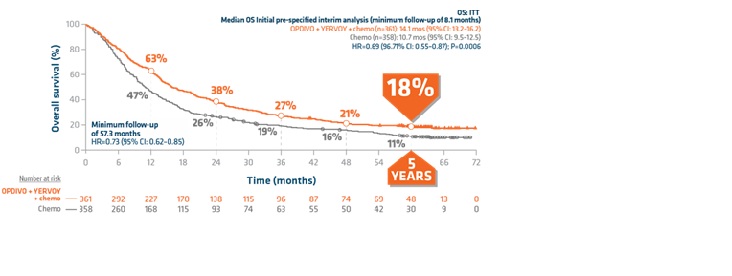
  • Statistically significant and superior mOS (14.1 months; [95% CI: 13.2–16.2]) vs chemotherapy alone (10.7 months; [95% CI: 9.5–12.5]) in the ITT population (HR=0.69; [96.71% CI: 0.55–0.87]; P=0.0006)1
  • Improved overall survival5‡:
    • PD-L1 <1% patient population (14.0 months with OPDIVO + YERVOY and chemo [95% CI: 13.2–NR] vs 10.0 months with chemotherapy alone [95% CI: 7.7–13.7])
    • PD-L1 ≥1% patient population (14.2 months with OPDIVO + YERVOY and chemo [95% CI: 13.1–NR] vs 10.6 with chemotherapy alone [95% CI: 9.4–12.6])

‡Limitation: Checkmate 9LA was not powered to detect differences in treatment effect in PD-L1 subgroups; therefore, results from this exploratory analysis should be interpreted with caution due to the limited patient numbers and potential imbalances in baseline characteristics within the subgroup.

In a 5-year follow-up analysis, durable survival and continued response to treatment were observed with OPDIVO + YERVOY and 2 cycles of chemotherapy compared with chemotherapy alone. The following data were observed at the 57.3-month minimum follow-up3:

  • mOS3:
    • ITT patient population: 15.8 months (95% CI: 13.9–19.7) with OPDIVO + YERVOY and chemo vs 11.0 months (95% CI: 9.5–12.7) with chemo (HR=0.73; [95% CI: 0.62–0.85])
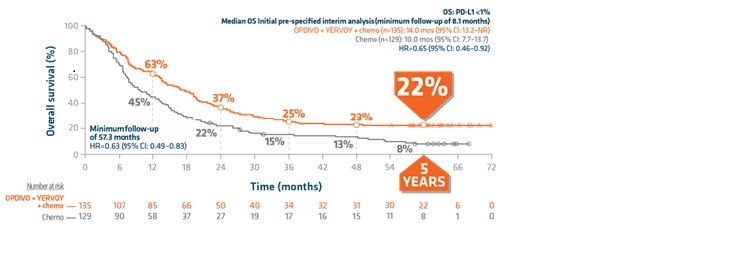
    • PD-L1 <1% patient population: 17.7 months (95% CI: 13.7–20.3) with OPDIVO + YERVOY and chemo vs 9.8 months (95% CI: 7.7–13.5) with chemo (HR=0.63; [95% CI: 0.49–0.83])
    • PD-L1 ≥1% patient population: 15.8 months (95% CI: 13.8–22.2) with OPDIVO + YERVOY and chemo vs 10.9 months (95% CI: 9.5–13.2) with chemo (HR=0.73; [95% CI: 0.59–0.90])

Durable overall survival rate in patients with PD-L1 <1%: The only I-O combination with more than 1 in 5 patients alive at 5 years1,3,5,6
Durable-OS-in-Patients-with-PD-L1-Less-Than-1%

Limitation: Checkmate 9LA was not powered to detect differences in treatment effect in PD-L1 subgroups; therefore, results from this exploratory analysis should be interpreted with caution due to the limited patient numbers and potential imbalances in baseline characteristics within the subgroup.

“22% is high compared with 8% and that is why we like the Checkmate 9LA regimen,” explained Dr Raez.

Overall survival in ITT population: Extended 5-year follow-up analysis1,3,6
OS-in-ITT-Population

  • mDOR3:
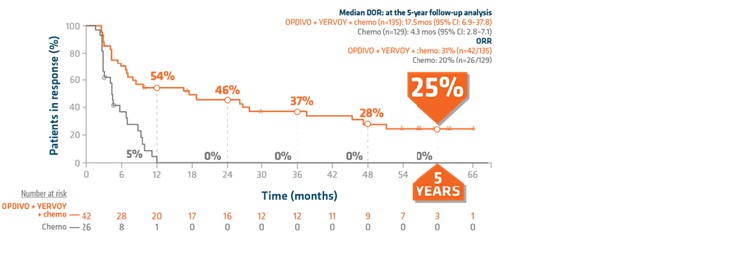
    • PD-L1 <1% patient population: 17.5 months with OPDIVO + YERVOY and chemo (95% CI: 6.9–37.8) vs 4.3 months with chemo (95% CI: 2.8–7.1)
    • PD-L1 ≥1% patient population: 11.8 months (95% CI: 8.6–20.3) vs 5.6 months and chemo (95% CI: 4.3–8.0)
    • ITT patient population: 12.4 months with OPDIVO + YERVOY and chemo (95% CI: 8.7–20.2) vs 5.6 months with chemo (95% CI: 4.4–7.1)

Duration of response in PD-L1 <1%: Extended 5-year follow-up analysis3
Duration-of-Response-in-PD-L1-Less-Than-1%

Limitation: Checkmate 9LA was not powered to detect differences in the treatment effect in this subgroup;
therefore, this exploratory analysis should be interpreted with caution because of the limited patient
numbers and potential imbalances in baseline characteristics within the subgroup.

“This regimen has markedly prolonged the duration of response at 5 years for 25% of patients with PD-L1 <1%” stated Dr. Raez.

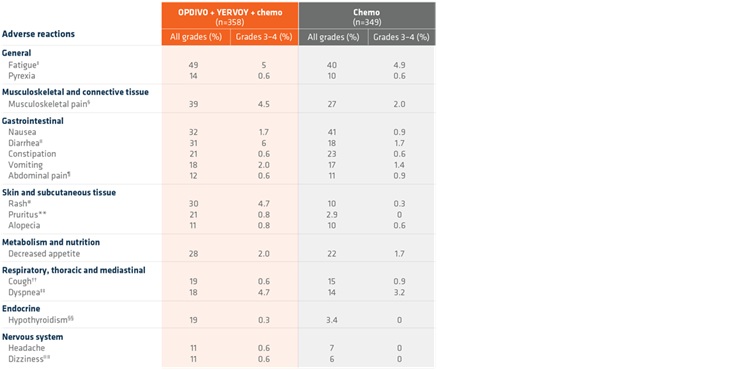
Adverse reactions in >10% of patients receiving OPDIVO + YERVOY and 2 cycles of chemo1*

Adverse-Reactions-Opdivo-Yervoy

  • OPDIVO + YERVOY with chemo was discontinued in 24% of patients due to adverse reactions, and 56% had at least one dose withheld for an adverse reaction1
  • Serious adverse reactions occurred in 57% of patients receiving OPDIVO + YERVOY with chemo1
  • The most frequent (>2%) serious adverse reactions were pneumonia, diarrhea, febrile neutropenia, anemia, acute kidney injury, musculoskeletal pain, dyspnea, pneumonitis, and respiratory failure. Fatal adverse reactions occurred in 7 (2%) patients, and included hepatic toxicity, acute renal failure, sepsis, pneumonitis, diarrhea with hypokalemia, and massive hemoptysis in the setting of thrombocytopenia1
  • The most common (>20%) adverse reactions were fatigue, musculoskeletal pain, nausea, diarrhea, rash, decreased appetite, constipation, and pruritus1
  • Median number of doses was 9 for OPDIVO, 4 for YERVOY, and 2 cycles of chemo7
  • With a minimum follow-up of 57.3 months, no new safety signals were identified for OPDIVO + YERVOY and 2 cycles of chemo3*

Toxicity was graded per NCI CTCAE v4.1
*vs chemo. In Checkmate 9LA, patients received 2 cycles of platinum-doublet chemo q3w in the experimental arm and 4 cycles in the comparator arm; NSQ: pemetrexed + carboplatin or cisplatin (optional pemetrexed maintenance therapy in the comparator arm only); SQ: paclitaxel + carboplatin.1 †Based on types of adverse reactions reported in 1L mNSCLC. Please note clinical trials are conducted under varying conditions, including different trial designs and dosing. Adverse reaction rates cannot be directly compared between trials.1 ‡Includes fatigue and asthenia.1 §Includes myalgia, back pain, pain in extremity, musculoskeletal pain, bone pain, flank pain, muscle spasms, musculoskeletal chest pain, musculoskeletal disorder, osteitis, musculoskeletal stiffness, non-cardiac chest pain, arthralgia, arthritis, arthropathy, joint effusion, psoriatic arthropathy, and synovitis.1 Includes colitis, ulcerative colitis, diarrhea, and enterocolitis.1 ¶Includes abdominal discomfort, abdominal pain, lower abdominal pain, upper abdominal pain, and gastrointestinal pain.1 #Includes acne, dermatitis, acneiform dermatitis, allergic dermatitis, atopic dermatitis, bullous dermatitis, generalized exfoliative dermatitis, eczema, keratoderma blennorrhagica, palmar-plantar erythrodysesthesia syndrome, rash, erythematous rash, generalized rash, macular rash, maculo-papular rash, morbilliform rash, papular rash, pruritic rash, skin exfoliation, skin reaction, skin toxicity, Stevens-Johnson syndrome, and urticaria.1 **Includes pruritus and generalized pruritus.1 ††Includes cough, productive cough, and upper-airway cough syndrome.1 ‡‡Includes dyspnea, dyspnea at rest, and exertional dyspnea.1 §§Includes autoimmune thyroiditis, increased blood thyroid stimulating hormone, hypothyroidism, thyroiditis, and decreased free tri-iodothyronine.1 ║║Includes dizziness, vertigo and positional vertigo.1

“The safety profile in the extended 5-year follow-up analysis of Checkmate 9LA was consistent with the previously known profiles for each component,” explained Dr Raez.

Dosing

OPDIVO® (nivolumab) + low-dose YERVOY® (ipilimumab) (1 mg/kg) and 2 cycles of chemo
1

For the r/m NSCLC dosing regimen in combination with chemo: on the first week, 4 agents will be administered (OPDIVO 360 mg + YERVOY 1 mg/kg + platinum-doublet histology-based chemo†), followed by 3 agents (OPDIVO + platinum-doublet histology-based chemo†) on the third week, 2 agents (OPDIVO + YERVOY) on the sixth week, and OPDIVO monotherapy on the ninth week, followed by maintenance therapy of OPDIVO + YERVOY: OPDIVO 360 mg q3w + YERVOY 1 mg/kg q6w until disease progression, unacceptable toxicity, or for up to 2 years.1 Histology-based chemo: SQ patients: carboplatin AUC 6 + paclitaxel 200 mg/m2 q3w; NSQ patients: carboplatin AUC 5 or 6 or cisplatin 75 mg/m2 + pemetrexed 500 mg/m2 q3w. No chemo maintenance required.1

  • OPDIVO is administered as an IV infusion over 30 minutes1
  • YERVOY is administered as an IV infusion over 30 minutes2

Summary and conclusions
5-year follow-up analysis of Checkmate 9LA continues to show prolonged survival data with OPDIVO + YERVOY and chemo vs chemo alone in patients who have r/m NSCLC across PD-L1 <1% and ≥1% expression.1,3 “Checkmate 9LA shows patient survival data that may be impactful,” stated Dr. Raez.
1L=first line; ALK=anaplastic lymphoma kinase; AUC=area under the curve; CI=confidence interval; DOR=duration of response; ECOG PS=Eastern Cooperative Oncology Group Performance Status; EGFR=epidermal growth factor receptor; HR=hazard ratio; I-O=immuno-oncology; ITT=intent to treat; IV=intravenous; mDOR=median DOR; mNSCLC=metastatic NSCLC; mo=month; mOS=median OS; NR=not reached; NSCLC=non-small cell lung cancer; NSQ=non-squamous; ORR=overall response rate; OS=overall survival; PD-1=programmed death receptor-1; PD-L1=programmed death ligand 1; PFS=progression-free survival; Pt=platinum; q3w=every 3 weeks; q6w=every 6 weeks; r/m=recurrent or metastatic; SQ=squamous.

INDICATION

OPDIVO® (nivolumab), in combination with YERVOY® (ipilimumab) and 2 cycles of platinum-doublet chemotherapy, is indicated for the first-line treatment of adult patients with metastatic or recurrent non-small cell lung cancer (NSCLC), with no EGFR or ALK genomic tumor aberrations.

IMPORTANT SAFETY INFORMATION

Severe and Fatal Immune-Mediated Adverse Reactions

  • Immune-mediated adverse reactions listed herein may not include all possible severe and fatal immune- mediated adverse reactions.
  • Immune-mediated adverse reactions, which may be severe or fatal, can occur in any organ system or tissue. While immune-mediated adverse reactions usually manifest during treatment, they can also occur after discontinuation of OPDIVO or YERVOY. Early identification and management are essential to ensure safe use of OPDIVO and YERVOY. Monitor for signs and symptoms that may be clinical manifestations of underlying immune-mediated adverse reactions. Evaluate clinical chemistries including liver enzymes, creatinine, adrenocorticotropic hormone (ACTH) level, and thyroid function at baseline and periodically during treatment with OPDIVO and before each dose of YERVOY. In cases of suspected immune-mediated adverse reactions, initiate appropriate workup to exclude alternative etiologies, including infection. Institute medical management promptly, including specialty consultation as appropriate.
  • Withhold or permanently discontinue OPDIVO and YERVOY depending on severity (please see section 2 Dosage and Administration in the accompanying Full Prescribing Information). In general, if OPDIVO or YERVOY interruption or discontinuation is required, administer systemic corticosteroid therapy (1 to 2 mg/kg/day prednisone or equivalent) until improvement to Grade 1 or less. Upon improvement to Grade 1 or less, initiate corticosteroid taper and continue to taper over at least 1 month. Consider administration of other systemic immunosuppressants in patients whose immune-mediated adverse reactions are not controlled with corticosteroid therapy. Toxicity management guidelines for adverse reactions that do not necessarily require systemic steroids (e.g., endocrinopathies and dermatologic reactions) are discussed below.

Immune-Mediated Pneumonitis

  • OPDIVO and YERVOY can cause immune-mediated pneumonitis. The incidence of pneumonitis is higher in patients who have received prior thoracic radiation.

Immune-Mediated Colitis

  • OPDIVO and YERVOY can cause immune-mediated colitis, which may be fatal. A common symptom included in the definition of colitis was diarrhea. Cytomegalovirus (CMV) infection/reactivation has been reported in patients with corticosteroid-refractory immune-mediated colitis. In cases of corticosteroid-refractory colitis, consider repeating infectious workup to exclude alternative etiologies.

Immune-Mediated Hepatitis and Hepatotoxicity

  • OPDIVO and YERVOY can cause immune-mediated hepatitis.

Immune-Mediated Endocrinopathies

  • OPDIVO and YERVOY can cause primary or secondary adrenal insufficiency, immune-mediated hypophysitis, immune-mediated thyroid disorders, and Type 1 diabetes mellitus, which can present with diabetic ketoacidosis. Withhold OPDIVO and YERVOY depending on severity (please see section 2 Dosage and Administration in the accompanying Full Prescribing Information). For Grade 2 or higher adrenal insufficiency, initiate symptomatic treatment, including hormone replacement as clinically indicated. Hypophysitis can present with acute symptoms associated with mass effect such as headache, photophobia, or visual field defects. Hypophysitis can cause hypopituitarism; initiate hormone replacement as clinically indicated. Thyroiditis can present with or without endocrinopathy. Hypothyroidism can follow hyperthyroidism; initiate hormone replacement or medical management as clinically indicated. Monitor patients for hyperglycemia or other signs and symptoms of diabetes; initiate treatment with insulin as clinically indicated.

Immune-Mediated Nephritis with Renal Dysfunction

  • OPDIVO and YERVOY can cause immune-mediated nephritis.

Immune-Mediated Dermatologic Adverse Reactions

  • OPDIVO can cause immune-mediated rash or dermatitis. Exfoliative dermatitis, including Stevens-Johnson syndrome (SJS), toxic epidermal necrolysis (TEN), and drug rash with eosinophilia and systemic symptoms (DRESS) has occurred with PD-1/PD-L1 blocking antibodies. Topical emollients and/or topical corticosteroids may be adequate to treat mild to moderate nonexfoliative rashes.
  • YERVOY can cause immune-mediated rash or dermatitis, including bullous and exfoliative dermatitis, SJS, TEN, and DRESS. Topical emollients and/or topical corticosteroids may be adequate to treat mild to moderate non-bullous/exfoliative rashes.
  • Withhold or permanently discontinue OPDIVO and YERVOY depending on severity (please see section 2 Dosage and Administration in the accompanying Full Prescribing Information).

Other Immune-Mediated Adverse Reactions

  • The following clinically significant immune-mediated adverse reactions occurred at an incidence of <1% (unless otherwise noted) in patients who received OPDIVO monotherapy or OPDIVO in combination with YERVOY or were reported with the use of other PD-1/PD-L1 blocking antibodies. Severe or fatal cases have been reported for some of these adverse reactions: cardiac/vascular: myocarditis, pericarditis, vasculitis; nervous system: meningitis, encephalitis, myelitis and demyelination, myasthenic syndrome/myasthenia gravis (including exacerbation), Guillain-Barré syndrome, nerve paresis, autoimmune neuropathy; ocular: uveitis, iritis, and other ocular inflammatory toxicities can occur; gastrointestinal: pancreatitis to include increases in serum amylase and lipase levels, gastritis, duodenitis; musculoskeletal and connective tissue: myositis/polymyositis, rhabdomyolysis, and associated sequelae including renal failure, arthritis, polymyalgia rheumatica; endocrine: hypoparathyroidism; other (hematologic/immune): hemolytic anemia, aplastic anemia, hemophagocytic lymphohistiocytosis (HLH), systemic inflammatory response syndrome, histiocytic necrotizing lymphadenitis (Kikuchi lymphadenitis), sarcoidosis, immune thrombocytopenic purpura, solid organ transplant rejection, other transplant (including corneal graft) rejection.
  • In addition to the immune-mediated adverse reactions listed above, across clinical trials of YERVOY monotherapy or in combination with OPDIVO, the following clinically significant immune-mediated adverse reactions, some with fatal outcome, occurred in <1% of patients unless otherwise specified: nervous system: autoimmune neuropathy (2%), myasthenic syndrome/myasthenia gravis, motor dysfunction; cardiovascular: angiopathy, temporal arteritis; ocular: blepharitis, episcleritis, orbital myositis, scleritis; gastrointestinal: pancreatitis (1.3%); other (hematologic/immune): conjunctivitis, cytopenias (2.5%), eosinophilia (2.1%), erythema multiforme, hypersensitivity vasculitis, neurosensory hypoacusis, psoriasis.
  • Some ocular IMAR cases can be associated with retinal detachment. Various grades of visual impairment, including blindness, can occur. If uveitis occurs in combination with other immune-mediated adverse reactions, consider a Vogt-Koyanagi-Harada–like syndrome, which has been observed in patients receiving OPDIVO and YERVOY, as this may require treatment with systemic corticosteroids to reduce the risk of permanent vision loss.

Infusion-Related Reactions

  • OPDIVO and YERVOY can cause severe infusion-related reactions. Discontinue OPDIVO and YERVOY in patients with severe (Grade 3) or life-threatening (Grade 4) infusion-related reactions. Interrupt or slow the rate of infusion in patients with mild (Grade 1) or moderate (Grade 2) infusion-related reactions.

Complications of Allogeneic Hematopoietic Stem Cell Transplantation

  • Fatal and other serious complications can occur in patients who receive allogeneic hematopoietic stem cell transplantation (HSCT) before or after being treated with OPDIVO or YERVOY. Transplant-related complications include hyperacute graft-versus-host-disease (GVHD), acute GVHD, chronic GVHD, hepatic veno-occlusive disease (VOD) after reduced intensity conditioning, and steroid-requiring febrile syndrome (without an identified infectious cause). These complications may occur despite intervening therapy between OPDIVO or YERVOY and allogeneic HSCT.
  • Follow patients closely for evidence of transplant-related complications and intervene promptly. Consider the benefit versus risks of treatment with OPDIVO and YERVOY prior to or after an allogeneic HSCT.

Embryo-Fetal Toxicity

  • Based on its mechanism of action and findings from animal studies, OPDIVO and YERVOY can cause fetal harm when administered to a pregnant woman. The effects of YERVOY are likely to be greater during the second and third trimesters of pregnancy. Advise pregnant women of the potential risk to a fetus. Advise females of reproductive potential to use effective contraception during treatment with OPDIVO and YERVOY and for at least 5 months after the last dose.

Increased Mortality in Patients with Multiple Myeloma when OPDIVO is Added to a Thalidomide Analogue and Dexamethasone

  • In randomized clinical trials in patients with multiple myeloma, the addition of OPDIVO to a thalidomide analogue plus dexamethasone resulted in increased mortality. Treatment of patients with multiple myeloma with a PD-1 or PD-L1 blocking antibody in combination with a thalidomide analogue plus dexamethasone is not recommended outside of controlled clinical trials.

Lactation

  • There are no data on the presence of OPDIVO or YERVOY in human milk, the effects on the breastfed child, or the effects on milk production. Because of the potential for serious adverse reactions in breastfed children, advise women not to breastfeed during treatment and for 5 months after the last dose.

Serious Adverse Reactions

  • In Checkmate 9LA, serious adverse reactions occurred in 57% of patients (n=358). The most frequent (>2%) serious adverse reactions were pneumonia, diarrhea, febrile neutropenia, anemia, acute kidney injury, musculoskeletal pain, dyspnea, pneumonitis, and respiratory failure. Fatal adverse reactions occurred in 7 (2%) patients, and included hepatic toxicity, acute renal failure, sepsis, pneumonitis, diarrhea with hypokalemia, and massive hemoptysis in the setting of thrombocytopenia.

Common Adverse Reactions

  • In Checkmate 9LA, the most common (>20%) adverse reactions were fatigue (49%), musculoskeletal pain (39%), nausea (32%), diarrhea (31%), rash (30%), decreased appetite (28%), constipation (21%), and pruritus (21%).

Please see US Full Prescribing Information for OPDIVO and YERVOY.

References:

  1. OPDIVO [package insert]. Princeton, NJ: Bristol-Myers Squibb Company.
  2. YERVOY [package insert]. Princeton, NJ: Bristol-Myers Squibb Company.
  3. Reck M, Ciuleanu TE, Schenker M, et al. Five-year outcomes with first-line nivolumab plus ipilimumab with 2 cycles of chemotherapy versus 4 cycles of chemotherapy alone in patients with metastatic non-small cell lung cancer in the randomized CheckMate 9LA trial. Eur J Cancer. Published online August 25, 2024. doi:10.1016/j.ejca.2024.114296
  4. Paz-Ares L, Ciuleanu TE, Cobo M, et al. First-line nivolumab plus ipilimumab combined with two cycles of chemotherapy in patients with non-small-cell lung cancer (CheckMate 9LA): an international, randomised, open-label, phase 3 trial. Lancet Oncol. 2021;22(2):198-211.
  5. Data on file. NIVO 566. Princeton, NJ: Bristol-Myers Squibb Company; 2020.
  6. Reck M, Ciuleanu T-E, Cobo M, et al. First-line nivolumab plus ipilimumab with two cycles of chemotherapy versus chemotherapy alone (four cycles) in advanced non-small cell lung cancer: CheckMate 9LA 2-year update. ESMO Open. 2021;6(5):100273.
  7. Data on file. NIVO 562. Princeton NJ: Bristol-Myers Squibb Company; 2020.

© 2024 Bristol-Myers Squibb Company. OPDIVO® and YERVOY® are registered trademarks of Bristol-Myers Squibb Company.
7356-US-2400513 12/24