Ceritinib in ALK-Rearranged Non–Small-Cell Lung Cancer

SUMMARY: EML4-ALK (Echinoderm Microtubule associated protein Like 4) – (Anaplastic Lymphoma Kinase) is an aberrant fusion-type oncoprotein and is a tyrosine kinase. This oncoprotein/tyrosine kinase is found in 2-7% of all Non Small Cell Lung Cancers (NSCLC) and is generated due to an inversion in the short arm of chromosome 2. This oncoprotein is more prevalent in patients with adenocarcinoma, who have little or no exposure to tobacco. Tyrosine kinases normally play an important role in cellular proliferation and differentiation. However with point mutations, translocation/rearrangement and amplification of the respective genes, the associated tyrosine kinases can potentially cause malignancy. Such is the case with mutations or translocations of the Anaplastic Lymphoma Kinase gene (ALK). XALKORI® (Crizotinib) is a small molecule Tyrosine Kinase Inhibitor that targets ALK, MET and ROS1 tyrosine kinases. In an open label phase III trial involving 347 patients with locally advanced or metastatic ALK-positive lung cancer who had received one prior platinum based regimen, treatment with XALKORI® significantly improved Progression Free Survival (PFS) and Response Rates (RR). In spite of this initial benefit, patients will however relapse within 12 months, with the average response duration of about 8 months. This has been attributed to acquired mutation within the ALK tyrosine kinase domain, amplification of the ALK fusion gene, subtherapeutic inhibition of ALK tyrosine kinase or activation of other pathways that can cause abnormal cell proliferation. Ceritinib (LDK378) is an oral, small molecule, second generation tyrosine kinase inhibitor of ALK and is 20 times as potent as XALKORI® against ALK. Unlike XALKORI®, Ceritinib does not inhibit MET kinase activity. Based on preclinical data supporting the efficacy of Ceritinib in both XALKORI® sensitive and resistant NSCLC tumors, the authors conducted a study to evaluate the antitumor activity of Ceritinib in patients with advanced NSCLC and other cancers harboring genetic alterations in ALK, in addition to determining the safety, MTD (maximum tolerated dose) and pharmacokinetics of Ceritinib. In this trial, patients who had received prior therapy with one or more ALK inhibitors as well as those with asymptomatic treated or untreated CNS metastases, were eligible to be enrolled. This study had 2 components – a dose escalation phase and an expansion phase. In the dose escalation phase, 59 patients were enrolled and the MTD of Ceritinib was determined to be 750 mg PO daily. In the expansion phase, 71 additional patients were treated for a total of 130 patients (N=59+71). Majority of these patients (94%) had advanced NSCLC. Patients with NSCLC who received at least 400mg of Ceritinib daily (N=114) had an overall response rate (RR) of 58% and median PFS was 7 months. Patients with advanced NSCLC who had received XALKORI® prior to enrollment (N=80) had a RR of 56%. The responses were noted both in patients with tumors harboring resistance mutations in the ALK tyrosine kinase domain as well as those in whom there was no new genetic alterations of ALK. Further, responses were seen in the untreated CNS lesions both in patients who had prior therapy with XALKORI® as well as those who did not. Adverse events were grade 1or 2 and GI related. These included vomiting, diarrhea, elevated aminotransferase levels and hypophosphatemia. The authors concluded that Cerifinib has marked antitumor activity in patients with advanced ALK rearranged NSCLC and in those who had progressed during XALKORI® treatment, regardless of the presence of resistance mutations in the ALK tyrosine kinase domain. Whether Cerifinib should be considered for the first line treatment of advanced ALK rearranged NSCLC, remains to be seen. Shaw AT, Kim D, Mehra R, et al. N Engl J Med 2014; 370:1189-1197
 

Safety and efficacy of weekly nab® paclitaxel in combination with carboplatin as first-line therapy in elderly patients with advanced non-small-cell lung cancer

SUMMARY: ABRAXANE® (Albumin-bound Paclitaxel or nab-Paclitaxel) is a solvent-free formulation of Paclitaxel with a superior therapeutic index and delivers higher concentrations of the drug’s active ingredient into the tumor cell. This is unlike solvent based taxanes such as TAXOL® (Paclitaxel) and TAXOTERE® (Docetaxel), which have delivery vehicles such as Cremaphor and Polysorbate 80 respectively. By virtue of being solvent free, ABRAXANE® can be administered over a shorter period of time without premedications and is associated with fewer side effects with possibly superior efficacy. In a phase III trial, 1052 treatment naive patients with Stage IIIB/IV Non Small Cell Lung Cancer (NSCLC) were randomly assigned to receive ABRAXANE® 100 mg/m2 weekly and PARAPLATIN® (Carboplatin) at Area Under the Concentration-time curve (AUC) 6, once every 3 weeks (nab-PC) or TAXOL® 200mg/m2 plus PARAPLATIN® AUC 6 once every 3 weeks (sb-PC). Patients were stratified by disease (Stage IIIB vs IV), age (< 70 vs ≥ 70 years), sex (male vs female), histology (squamous vs adenocarcinoma vs others). The primary end point was Overall Response Rate (ORR). Secondary end points included Progression Free Survival (PFS) and Overall Survival (OS). In their original report, the authors concluded that the study met its primary end point and ABRAXANE® combination (nab-PC) significantly improved ORR compared to TAXOL® combination (sb-PC) and was also associated with less neuropathy. In a sub-set analysis of patients 70 years or older (N=156), those in the ABRAXANE® group had a significantly longer median OS compared to the TAXOL® group (19.9 vs 10.4 months, HR=0.58, P=0.009). The PFS in this elderly group trended in favor of ABRAXANE® (8 vs 6.8 months, P=0.13). This survival benefit was not seen in the younger patients. Elderly patients with NSCLC usually tend to have other co-morbidities and treatment can be challenging. With lower incidence of toxicities such as neuropathy, neutropenia and arthralgias, ABRAXANE® combination therapy can be a valuable option for the first line treatment of elderly patients with advanced NSCLC of all histologies. Socinski MA, Langer CJ, Okamoto I, et al. Ann Oncol. 2013;24:314-321

Crizotinib versus Chemotherapy in Advanced ALK-Positive Lung Cancer

SUMMARY: EML4-ALK (Echinoderm Microtubule associated protein Like 4) – ALK (Anaplastic Lymphoma Kinase) is an aberrant fusion-type oncoprotein and is a tyrosine kinase. This oncoprotein/tyrosine kinase is found in 2-7% of all Non Small Cell Lung Cancers (NSCLC) and is generated due to an inversion in the short arm of chromosome 2. This oncoprotein is more prevalent in patients with adenocarcinoma, who have little or no exposure to tobacco. Tyrosine kinases normally play an important role in cellular proliferation and differentiation. However with point mutations, translocation/rearrangement and amplification of the respective genes, the associated tyrosine kinases can potentially cause malignancy. Such is the case with mutations or translocations of the Anaplastic Lymphoma Kinase gene (ALK). Crizotinib (XALKORI®) is a small molecule Tyrosine Kinase Inhibitor that targets ALK, MET and ROS1 tyrosine kinases. In this open label phase III trial, 347 patients with locally advanced or metastatic ALK-positive lung cancer who had received one prior platinum based regimen, were randomly assigned to receive XALKORI® 250 mg PO twice daily (N=173) or intravenous chemotherapy with either Pemetrexed (ALIMTA®) 500 mg/m2 or Docetaxel (TAXOTERE®) 75 mg/m2, every 3 weeks (N=174). The primary endpoint was Progression Free Survival (PFS) and secondary endpoints included Overall Survival (OS), Response Rate (RR) and safety. The median PFS was 7.7 months in the XALKORI® group as compared to 3 months in the chemotherapy group (HR=0.49; P<0.001). The Response Rates for XALKORI® and chemotherapy were 65% and 20% respectively (P<0.001). At the time of interim analysis, there was no significant difference in the OS between the XALKORI® and chemotherapy groups. The authors pointed out that this lack of OS benefit was due to the high cross over rate to the XALKORI® group from the chemotherapy group. Patients in the XALKORI® group had better quality of life, greater reduction in lung cancer symptoms and were on the study treatment longer, than with chemotherapy. The authors concluded that XALKORI® improves PFS, Response Rates as well as Quality Of Life in patients with previously treated, ALK positive advanced Non Small Cell Lung Cancer. This is remarkable, considering that the response rates in this patient population treated with second line chemotherapy is around 10-15%. As we move forward, it is very likely that tailored therapy based on molecular genotyping will become standard practice. Shaw AT, Kim D, Nakagawa K, et al. N Engl J Med 2013; 368:2385-2394

Results of Initial Low-Dose Computed Tomographic Screening for Lung Cancer

SUMMARY: The National Lung Screening Trial (NLST), a federally funded U.S. study, enrolled 53,439 asymptomatic participants, 55 to 74 years of age, with at least 30 pack-year smoking history, and were randomized to undergo annual screening with either low dose CT scan (n=26,715) or a chest X-Ray (n=26,724), for three years. The use of low dose CT scans for 3 years in this high risk, healthy patients, resulted in a 20% reduction in Lung Cancer mortality, compared to screening with a chest X-Ray. Based on these findings, Lung Cancer Screening is recommended for the following groups

1) People 55-74 years of age with no signs or symptoms of Lung Cancer

2) Current or former smoker with a 30 pack year smoking history (Number of years smoked multiplied by the number of packs of cigarettes per day)

3) Current smokers are strongly urged to enter a smoking cessation program

4) Former smokers must have quit smoking within the past 15 years

Lung Cancer screening is performed using a non-contrast, low dose CT scan. People with serious co-morbid conditions, those on home oxygen and individuals with metallic devices or implants in the chest or back (which can interfere with the scan) should be excluded from Lung Cancer screening. It should be noted that Lung cancer screening with low dose CT scan is presently not covered by most insurance plans. The National Lung Screening Trial Research Team. N Engl J Med 2013;368:1980-1991

VERISTRAT® Testing – A novel approach to NSCLC

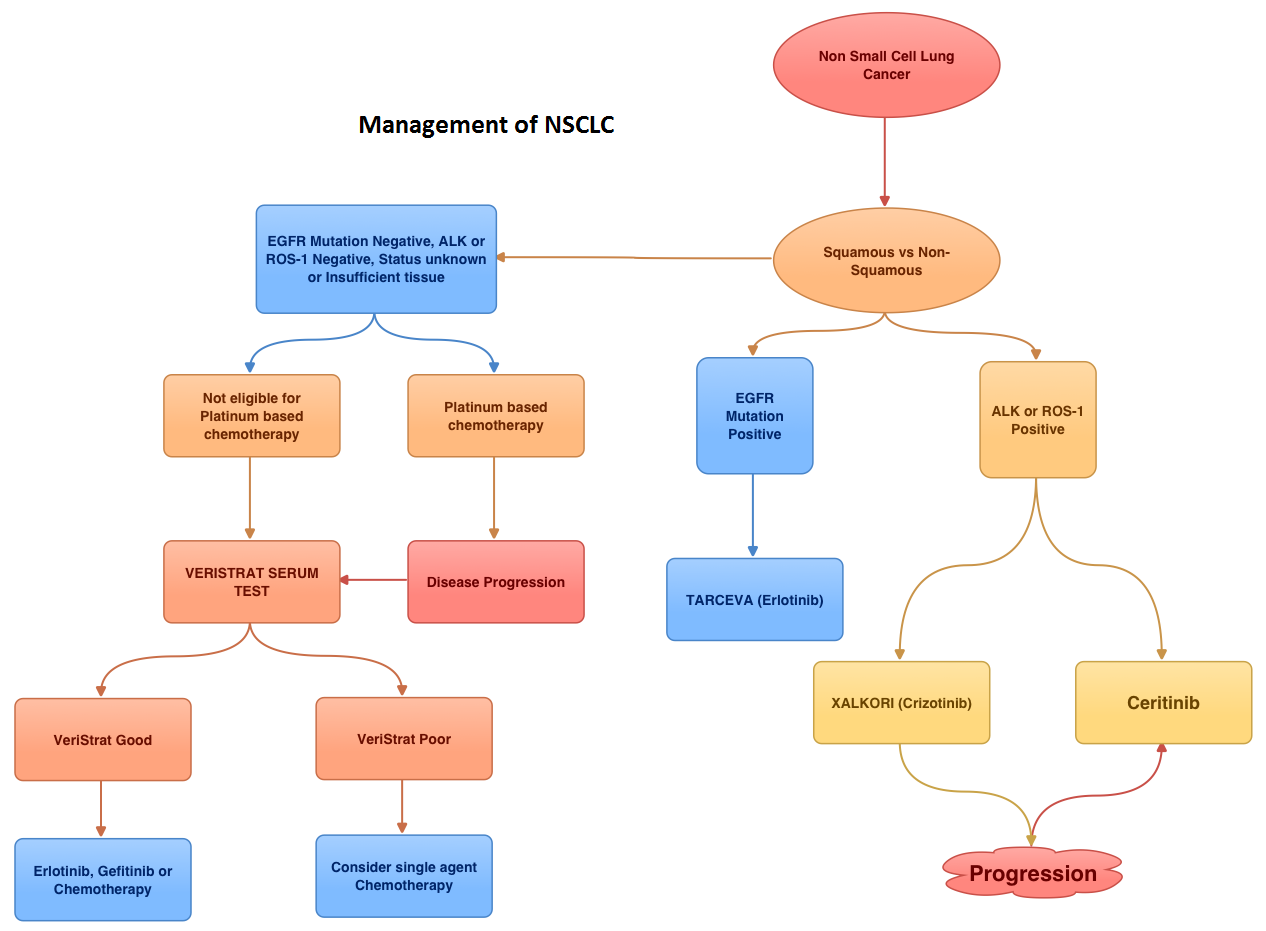
VeriStrat®, a serum based proteomic assay can help physicians identify patients who are likely to have good or poor outcomes after treatment with EGFR inhibitors and thereby can provide valuable insight into whether chemotherapy or targeted therapy with TARCEVA®, a EGFR-TKI, is appropriate for their patients with advanced NSCLC, in the second line setting. This information is especially important for patients without an EGFR mutation or for those, whose EGFR mutation status is unknown. In the PROSE trial, patients classified as VeriStrat-Poor have better survival with chemotherapy than TARCEVA®, whereas patients classified as VeriStrat-Good have similar survival with TARCEVA® and chemotherapy. This data was presented at the 2013 ASCO meeting.

Phase III Study of Afatinib or Cisplatin Plus Pemetrexed in Patients With Metastatic Lung Adenocarcinoma With EGFR Mutations

SUMMARY: GILOTRIF® (Afatinib) is an oral, irreversible blocker of the ErbB family which includes EGFR (ErbB1), HER2 (ErbB2), ErbB3 and ErbB4. The approval of GILOTRIF® was based on a multi-center, international, open-label, randomized, phase III trial, in which 345 patients with Stage IIIB (wet)/IV lung adenocarcinoma, with tumors demonstrating Epidermal Growth Factor Receptor (EGFR) exon 19 deletions or exon 21 (L858R) substitution mutations, as detected by an FDA-approved test, were enrolled in a 2:1 ratio. Patients were randomized to receive GILOTRIF® 40 mg orally once daily (n=230) or ALIMTA® (Pemetrexed)/Cisplatin (n=115) given every 21 days for up to six cycles. Patients were stratified according to EGFR mutation status (exon 19 deletion vs. exon 21 L858R vs. ‘other’) and race (Asian vs. non-Asian). The primary endpoint was Progression Free Survival (PFS). The median PFS in the GILOTRIF® group was 11.1 months and 6.9 months in the chemotherapy group (HR= 0.58, P<0.001). In patients whose tumors demonstrated EGFR mutations, the median PFS was 13.6 months in the GILOTRIF® arm and 6.9 months in the chemotherapy arm (HR= 0.47, P<0.001). Objective response rates were 56% and 23% in the GILOTRIF® and chemotherapy groups respectively (P=0.001). There was no statistically significant difference in overall survival between the two treatment groups. The most frequent adverse reactions in the GILOTRIF® group were skin rash, pruritus, stomatitis, diarrhea and decreased appetite. The authors concluded that GILOTRIF® is better than chemotherapy in the first line treatment of EGFR mutant Non Small Cell Lung Cancer patients. However, it remains to be seen if this agent is superior to TARCEVA® (Erlotinib) and IRESSA® (Gefitinib). Sequist LV, Yang JC, Yamamoto N, et al. J Clin Oncol 2013;31:3327-3334

LUX-Lung 3 A randomized, open-label, phase III study of afatinib versus pemetrexed and cisplatin as first-line treatment for patients with advanced adenocarcinoma of the lung harboring EGFR-activating mutations

SUMMARY: GILOTRIF® (Afatinib) is an oral, irreversible blocker of the ErbB family which includes EGFR (ErbB1), HER2 (ErbB2), ErbB3 and ErbB4. The approval of GILOTRIF® was based on a multi-center, international, open-label, randomized, phase III trial, in which 345 patients with Stage IIIB (wet)/IV lung adenocarcinoma, with tumors demonstrating Epidermal Growth Factor Receptor (EGFR) exon 19 deletions or exon 21 (L858R) substitution mutations, as detected by an FDA-approved test, were enrolled in a 2:1 ratio. Patients were randomized to receive GILOTRIF® 40 mg orally once daily (n=230) or ALIMTA® (Pemetrexed)/Cisplatin (n=115). Patients were stratified according to EGFR mutation status (exon 19 deletion vs. exon 21 L858R vs. ‘other’) and race (Asian vs. non-Asian). The primary endpoint was Progression Free Survival (PFS). The median PFS in the GILOTRIF® group was 11.1 months and 6.9 months in the chemotherapy group (HR= 0.58, P<0.001). In patients whose tumors demonstrated EGFR mutations, the median PFS was 13.6 months in the GILOTRIF® arm and 6.9 months in the chemotherapy arm (HR= 0.47, P<0.0001). Objective response rates were 50.4% and 19.1% in the GILOTRIF® and chemotherapy groups respectively. There was no statistically significant difference in overall survival between the two treatment groups. The most frequent adverse reactions in the GILOTRIF® group were skin rash, pruritus, stomatitis, diarrhea and decreased appetite. The authors concluded that GILOTRIF® is better than chemotherapy in the first line treatment of EGFR mutant Non Small Cell Lung Cancer patients. However, it remains to be seen if this agent is superior to TARCEVA® (Erlotinib) and IRESSA® (Gefitinib). Yang JC, Shuler M, Yamamoto N, et al. J Clin Oncol 2012;30(18,Suppl):abstract LBA 7500.

GILOTRIF® for EGFR mutation positive Lung Cancer

GILOTRIF® (Afatinib) is an oral, irreversible blocker of the ErbB family which includes EGFR (ErbB1), HER2 (ErbB2), ErbB3 and ErbB4. The FDA approved GILOTRIF® based on a multicenter, randomized phase III trial (LUX-Lung 3) in which GILOTRIF® trumped chemotherapy when administered to chemonaive patients with EGFR mutation positive Non Small Lung Cancer. We have yet another targeted oral agent besting chemotherapy. This is another milestone in the Lung Cancer treatment paradigm.

GILOTRIF® (Afatinib)

The FDA on July 12, 2013 approved the use of GILOTRIF® tablets for the first-line treatment of patients with metastatic Non-Small Cell Lung Cancer (NSCLC) whose tumors have Epidermal Growth Factor Receptor (EGFR) exon 19 deletions or exon 21 (L858R) substitution mutations as detected by an FDA-approved test. The FDA also approved THERASCREEN, a test provided by QIAGEN, for the detection of EGFR exon 19 deletions or exon 21 (L858R) substitution mutations. GILOTRIF® is a product of Boehringer Ingelheim Pharmaceuticals, Inc.

TARCEVA® (Erlotinib)

TARCEVA® (Erlotinib): The FDA on May 14, 2013 approved TARCEVA® for the first-line treatment of metastatic non-small cell lung cancer (NSCLC) patients whose tumors have epidermal growth factor receptor (EGFR) exon 19 deletions or exon 21 (L858R) substitution mutations. The FDA concurrently approved the cobas EGFR Mutation Test, a companion diagnostic test for detection of these molecular abnormalities. TARCEVA has had prior FDA approval for the treatment of patients with locally advanced or metastatic NSCLC after failure of at least one prior chemotherapy regimen and for maintenance treatment of patients with locally advanced or metastatic NSCLC, whose disease has not progressed after four cycles of platinum-based first-line chemotherapy. TARCEVA® is a product of Astellas Pharma Inc.