Underutilization and Suboptimal Use of Hypomethylating Agents in Myelodysplastic Syndromes: Insights from a National Medicare Analysis

SUMMARY: It is estimated that in the US approximately 13,000 people are diagnosed with MyeloDysplastic Syndromes (MDS) each year. The prevalence has been estimated to be from 60,000 to 170,000 in the US. MyeloDysplastic Syndromes are a heterogenous group of stem cell disorders characterized by marrow failure resulting in cytopenias, mainly symptomatic anemia, with associated cytogenetic abnormalities, and abnormal cellular maturation with morphologic changes in clonal cells. Majority of the individuals diagnosed with MDS are 65 years or older and die as a result of infection and/or bleeding, consequent to bone marrow failure. About a third of patients with MDS develop Acute Myeloid Leukemia (AML).

The International Prognostic Scoring System (IPSS) for MDS has 4 risk groups based on Total Risk Score (Low, Intermediate-1, Intermediate-2 and High). The three prognostic factors scored to predict the course of the patient’s disease include, percentage of blast cells in the bone marrow, type of chromosomal changes in the marrow cells and number of cytopenias (anemia, neutropenia or thrombocytopenia). Patients with low-risk MDS have an indolent disease course with a median survival of about 6 years with no therapeutic intervention. Patients with intermediate and higher-risk disease however have a shorter median survival even with treatment, with approximately a third of the patients progressing to AML within 3 years.

Patients with Low-risk MDS often present with symptomatic anemia and these patients are in chronic need for RBC transfusions. These patients are treated with Erythropoiesis Stimulating Agents (ESAs) as first line therapy. ESAs such as Darbepoetin alfa and Epoetin alfa are re-engineered and recombinant DNA technology products of Erythropoietin (EPO), and they stimulate erythropoiesis by binding and activating the EPO receptor. However, transfusion-dependent patients with serum EPO levels above 200U per liter are less likely to respond to ESAs. A majority of patients with higher-risk MDS are treated with hypomethylating agents such as Azacitidine and Decitabine and these agents can favorably modify the natural history of the disease, and have been shown to improve survival.

Despite the availability of hypomethylating agents (HMAs) for nearly two decades, survival outcomes for patients with high-risk myelodysplastic syndromes (MDS) in the United States have remained largely unchanged. New population-level data from a large Medicare-based analysis shed light on real-world utilization patterns, revealing substantial underuse and deviations from evidence-based treatment practices that may help explain the persistent gap between clinical trial efficacy and real-world effectiveness.

Clinical Context

For patients with MDS, allogeneic hematopoietic stem cell transplantation remains the only curative approach. However, most individuals are ineligible for transplant because of advanced age, comorbidities, or limited donor availability, underscoring the importance of effective pharmacologic therapies. Azacitidine and Decitabine, both FDA-approved HMAs, are the cornerstone of therapy for higher-risk disease. In pivotal trials, Azacitidine improved Overall Survival by approximately 9 months compared with conventional care regimens. Yet, real-world studies have shown little to no improvement in survival outcomes among patients with high-risk MDS over the past two decades.

Study Design and Population

Investigators conducted a retrospective cohort analysis using national Medicare claims data from 2011–2014 to explore factors associated with HMA use in clinical practice. The study identified 49,514 individuals aged ≥65 years diagnosed with incident MDS between 2012 and 2013 (median age 76 years; 53.9% male; 88.4% White). Demographic, clinical, and socioeconomic variables were analyzed to determine predictors of HMA receipt and treatment duration.

Only 16.1% of patients received HMA therapy, despite an estimated 30–40% of newly diagnosed cases representing higher-risk disease for which such therapy is indicated. Of those treated, 73% received Azacitidine, while 27% received Decitabine.

Disparities in HMA Utilization

Multivariable regression analyses revealed striking disparities across age, sex, and race. Compared with patients aged 65–74 years, those aged 75–84 years and ≥85 years had progressively lower odds of receiving HMAs (adjusted odds ratios [aOR], 0.81 and 0.41, respectively). Women were less likely than men to receive treatment (aOR, 0.81), and Black patients were significantly less likely than White patients (aOR, 0.70). These trends suggest potential access barriers, physician bias, or perceived differences in disease risk that may contribute to inequitable care delivery.

Suboptimal Treatment Duration and Adherence

Even among those initiated on therapy, adherence to recommended dosing and duration was poor. Nearly one-third of patients discontinued treatment after a single cycle, and by cycle six, up to half had stopped therapy. Only about half of patients completed the minimum four treatment cycles required to assess efficacy, with even fewer reaching six cycles. Inadequate dosing was also frequent, with 31% of patients failing to complete a full first cycle, and this proportion rose to 40% by the sixth cycle.

These findings stand in sharp contrast to clinical trial protocols, where patients received continuous therapy for at least 4–6 months before response assessment. Premature discontinuation, often due to early cytopenias, perceived lack of benefit, or logistical barriers such as weekend clinic closures, may deprive patients of therapeutic benefit.

Predictors of Shorter Treatment Duration

Factors associated with receipt of fewer than four HMA cycles included treatment with Decitabine (aOR, 0.70), presence of multiple cytopenias (aOR, 0.69), residence in a nursing home (aOR, 0.64), and high frailty scores (aOR, 0.50). These observations highlight how clinical frailty, comorbidity burden, and treatment logistics intersect to affect real-world delivery of care.

Clinical and System-Level Implications

The study underscores two major issues in MDS management: underutilization of effective therapies and nonadherence to evidence-based treatment schedules. Together, these gaps may explain why survival outcomes have not mirrored those seen in pivotal trials. The findings also raise concerns about potential inequities in care, with older, female, and non-White patients less likely to receive HMAs.

Real-world challenges, such as treatment-related cytopenias, patient fatigue, and logistical burdens associated with frequent clinic visits, likely contribute to early discontinuation. Furthermore, variable provider familiarity with MDS treatment guidelines and limited access to pathologic and genomic expertise in community settings may exacerbate these gaps.

Expert Perspective

As study investigators noted, clinical response to HMAs often requires patience and persistence: “Things tend to get worse before they get better.” Awareness of expected early cytopenias and reassurance that delayed response is typical are essential to avoid premature discontinuation. Provider education and patient counseling can play critical roles in improving adherence to treatment duration recommendations.

The authors also emphasize the potential value of consultation at specialized MDS centers or centers of excellence, even if only once at diagnosis. Such consultations can facilitate individualized treatment planning, ensure proper risk stratification, and enable shared-care models with community oncologists, approaches that have been associated with improved outcomes in rare hematologic malignancies.

Conclusion

This large, population-based study exposes significant real-world deficiencies in the use of hypomethylating agents for MDS, both in treatment initiation and duration. Despite clear clinical guidelines and two decades of experience with these agents, underuse, early discontinuation, and inequities in care persist. Strengthening adherence to guideline-based therapy, expanding access to specialized expertise, and addressing system-level barriers may help realize the survival benefits long demonstrated in clinical trials.

Key Takeaways

  • Underuse of HMAs: Only 16% of older adults with MDS received hypomethylating agents, despite 30–40% having high-risk disease warranting treatment.
  • Disparities in Care: Older age, female sex, and Black race were independently associated with lower odds of receiving HMA therapy.
  • Suboptimal Treatment Duration: Nearly half of patients discontinued therapy before completing the minimum 4–6 recommended cycles, often due to early cytopenias or logistical barriers.
  • Practice Implications: Improved adherence to guideline-based therapy, enhanced education for community clinicians, and access to expert consultation at MDS specialty centers could help narrow the survival gap between clinical trials and real-world outcomes.

Disparities in Real-World Treatment Patterns of Hypomethylating Agents Among Patients with Myelodysplastic Syndromes in the US. Mukherjee S, Dong W, Gerds AT, et al. Blood Neoplasia. 2025;doi:10.1016/j.bneo.2025.100156. 
FDA Approval of INLURIYO® for ESR1-Mutated ER-positive, HER2-negative Metastatic Breast Cancer: Insights from EMBER-3

SUMMARY: The FDA on September 25, 2025, approved Imlunestrant (INLURIYO®), an Estrogen Receptor antagonist, for adults with Estrogen Receptor (ER)-positive, Human Epidermal growth factor Receptor 2 (HER2)-negative, ESR1-mutated advanced or metastatic breast cancer with disease progression following at least one line of endocrine therapy. FDA also approved the Guardant360 CDx assay as a companion diagnostic device to identify patients with breast cancer with ESR1 mutations for treatment with Imlunestrant.

Breast cancer is the most common cancer among women in the US and about 1 in 8 women (12%) will develop invasive breast cancer during their lifetime. It is estimated that in the US, approximately 316,950 new cases of female breast cancer will be diagnosed in 2025, and about 42,170 women will die of the disease, largely due to metastatic recurrence.

Approximately 70% of breast tumors express Estrogen Receptors and/or Progesterone Receptors. The most common subtype of metastatic breast cancer is Hormone Receptor-positive (HR-positive), HER2-negative breast cancer (65% of all metastatic breast tumors), and these patients are often treated with anti-estrogen therapy as first line treatment. However, resistance to hormonal therapy occurs in a majority of the patients, with a median Overall Survival (OS) of 36 months. With the development of Cyclin Dependent Kinases (CDK) 4/6 inhibitors, endocrine therapy plus a CDK4/6 inhibitor is the mainstay, for the management of ER+/HER2-negative metastatic breast cancer, as first line therapy. Even with this therapeutic combination, most patients will eventually experience disease progression, with up to 50% of patients acquiring ESR1 (Estrogen Receptor gene alpha) mutations after exposure to prior endocrine therapy in combination with CDK4/6 inhibitors. These mutations enable constitutive activation of the estrogen receptor, rendering tumors less responsive to traditional endocrine agents. Although Selective Estrogen Receptor Degraders (SERDs) such as Fulvestrant are often used in this setting, their clinical activity is modest and limited by pharmacokinetic and mechanistic constraints, especially in heavily pretreated, endocrine-resistant disease.

Imlunestrant: A Next-Generation ER Antagonist
Imlunestrant is an oral selective estrogen receptor antagonist and degrader designed to provide continuous ER inhibition, including in ESR1-mutated cancers. By binding, blocking, and promoting degradation of the receptor, Imlunestrant aims to suppress ER-driven tumor growth beyond the limits of standard endocrine therapy. Further, Imlunestrant crosses the blood-brain barrier.

The EMBER-3 Trial: Pivotal Data Supporting Approval
The efficacy and safety of Imlunestrant were evaluated in the Phase 3 EMBER-3 trial (NCT04975308), an open-label randomized study that enrolled 874 patients with ER-positive, HER2-negative locally advanced or metastatic breast cancer. All participants had received prior treatment with an aromatase inhibitor, either as monotherapy or in combination with a CDK4/6 inhibitor, but were ineligible for PARP inhibitor therapy.

Patients were randomized (1:1:1) to one of three arms:

  • Arm A: Imlunestrant monotherapy 400 mg orally once daily (N=331)
  • Arm B: Investigators choice of Fulvestrant or Exemestane (N=330)
  • Arm C: Imlunestrant plus Abemaciclib (N=213, investigational)

Randomization was stratified by prior CDK4/6 inhibitor exposure, visceral disease status, and geographic region. ESR1 mutation status was determined via ctDNA analysis using the Guardant360 CDx assay, restricted to defined ligand-binding domain mutations.

The FDA approval was specifically based on results in the ESR1-mutated cohort (N=256). In this subgroup, 21% received therapy as first-line treatment for metastatic breast cancer (following recurrence on adjuvant Aromatase Inhibitor-AI) and 79% as second-line treatment (post-progression on AI, with or without prior CDK4/6 inhibitor).

Efficacy Outcomes

  • Primary endpoint (PFS): Median Progression-Free Survival was 5.5 months with Imlunestrant vs. 3.8 months with standard endocrine therapy (HR 0.62; 95% CI: 0.46–0.82; P=0.0008).
  • Objective Response Rate (ORR): 14.3% with Imlunestrant vs. 7.7% with investigator’s choice.
  • Overall Survival (OS): Data remain immature, with 31% of deaths reported at the time of analysis.

These findings demonstrate a statistically and clinically meaningful improvement in PFS for patients with ESR1-mutant disease, a group with limited therapeutic options following resistance to aromatase inhibitors.

Safety Profile
The safety profile of Imlunestrant was consistent with ER-targeting strategies. Common adverse events (≥10%) included hematologic abnormalities (decreased hemoglobin, neutrophils, platelets), musculoskeletal pain, fatigue, gastrointestinal effects (diarrhea, nausea, constipation, abdominal pain), and laboratory changes such as elevated liver enzymes, triglycerides, or cholesterol.

Looking Ahead: Ongoing EMBER Program
Beyond metastatic disease, Imlunestrant is being studied in earlier disease settings. The EMBER-4 trial is enrolling about 8,000 patients worldwide to evaluate Imlunestrant in the adjuvant treatment of ER-positive, HER2-negative early breast cancer, at elevated risk of recurrence. Combination strategies, including Imlunestrant plus Abemaciclib, are also under active investigation to further enhance ER pathway blockade.

Clinical Perspective
The approval of Imlunestran marks an important advance in precision endocrine therapy, particularly for patients with ESR1-mutated metastatic breast cancer, a population historically limited to suboptimal options after progression on aromatase inhibitors. By offering a targeted, oral agent with meaningful PFS benefit, Imlunestran provides oncologists with a new tool to extend disease control in a challenging clinical context.

Imlunestrant with or without Abemaciclib in Advanced Breast Cancer. Jhaveri KL, Neven P, Casalnuovo ML, et al. for the EMBER-3 Study Group. N Engl J Med 2025;392:1189-1202 

MRD-Guided Ibrutinib-Venetoclax Therapy Shows Durable Survival Benefit in CLL: Results from the Phase 3 FLAIR Trial

SUMMARY: The American Cancer Society estimates that for 2025, about 23,690 new cases of Chronic Lymphocytic Leukemia (CLL) will be diagnosed in the US and 4460 patients will die of the disease. CLL accounts for about one-quarter of the new cases of leukemia. The average age of patients diagnosed with CLL is around 70 years, and is rarely seen in people under age 40, and is extremely rare in children. Patients with CLL often receive continuous therapy with either Brutons Tyrosine Kinase (BTK) inhibitors, time limited therapy with BCL2 inhibitor Venetoclax (VENCLEXTA®) given along with anti-CD20 antibody Obinutuzumab, or under certain circumstances, chemoimmunotherapy.

BTK inhibitors approved in the US include first-generation irreversible inhibitor Ibrutinib (IMBRUVICA®), second-generation covalent inhibitors Acalabrutinib (CALQUENCE®) and Zanubrutinib (BRUKINSA®), and the third-generation, reversible (non-covalent) inhibitor Pirtobrutinib (JAYPIRCA®).

Continuous BTK inhibition improves outcomes but is associated with resistance and toxicity over time. Given the complementary mechanisms of action, the combination of Ibrutinib and Venetoclax has been evaluated in multiple trials. Notably, fixed-duration combination therapy improved Progression-Free Survival (PFS) and Overall Survival (OS) compared with chemoimmunotherapy in the GLOW and CAPTIVATE studies, while the CLARITY trial demonstrated the feasibility of Measurable Residual Disease (MRD)-guided therapy in relapsed/refractory CLL.

The Phase 3 FLAIR trial expands this investigation in previously untreated CLL patients, testing whether MRD-guided Ibrutinib–Venetoclax can improve long-term outcomes compared with Ibrutinib alone or Fludarabine, Cyclophosphamide and Rituximab combination (FCR).

Trial Design

  • Population: Patients with previously untreated CLL.
  • Randomization (1:1:1):
    • Ibrutinib–Venetoclax (N=260)
    • Ibrutinib monotherapy (N=263)
    • FCR (N=263)
  • Treatment Regimens:
    • FCR: Six 28-day cycles of Fludarabine, Cyclophosphamide, and Rituximab.
    • Ibrutinib monotherapy: 420 mg orally daily, up to 6 years.
    • Ibrutinib–Venetoclax: Eight-week Ibrutinib lead-in followed by Venetoclax ramp-up to 400 mg daily. Treatment duration (2–6 years) was MRD-guided, with discontinuation allowed after sustained MRD negativity.
  • Primary endpoints:
    • Undetectable MRD in bone marrow within 2 years (Ibrutinib–Venetoclax vs single agent Ibrutinib).
    • PFS (Ibrutinib–Venetoclax vs FCR).
  • Secondary endpoints: PFS (Ibrutinib–Venetoclax vs Ibrutinib alone), OS, and safety.

Key Results

With a median follow-up of 62.2 months, the findings strongly favored the Ibrutinib–Venetoclax combination arm:

  • MRD Negativity (Bone Marrow, ≤2 years):
    • 66.2% with Ibrutinib–Venetoclax combination vs 0% with Ibrutinib alone (P<0.001)
    • 48.3% with FCR
  • Progression-Free Survival (5 years):
    • 93.9% (Ibrutinib–Venetoclax) vs 79.0% with Ibrutinib alone and 58.1% with FCR
      • HR for progression or death = 0.29 (Ibrutinib–Venetoclax vs single agent Ibrutinib, P<0.001), and 0.13 (Ibrutinib–Venetoclax vs FCR, P<0.001)
  • Estimated Overall Survival (5 years):
    • 95.9% (Ibrutinib–Venetoclax) vs 90.5% with Ibrutinib alone and 86.5% with FCR
      • HR for death: 0.41 (Ibrutinib–Venetoclax vs Ibrutinib), and 0.26 (Ibrutinib–Venetoclax vs FCR)
  • IGHV Subgroup Analysis:
    • Unmutated IGHV: Strongest OS benefit with Ibrutinib–Venetoclax compared to Ibrutinib alone (HR for death = 0.30), and compared to FCR (HR for death = 0.16). The Ibrutinib alone group and the FCR group had similar results for OS.
    • Mutated IGHV: Overall Survival outcomes were similar between Ibrutinib–Venetoclax and Ibrutinib alone.
  • Treatment Exposure:
    Median duration of Ibrutinib–Venetoclax was 35 months. The percentage of patients with undetectable MRD in peripheral blood at 2 years was 73.1% in the Ibrutinib–Venetoclax group, 0% in the Ibrutinib-alone group, and 60.8% in the FCR group. The median time to the first occurrence of undetectable MRD in peripheral blood was 13.0 months in the Ibrutinib–Venetoclax group, and was 8.9 months in the FCR group.
  • Safety:
    No new safety signals were reported. Atrial fibrillation and hypertension were more frequent in Ibrutinib-containing arms than FCR, but were manageable with cardiovascular risk optimization. Rates of sudden death were low and similar across groups.

Clinical Implications

The FLAIR trial reinforces MRD-guided Ibrutinib–Venetoclax as a highly effective strategy for previously untreated CLL, achieving durable disease control and survival benefits beyond both continuous BTK inhibitor monotherapy and FCR.

Key takeaways for practice:

  • Deep remissions: Two-thirds of patients achieved bone marrow MRD negativity with Ibrutinib–Venetoclax combination, within 2 years, a strong surrogate for long-term disease control.
  • Superior survival: The 5-year PFS and OS rates with Ibrutinib–Venetoclax combination therapy exceed historical outcomes with continuous BTK inhibition or fixed-duration Venetoclax regimens.
  • IGHV status matters: Patients with unmutated IGHV appear to derive the greatest benefit, whereas outcomes are more similar across strategies in mutated IGHV.
  • Individualized therapy feasible: MRD-guided discontinuation allowed many patients to stop treatment early, balancing efficacy with reduced exposure.

While questions remain regarding optimal duration, cost-effectiveness, and the logistics of real-time MRD monitoring, FLAIR provides compelling evidence that tailored combination therapy could redefine first-line management of CLL, particularly for patients with unmutated IGHV.

Measurable Residual Disease–Guided Therapy for Chronic Lymphocytic Leukemia. Munir T,  Girvan S,  Cairns DA, et al. for the UK CLL Trials Group. N Engl J Med 2025;393:1177-1190

FDA Approves First Subcutaneous Formulation of KEYTRUDA®: KEYTRUDA QLEX®

SUMMARY: The FDA on September 19, 2025 approved Pembrolizumab and berahyaluronidase alfa-pmph (KEYTRUDA QLEX®) for subcutaneous injection for adult and pediatric (12 years and older) solid tumor indications, approved for the intravenous formulation of Pembrolizumab (KEYTRUDA®).

KEYTRUDA® is a fully humanized, Immunoglobulin G4, monoclonal antibody and checkpoint inhibitor, that binds to the PD-1 receptor and blocks its interaction with ligands PD-L1 and PD-L2, thereby undoing PD-1 pathway-mediated inhibition of the immune response and unleashing the tumor-specific effector T cells.

KEYTRUDA QLEX® is a fixed-dose combination of Pembrolizumab and Berahyaluronidase alfa, a recombinant variant of human hyaluronidase that enhances drug dispersion and absorption to enable subcutaneous delivery.

Clinical Evidence Supporting Approval

The regulatory decision was based on results from the MK-3475A-D77 trial (NCT05722015), a randomized, open-label, multicenter Phase 3 study in treatment-naïve metastatic Non–Small Cell Lung Cancer (NSCLC) without EGFR, ALK, or ROS1 alterations.

  • Design: 377 patients were randomized 2:1 to receive either subcutaneous KEYTRUDA QLEX® (790 mg/9,600 units) plus platinum doublet chemotherapy every six weeks (N=251) or KEYTRUDA® 400 mg IV plus platinum doublet chemotherapy every six weeks (N=126).
  • Primary Objective: Pharmacokinetic (PK) comparability, with dual endpoints of Cycle 1 AUC 0-6 weeks and Cycle 3 steady-state trough concentration (C trough).
  • Descriptive Outcomes: Objective Response Rate (ORR), Progression-Free Survival (PFS), and Overall Survival (OS) assessed by Blinded Independent Central Review (BICR).

Key findings:

  • The PK exposure of subcutaneous KEYTRUDA QLEX® met predefined comparability criteria, with geometric mean ratios exceeding the prespecified threshold of 0.8.
  • Confirmed ORR was 45.4% with KEYTRUDA QLEX® versus 42.1% with IV KEYTRUDA® (ORR ratio 1.08, 95% CI 0.85-1.37)
  • No clinically meaningful differences were observed in PFS or OS between the two treatment groups.
  • Safety profile was consistent with IV KEYTRUDA®. The most common adverse reactions (≥20%) with KEYTRUDA QLEX® plus chemotherapy included nausea (25%), fatigue (25%), and musculoskeletal pain (21%).

Clinical and Practical Implications

While the pivotal data were generated in NSCLC, the FDA approval extends to all solid tumor indications where KEYTRUDA® is currently approved, offering oncologists a new delivery option across a broad spectrum of cancers.

The subcutaneous formulation provides substantial administration advantages:

  • Time savings: injection takes ~1–2 minutes versus ~30 minutes for IV infusion.
  • Patient convenience: fewer logistical barriers, particularly relevant for patients requiring long-term therapy.
  • System efficiency: reduced chair time and preparation burden for healthcare providers.

The approved dosing schedules are:

  • KEYTRUDA QLEX® 395 mg/4,800 units SQ every 3 weeks, or
  • KEYTRUDA QLEX® 790 mg/9,600 units SQ every 6 weeks,
    continued until disease progression, unacceptable toxicity, or as otherwise specified in the prescribing information.

Takeaway for Practice

The approval of KEYTRUDA QLEX® represents an important advancement in immuno-oncology care delivery. By maintaining clinical efficacy and safety while significantly streamlining treatment administration, this new formulation has the potential to improve both the patient experience and healthcare system efficiency. For busy oncology practices, it provides a practical alternative to infusion without compromising the therapeutic benefits of KEYTRUDA®.

Subcutaneous versus intravenous pembrolizumab, in combination with chemotherapy, for treatment of metastatic non-small-cell lung cancer: the phase III 3475A-D77 trial. Felip E, Rojas CI, Schenker M, et al. Ann Oncol. 2025;36:775-785.

De-escalated Adjuvant Radiotherapy Demonstrates Reduced Long-Term Toxicity in HPV-Associated Oropharyngeal Cancer

SUMMARY: The American Cancer Society estimates that about 59,660 new cases of oral cavity and pharynx cancer will be diagnosed in the US in 2025 and about 12,770 patients will die of the disease. According to the CDC, about 46,711 Human PapillomaVirus (HPV)-associated cancers occur in the United States each year (25,689 among women, and 21,022 among men). Cervical cancer is the most common HPV-associated cancer among women, and Oropharyngeal cancers are the most common among men. There has been a significant increase in the incidence during the past several decades, due to changes in sexual practices.

HPV-positive Oropharyngeal Squamous Cell Carcinoma (OPSCC) is an entirely distinct disease entity from HPV-negative OPSCC. Patients with HPV-positive OPSCC tend to be younger males, who are former smokers or nonsmokers, with risk factors for exposure to High Risk HPV. The HPV-positive primary Squamous Cell Carcinoma tend to be smaller in size, with early nodal metastases, and these patients have a better prognosis compared with patients with HPV-negative Head and Neck Squamous Cell Carcinoma (HNSCC) when treated similarly. Expression of tumor suppressor protein, known as p16, is highly correlated with infection with HPV in HNSCC. Accurate HPV assessment in Head and Neck cancers is becoming important as it significantly impacts clinical management. HPV status is considered the most important prognostic indicator in patients with Head and Neck cancer, and p16 status is now included in the American Joint Committee on Cancer (AJCC) Staging System.

HPV-positive OPSCC is more sensitive to chemotherapy and radiotherapy than is HPV-negative OPSCC, which translates to a much better prognosis and survival, when treated with a combination of platinum based chemotherapy and radiotherapy. This treatment however can be associated with substantial morbidity and lifelong toxicities such as dry mouth, difficulty swallowing, and loss of taste. These tumors, typically being more responsive to therapy than their non-HPV counterparts, appear to benefit from reduced radiation doses, potentially minimizing the severe toxicities linked with conventional radiotherapy, without compromising oncologic outcomes.

Adjuvant chemoradiotherapy has been a mainstay of treatment for patients with surgically resected HPV-positive OPSCC, offering excellent oncologic control. However, standard radiotherapy regimens, typically 60-66 Gy with concurrent chemotherapy, are associated with substantial treatment-related morbidity, particularly long-term dysphagia and feeding tube dependence. With the rising incidence of HPV-driven OPSCC in younger patients with favorable prognoses, interest has grown in identifying de-escalated approaches that maintain efficacy while reducing toxicity.

Trial Overview
The MC1675 Phase III trial (NCT02908477), conducted at two Mayo Clinic sites, directly compared a de-intensified adjuvant regimen against the conventional standard of care. Eligible participants were adults with resected, pathologic Stage III–IV HPV-associated OPSCC (≥70% p16 expression) and at least one intermediate-risk pathological feature. Patients had an ECOG performance status of 0-1 and were stratified by extranodal extension and smoking history.

A total of 194 patients were randomized 2:1 to receive either:

  • De-escalated regimen (DART): 30-36 Gy delivered in 1.5-1.8 Gy twice-daily fractions over 2 weeks, with Docetaxel 15 mg/m² IV on days 1 and 8.
  • Standard of care (SOC): 60 Gy delivered in 2 Gy daily fractions over 6 weeks, with concurrent weekly IV Cisplatin at 40 mg/m².

The Primary endpoint was the cumulative incidence of chronic grade ≥3 toxicity between 3 and 24 months post-treatment.

Key Findings
With a median follow-up of 37.3 months, the trial confirmed that de-escalated adjuvant therapy significantly reduced late high-grade toxicities:

  • Cumulative grade ≥3 toxicity: 3% with DART vs 11% with SOC (P=0.042).
  • Feeding tube dependence: 2% with DART vs 8% with SOC (p=0.039).
  • Most frequent toxicities: Dysphagia (2%) and esophagitis (1%) in the DART arm vs dysphagia (8%), fatigue (2%), pain (2%), and osteonecrosis of the jaw (2%) in the SOC arm.

Importantly, no new unexpected safety signals emerged, and the reduction in morbidity was consistent across subgroups.

Clinical Implications
These findings add to the growing body of evidence that de-intensification strategies can safely reduce long-term treatment burden for patients with HPV-associated OPSCC, a population with excellent baseline prognosis. The DART approach, using half the standard radiation dose combined with Docetaxel, achieved meaningful reductions in swallowing dysfunction and PEG tube dependence, two of the most disabling toxicities after chemoradiation.

While efficacy outcomes were not the primary endpoint, the trial’s results suggest that oncologic control can be preserved even with substantially lower radiation exposure, provided patient selection is stringent. Longer follow-up and confirmatory studies will be critical to define which subsets of patients may benefit most, and whether this regimen could shift practice standards for intermediate-risk HPV-positive disease.

Looking Ahead
The MC1675 trial underscores a pivotal movement in head and neck oncology, tailoring therapy intensity to disease biology and patient risk, rather than applying a uniform high-intensity standard. For the increasing number of younger patients facing decades of survivorship, approaches like DART may offer durable disease control with far less long-term morbidity. Ongoing research will clarify whether such regimens could become a new benchmark for adjuvant treatment in this favorable-risk population.

De-escalated adjuvant radiotherapy versus standard adjuvant treatment for human papillomavirus-associated oropharyngeal squamous cell carcinoma (MC1675): a phase 3, open-label, randomised controlled trial. Ma D, Price K, Moore E, et al. The Lancet Oncology. 2025;26:1227-1239

CAN-2409 in Advanced NSCLC: Turning Tumors into Vaccines

SUMMARY: The American Cancer Society estimates that for 2025, about 226,650 new cases of lung cancer will be diagnosed and 124,730 patients will die of the disease. Lung cancer is the leading cause of cancer-related mortality in the United States. Non-Small Cell Lung Cancer (NSCLC) accounts for approximately 85% of all lung cancers and Adenocarcinoma is now the most frequent histologic subtype of lung cancer.

A New Approach to Overcoming Resistance
For patients with advanced Non-Small Cell Lung Cancer (NSCLC), Immune Checkpoint Inhibitors (ICIs) have changed the treatment landscape. Yet, many patients develop resistance or fail to respond altogether, leaving clinicians with limited options. A novel gene therapy, CAN-2409, is offering a different strategy, one that uses the tumor itself as a source of immune activation.

How It Works: An In Situ Vaccination
CAN-2409 is an engineered, replication-defective adenovirus designed to deliver the Herpes Simplex Virus thymidine kinase (HSV-tk) gene directly into tumor cells. Once inside, the cells express HSV-tk. When patients take the oral prodrug Valacyclovir, the enzyme HSV-tk converts it into a toxic metabolite, selectively killing the tumor cells.

But the therapeutic effect goes far beyond cell death.

  • Immunogenic cell death releases tumor-specific antigens and creates a pro-inflammatory environment.
  • The adenovirus itself adds inflammatory cues.
  • Dendritic cells capture and present these antigens, training cytotoxic T cells to recognize the tumor.

The result is a two-step, multimodal effect: localized destruction followed by a systemic immune response. This “in situ vaccination” primes the immune system not just against the injected lesion, but also against distant metastases, creating the potential for durable control.

Clinical Trial in ICI-Refractory NSCLC
A Phase IIa open-label trial evaluated CAN-2409 plus Valacyclovir in patients with unresectable Stage III/IV NSCLC who had failed to respond adequately to anti-PD-(L)1 therapy. Patients continued on their checkpoint inhibitor therapy and received two intratumoral injections of CAN-2409 (5 × 10^11 vp) five to seven weeks apart via bronchoscopic or percutaneous injection into lung tumor, disease-positive lymph node, or peripheral metastasis, followed by oral prodrug Valacyclovir administered for 15 days. The median age was 67 yrs, 44% were female, 68% were on checkpoint inhibitor therapy alone and 32% were on checkpoint inhibitor therapy plus Pemetrexed regimen. Majority of patients (90%) had Stage IV disease, 46% had PD-L1 TPS < 1%, 91% were former or current smokers.

Participants were enrolled into two cohorts:

  • Cohort 1: Stable disease while on ICI therapy
  • Cohort 2: Progressive disease despite ICI therapy

The goal was to assess Overall Survival (OS), abscopal responses, and immune correlates.

Extended Follow-Up Results
Seventy-six patients were enrolled, of whom 46 patients were considered evaluable

At a median follow-up of 32.4 months, the findings were striking:

  • Median OS (all evaluable patients): 24.5 months
  • Median OS in Cohort 2 (progressive disease): 21.5 months
  • Long-term survival: 37% alive beyond 2 years
  • Histology-specific benefit: Patients with nonsquamous disease had longer OS than those with squamous histology (25.4 vs. 13.3 months).

Notably, patients with nonsquamous tumors showed greater expansion of cytotoxic T cells, B cells, and dendritic cells, suggesting that histology-linked biology may shape immune responsiveness to CAN-2409.

Evidence of Systemic Immune Activation
One of the most compelling signals came from the observation of abscopal responses. Among patients with multiple lesions, 69% experienced shrinkage at uninjected sites, confirming that local therapy could indeed drive a systemic anti-tumor effect.

Safety and Tolerability
Throughout extended follow-up, CAN-2409 maintained a favorable safety profile. The most common Treatment Related Adverse Events (TRAEs) were Grade 1/2, with fatigue, fever, and chills in 18-39% of patients. No dose-limiting toxicities or Grade 4 or more treatment-related AEs were noted. No new safety signals emerged, underscoring its feasibility as a repeat intratumoral intervention alongside checkpoint blockade.

Looking Ahead
These results highlight the promise of CAN-2409 as a next-generation immunotherapy platform for patients with advanced NSCLC resistant to ICIs. With durable survival in a subset of patients, particularly those with nonsquamous histology, the findings support the initiation of a larger, randomized trial to validate efficacy and refine patient selection strategies.

Key Takeaway for Oncology Practice
CAN-2409 represents a novel paradigm in NSCLC, transforming tumors into personalized vaccines that harness both direct cytotoxicity and immune training. For patients progressing on ICIs, this dual mechanism could offer a meaningful new avenue of durable disease control.

MA10.02 CAN-2409 With Continued Immune Checkpoint Inhibitor (ICI) in Patients With Stage III/IV NSCLC With Inadequate Response to ICI. Aggarwal C, Sterman D, Nicholas G, et al. Presented at the 2025 World Conference on Lung Cancer. September 6-9, 2025. Barcelona, Spain.

Low Dose Aspirin Reduces Recurrence in Colorectal Cancer Patients with PI3K Pathway Alterations

SUMMARY: ColoRectal Cancer (CRC) is the third most common cancer diagnosed in both men and women in the United States. The American Cancer Society estimates that approximately 154,270 new cases of CRC will be diagnosed in the United States in 2025 and about 52,900 patients will die of the disease. The lifetime risk of developing CRC is about 1 in 23. Among patients with Stage II-III CRC, 20-40% will develop metastatic disease.

The majority of CRC cases (about 75 %) are sporadic whereas the remaining 25 % of the patients have a family history of the disease. Only 5-6 % of patients with CRC with a family history background are due to inherited mutations in major CRC genes, while the rest are the result of accumulation of both genetic mutations and epigenetic modifications of several genes. Colorectal Cancer is a heterogeneous disease classified by its genetics, and even though the diagnosis of Colorectal Cancer in the US is dropping among people 65 years and older, the incidence has been rising in the younger age groups, with 12% of Colorectal Cancer cases diagnosed in people under age 50.

Aspirin (AcetylSalicylic Acid) has been studied as a chemopreventive agent for several decades and the temporal relationship between systemic inflammation and cancer has been a topic of ongoing investigation. The US Preventive Services Task Force (USPSTF) found adequate evidence that Aspirin use reduces the incidence of CRC in adults after 5-10 years of use, and recommends initiating low-dose Aspirin use for the primary prevention of CardioVascular Disease (CVD) and CRC, in adults aged 50-69 years, who have a 10% or greater 10-year CVD risk, are not at increased risk for bleeding, have a life expectancy of at least 10 years, and are willing to take low-dose Aspirin daily for at least 10 years.

Aspirin has been shown to lower the incidence of adenomas and CRC in high-risk patients. Additionally, observational studies suggest that treatment with Aspirin following diagnosis improves Disease-Free Survival (DFS) in unselected populations. Furthermore, retrospective findings indicate that somatic PIK3CA mutations predict treatment response to Aspirin. However this has not been validated in randomized trials.

The ALASCCA trial was designed to find the impact of Aspirin, on the recurrence of CRC with PI3K pathway mutations. The ALASCCA trial is a randomized, double-blind, multicenter, placebo-controlled trial conducted across 33 hospitals in Sweden, Denmark, Finland, and Norway. Researchers screened 3,508 patients diagnosed with Stage II or III colon cancer or Stage I, II, or III rectal cancer and identified 1,103 individuals with PI3K pathway mutations. Participants were categorized into two groups:

Group A (N=515): Patients with a PIK3CA mutation in exon 9 and/or 20.
Group B (N=588): Patients with other PI3K mutations, including PIK3CA mutations outside exon 9/20 or mutations in PIK3R1 or PTEN genes.

Of the 626 patients (419 with colon cancer and 207 with rectal cancer) who continued participation in this trial, 157 and 156 patients in Groups A and B respectively, received Aspirin 160 mg daily for 3 years, whereas 157 and 156 patients in each respective group received placebo. The median age was 66 years, 52% of patients were female, and majority of patients were white. Fifty percent of patients with both rectal and colon cancer had received neoadjuvant therapy. The Primary end point was Time to CRC recurrence (TTR) in Group A patients. Secondary end points included Disease Free Survival (DFS) and Overall Survival (OS) in Group A, DFS and OS in Group B, and Safety.

The study met its Primary end point and demonstrated that Aspirin use significantly reduced the risk of CRC recurrence. After 3 years of follow up in Group A, patients taking Aspirin had a 51% lower recurrence risk compared to the placebo group (HR=0.49; P=0.044). In Group B, patients taking Aspirin experienced a 58% reduction in recurrence risk versus the placebo group (HR=0.42; P=0.013). Overall, across all groups, Aspirin was associated with a 55% reduced risk of recurrence compared to placebo. There was no statistically significant difference in 3-year DFS rates among those who received Aspirin versus placebo in Group A (88.5% versus 81.4%, respectively; HR=0.61; P =0.091). There was however significantly improved DFS rates in Group B with Aspirin use (89.1% versus 78.7%, respectively; HR=0.51; P=0.17). Severe side effects of daily Aspirin use were rare.

The researchers concluded that this landmark study provides compelling evidence for the role of low-dose Aspirin in reducing colorectal cancer recurrence in patients with PI3K pathway mutations. By integrating precision medicine with a widely available drug, the ALASCCA trial sets the stage for a new standard in colorectal cancer management.

Low-Dose Aspirin for PI3K-Altered Localized Colorectal Cancer. Martling A, Myrberg IH, Nilbert M, et al.,  for the ALASCCA Study Group. N Engl J Med 2025;393:1051-1064.

OPDIVO® (nivolumab) + YERVOY® (ipilimumab) in the first-line treatment of unresectable or metastatic HCC1-5

Treating 1L unresectable or metastatic HCC? 3-year data may help you reassess your approach
Explore this 1L dual immunotherapy option for eligible patients

Expert opinion: Aiwu Ruth He, MD, PhD*
*Dr Aiwu Ruth He, MD, PhD, is a paid consultant of Bristol Myers Squibb (BMS) who was compensated by BMS for her contributions to this article.
Content sponsored by Bristol Myers Squibb

Unmet need in unresectable or metastatic HCC
Hepatocellular carcinoma (HCC) accounts for 75–85% of primary liver cancer cases and unresectable or metastatic HCC (uHCC) is associated with poor prognosis4,6. Thus, additional 1L treatments that prolong survival are needed. Approved 1L options, e.g. I-O + VEGFi and a dual I-O option, were evaluated against sorafenib alone, while OPDIVO® + YERVOY® was evaluated against investigator’s choice of lenvatinib or sorafenib, offering an alternative 1L immunotherapy option for uHCC1-5.

OPDIVO + YERVOY are associated with the following Warnings and Precautions2: severe and fatal immune-mediated adverse reactions including pneumonitis, colitis, hepatitis and hepatotoxicity, endocrinopathies, nephritis with renal dysfunction, dermatologic adverse reactions, other immune-mediated adverse reactions; infusion-related reactions; complications of allogeneic hematopoietic stem cell transplantation (HSCT); embryo-fetal toxicity; and increased mortality in patients with multiple myeloma when OPDIVO is added to a thalidomide analogue and dexamethasone, which is not recommended outside of controlled clinical trials.

Please see additional Important Safety Information for OPDIVO and YERVOY below, and U.S. Full Prescribing Information for OPDIVO and YERVOY.

OPDIVO + YERVOY in 1L treatment of unresectable or metastatic HCC
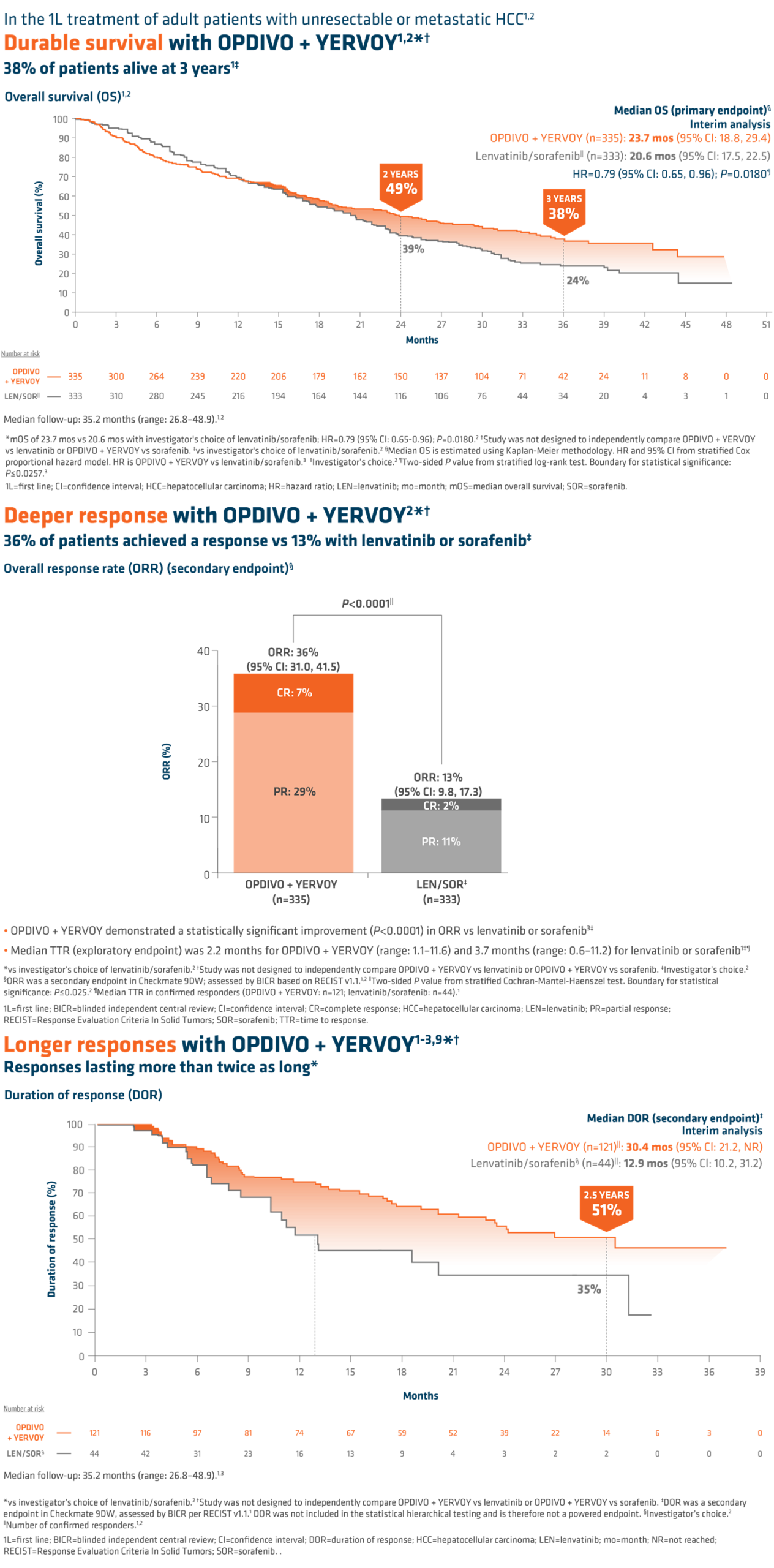
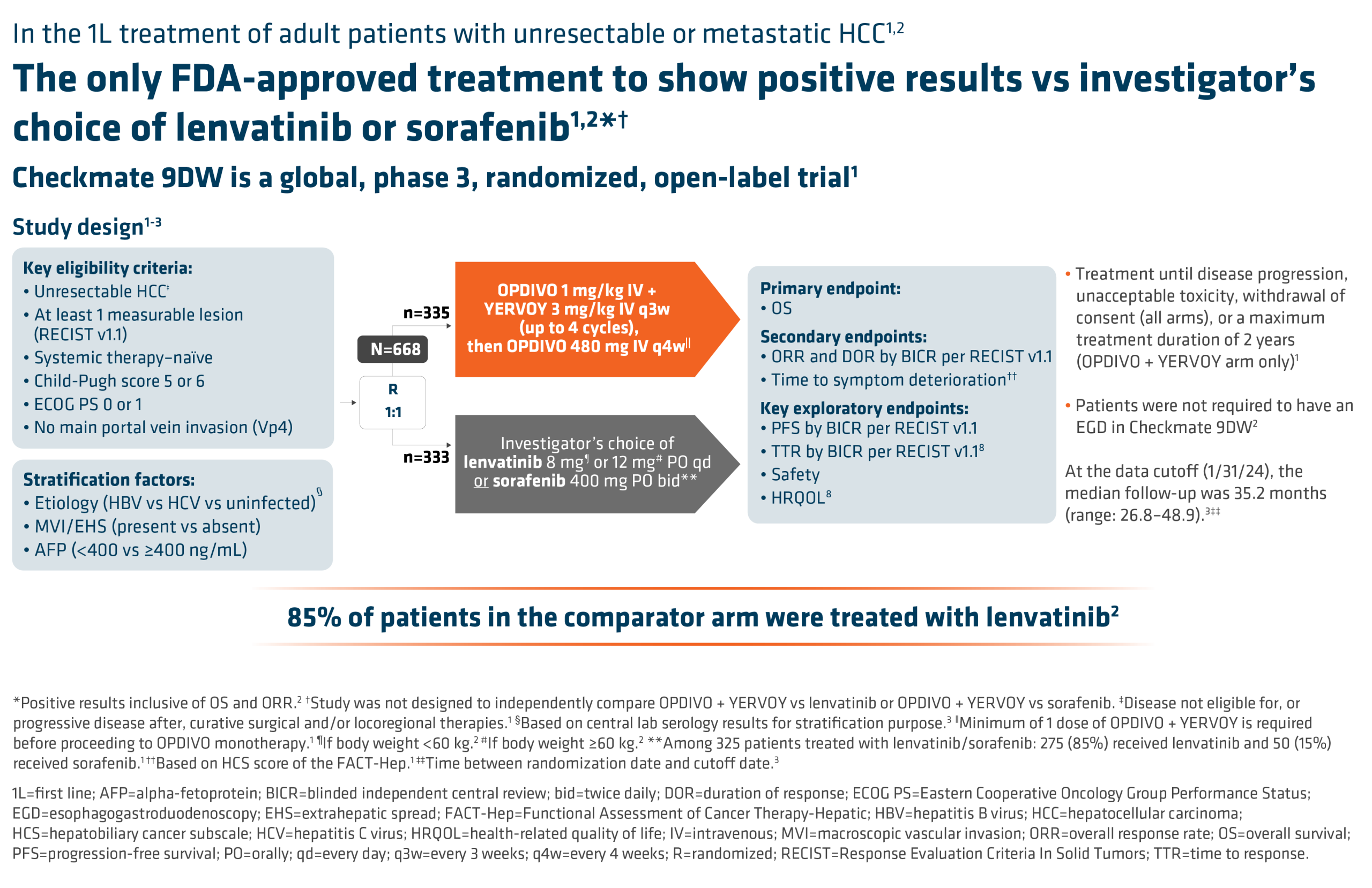
OPDIVO + YERVOY, a dual immune-checkpoint inhibitor combination studied in the global, randomized, phase 3 Checkmate 9DW trial, is the only FDA-approved treatment to show positive results* versus investigator’s choice of lenvatinib or sorafenib, in the 1L treatment of adult patients with uHCC1-5. Checkmate 9DW enrolled 668 patients with uHCC who were systemic-therapy–naïve, with at least 1 measurable lesion, Child-Pugh score 5 or 6, ECOG PS 0 or 1, and no main portal vein invasion (Vp4)1-3. An esophagogastroduodenoscopy (EGD) was not required2. Patients were randomized 1:1 to receive either OPDIVO (1 mg/kg) + YERVOY (3 mg/kg) q3w for up to 4 cycles followed by OPDIVO (480 mg IV) q4w or investigator’s choice of lenvatinib or sorafenib in the comparator arm1,2,5. YERVOY 3 mg/kg dosing in Checkmate 9DW was supported by Checkmate 0407.

HCC-Only-FDA-Approved-Treatment-Positive_Results

Efficacy and safety data for OPDIVO + YERVOY
Median overall survival (mOS), the primary endpoint, was 23.7 months (95% CI: 18.8, 29.4) with OPDIVO + YERVOY versus 20.6 months (95% CI: 17.5, 22.5) with the comparator arm, with a hazard ratio of 0.79 (95% CI: 0.65, 0.96; P=0.018)1,2. Notably, 38% of patients were alive at 3 years with OPDIVO + YERVOY, compared to 24% with the comparator arm1-3,5. According to Dr. He, “The Checkmate 9DW design was unique because one of the comparator arm treatments was investigator’s choice of lenvatinib—a modern TKI, received by 85% of patients—making these results particularly meaningful.”

OPDIVO + YERVOY achieved a deeper overall response rate (ORR), a secondary endpoint, of 36%, versus 13% with the comparator arm (P<0.0001)1-3,5. “The ORR being higher than the comparator arm is great. When my patients are symptomatic with a high tumor burden, I choose treatments with a higher response rate than their comparator arms to ease their symptoms and potentially reduce liver stress. Furthermore, an exploratory analysis found median time to response was 2.2 months,” said Dr. He.

Responses lasted over twice as long with the median duration of response (mDOR) at 30.4 months (95% CI: 21.2, NR) versus 12.9 months (95% CI: 10.2, 31.2) with the comparator arm1-3,5. Dr. He shared, “The DOR is clinically meaningful. Some of my Checkmate 9DW patients are now off treatment after 2 years, with ongoing disease control.”

Durable-Survival-Durable-Responses-Longer-Responses

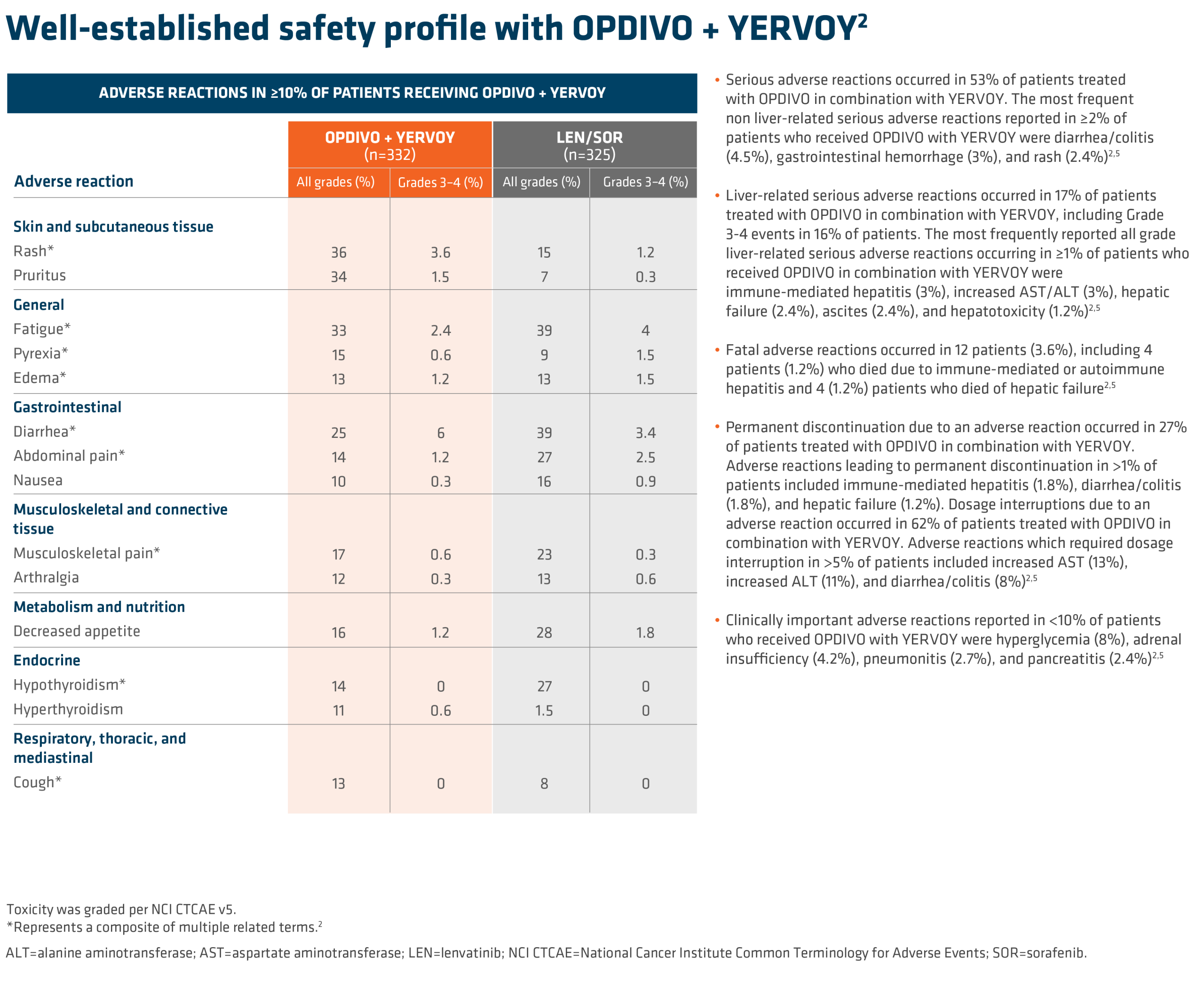
The safety profile of OPDIVO + YERVOY is well established2,5. Dr. He added, “No new IMARs were observed in Checkmate 9DW. I encourage patients to report side effects early, and I manage IMARs per established protocols including treatment holds and steroid use.”

Opdivo-Yervoy-Safety

Summary and conclusions
OPDIVO + YERVOY, a differentiated 1L option for treatment of uHCC, achieved durable survival, deeper and longer responses with a well-established safety profile. “For OPDIVO + YERVOY, I choose patients who are relatively robust, socially supported, and report side effects promptly. I’m excited about this 1L treatment and its demonstrated durable survival benefits,” noted Dr. He.

INDICATIONS

OPDIVO, in combination with YERVOY, is indicated for the first-line treatment of adult patients with unresectable or metastatic hepatocellular carcinoma (HCC).

IMPORTANT SAFETY INFORMATION

Severe and Fatal Immune-Mediated Adverse Reactions

  • Immune-mediated adverse reactions listed herein may not include all possible severe and fatal immune-mediated adverse reactions.
  • Immune-mediated adverse reactions, which may be severe or fatal, can occur in any organ system or tissue. While immune-mediated adverse reactions usually manifest during treatment, they can also occur after discontinuation of OPDIVO or YERVOY. Early identification and management are essential to ensure safe use of OPDIVO and YERVOY. Monitor for signs and symptoms that may be clinical manifestations of underlying immune-mediated adverse reactions. Evaluate clinical chemistries including liver enzymes, creatinine, adrenocorticotropic hormone (ACTH) level, and thyroid function at baseline and periodically during treatment with OPDIVO and before each dose of YERVOY. In cases of suspected immune-mediated adverse reactions, initiate appropriate workup to exclude alternative etiologies, including infection. Institute medical management promptly, including specialty consultation as appropriate.
  • Withhold or permanently discontinue OPDIVO and YERVOY depending on severity (please see section 2 Dosage and Administration in the accompanying Full Prescribing Information). In general, if OPDIVO or YERVOY interruption or discontinuation is required, administer systemic corticosteroid therapy (1 to 2 mg/kg/day prednisone or equivalent) until improvement to Grade 1 or less. Upon improvement to Grade 1 or less, initiate corticosteroid taper and continue to taper over at least 1 month. Consider administration of other systemic immunosuppressants in patients whose immune-mediated adverse reactions are not controlled with corticosteroid therapy. Toxicity management guidelines for adverse reactions that do not necessarily require systemic steroids (e.g., endocrinopathies and dermatologic reactions) are discussed below.

Immune-Mediated Pneumonitis

  • OPDIVO and YERVOY can cause immune-mediated pneumonitis. The incidence of pneumonitis is higher in patients who have received prior thoracic radiation. In patients receiving OPDIVO 1 mg/kg with YERVOY 3 mg/kg every 3 weeks, immune-mediated pneumonitis occurred in 7% (31/456) of patients, including Grade 4 (0.2%), Grade 3 (2.0%), and Grade 2 (4.4%).

Immune-Mediated Colitis

  • OPDIVO and YERVOY can cause immune-mediated colitis, which may be fatal. A common symptom included in the definition of colitis was diarrhea. Cytomegalovirus (CMV) infection/reactivation has been reported in patients with corticosteroid-refractory immune-mediated colitis. In cases of corticosteroid-refractory colitis, consider repeating infectious workup to exclude alternative etiologies. In patients receiving OPDIVO 1 mg/kg with YERVOY 3 mg/kg every 3 weeks, immune-mediated colitis occurred in 25% (115/456) of patients, including Grade 4 (0.4%), Grade 3 (14%) and Grade 2 (8%).

Immune-Mediated Hepatitis and Hepatotoxicity

  • OPDIVO and YERVOY can cause immune-mediated hepatitis. In patients receiving OPDIVO 1 mg/kg with YERVOY 3 mg/kg every 3 weeks, immune-mediated hepatitis occurred in 15% (70/456) of patients, including Grade 4 (2.4%), Grade 3 (11%), and Grade 2 (1.8%).

Immune-Mediated Endocrinopathies

  • OPDIVO and YERVOY can cause primary or secondary adrenal insufficiency, immune-mediated hypophysitis, immune-mediated thyroid disorders, and Type 1 diabetes mellitus, which can present with diabetic ketoacidosis. Withhold OPDIVO and YERVOY depending on severity (please see section 2 Dosage and Administration in the accompanying Full Prescribing Information). For Grade 2 or higher adrenal insufficiency, initiate symptomatic treatment, including hormone replacement as clinically indicated. Hypophysitis can present with acute symptoms associated with mass effect such as headache, photophobia, or visual field defects. Hypophysitis can cause hypopituitarism; initiate hormone replacement as clinically indicated. Thyroiditis can present with or without endocrinopathy. Hypothyroidism can follow hyperthyroidism; initiate hormone replacement or medical management as clinically indicated. Monitor patients for hyperglycemia or other signs and symptoms of diabetes; initiate treatment with insulin as clinically indicated.
  • In patients receiving OPDIVO 1 mg/kg with YERVOY 3 mg/kg every 3 weeks, adrenal insufficiency occurred in 8% (35/456) of patients, including Grade 4 (0.2%), Grade 3 (2.4%), and Grade 2 (4.2%).
  • In patients receiving OPDIVO 1 mg/kg with YERVOY 3 mg/kg every 3 weeks, hypophysitis occurred in 9% (42/456) of patients, including Grade 3 (2.4%) and Grade 2 (6%).
  • In patients receiving OPDIVO 1 mg/kg with YERVOY 3 mg/kg every 3 weeks, hyperthyroidism occurred in 9% (42/456) of patients, including Grade 3 (0.9%) and Grade 2 (4.2%).
  • In patients receiving OPDIVO 1 mg/kg with YERVOY 3 mg/kg every 3 weeks, hypothyroidism occurred in 20% (91/456) of patients, including Grade 3 (0.4%) and Grade 2 (11%).

Immune-Mediated Nephritis with Renal Dysfunction

  • OPDIVO and YERVOY can cause immune-mediated nephritis.

Immune-Mediated Dermatologic Adverse Reactions

  • OPDIVO can cause immune-mediated rash or dermatitis. Exfoliative dermatitis, including Stevens-Johnson syndrome (SJS), toxic epidermal necrolysis (TEN), and drug rash with eosinophilia and systemic symptoms (DRESS) has occurred with PD-1/PD-L1 blocking antibodies. Topical emollients and/or topical corticosteroids may be adequate to treat mild to moderate non-exfoliative rashes.
  • YERVOY can cause immune-mediated rash or dermatitis, including bullous and exfoliative dermatitis, SJS, TEN, and DRESS. Topical emollients and/or topical corticosteroids may be adequate to treat mild to moderate non-bullous/exfoliative rashes.
  • Withhold or permanently discontinue OPDIVO and YERVOY depending on severity (please see section 2 Dosage and Administration in the accompanying Full Prescribing Information).
  • In patients receiving OPDIVO 1 mg/kg with YERVOY 3 mg/kg every 3 weeks, immune-mediated rash occurred in 28% (127/456) of patients, including Grade 3 (4.8%) and Grade 2 (10%).

Other Immune-Mediated Adverse Reactions

  • The following clinically significant immune-mediated adverse reactions occurred at an incidence of <1% (unless otherwise noted) in patients who received OPDIVO monotherapy or OPDIVO in combination with YERVOY or were reported with the use of other PD-1/PD-L1 blocking antibodies. Severe or fatal cases have been reported for some of these adverse reactions: cardiac/vascular: myocarditis, pericarditis, vasculitis; nervous system: meningitis, encephalitis, myelitis and demyelination, myasthenic syndrome/myasthenia gravis (including exacerbation), Guillain-Barré syndrome, nerve paresis, autoimmune neuropathy; ocular: uveitis, iritis, and other ocular inflammatory toxicities can occur; gastrointestinal: pancreatitis to include increases in serum amylase and lipase levels, gastritis, duodenitis; musculoskeletal and connective tissue: myositis/polymyositis, rhabdomyolysis, and associated sequelae including renal failure, arthritis, polymyalgia rheumatica; endocrine: hypoparathyroidism; other (hematologic/immune): hemolytic anemia, aplastic anemia, hemophagocytic lymphohistiocytosis (HLH), systemic inflammatory response syndrome, histiocytic necrotizing lymphadenitis (Kikuchi lymphadenitis), sarcoidosis, immune thrombocytopenic purpura, solid organ transplant rejection, other transplant (including corneal graft) rejection.
  • In addition to the immune-mediated adverse reactions listed above, across clinical trials of YERVOY monotherapy or in combination with OPDIVO, the following clinically significant immune-mediated adverse reactions, some with fatal outcome, occurred in <1% of patients unless otherwise specified: nervous system: autoimmune neuropathy (2%), myasthenic syndrome/myasthenia gravis, motor dysfunction; cardiovascular: angiopathy, temporal arteritis; ocular: blepharitis, episcleritis, orbital myositis, scleritis; gastrointestinal: pancreatitis (1.3%); other (hematologic/immune): conjunctivitis, cytopenias (2.5%), eosinophilia (2.1%), erythema multiforme, hypersensitivity vasculitis, neurosensory hypoacusis, psoriasis.
  • Some ocular IMAR cases can be associated with retinal detachment. Various grades of visual impairment, including blindness, can occur. If uveitis occurs in combination with other immune-mediated adverse reactions, consider a Vogt-Koyanagi-Harada–like syndrome, which has been observed in patients receiving OPDIVO and YERVOY, as this may require treatment with systemic corticosteroids to reduce the risk of permanent vision loss.

Infusion-Related Reactions

  • OPDIVO and YERVOY can cause severe infusion-related reactions. Discontinue OPDIVO and YERVOY in patients with severe (Grade 3) or life-threatening (Grade 4) infusion-related reactions. Interrupt or slow the rate of infusion in patients with mild (Grade 1) or moderate (Grade 2) infusion-related reactions. In HCC patients receiving OPDIVO 1 mg/kg with YERVOY 3 mg/kg every 3 weeks, infusion-related reactions occurred in 8% (4/49) of patients.

Complications of Allogeneic Hematopoietic Stem Cell Transplantation

  • Fatal and other serious complications can occur in patients who receive allogeneic hematopoietic stem cell transplantation (HSCT) before or after being treated with OPDIVO or YERVOY. Transplant-related complications include hyperacute graft-versus-host-disease (GVHD), acute GVHD, chronic GVHD, hepatic veno-occlusive disease (VOD) after reduced intensity conditioning, and steroid-requiring febrile syndrome (without an identified infectious cause). These complications may occur despite intervening therapy between OPDIVO or YERVOY and allogeneic HSCT.
  • Follow patients closely for evidence of transplant-related complications and intervene promptly. Consider the benefit versus risks of treatment with OPDIVO and YERVOY prior to or after an allogeneic HSCT.

Embryo-Fetal Toxicity

  • Based on its mechanism of action and findings from animal studies, OPDIVO and YERVOY can cause fetal harm when administered to a pregnant woman. The effects of YERVOY are likely to be greater during the second and third trimesters of pregnancy. Advise pregnant women of the potential risk to a fetus. Advise females of reproductive potential to use effective contraception during treatment with OPDIVO and YERVOY and for at least 5 months after the last dose.

Increased Mortality in Patients with Multiple Myeloma when OPDIVO is Added to a Thalidomide Analogue and Dexamethasone

  • In randomized clinical trials in patients with multiple myeloma, the addition of OPDIVO to a thalidomide analogue plus dexamethasone resulted in increased mortality. Treatment of patients with multiple myeloma with a PD-1 or PD-L1 blocking antibody in combination with a thalidomide analogue plus dexamethasone is not recommended outside of controlled clinical trials.

Lactation

  • There are no data on the presence of OPDIVO or YERVOY in human milk, the effects on the breastfed child, or the effects on milk production. Because of the potential for serious adverse reactions in breastfed children, advise women not to breastfeed during treatment and for 5 months after the last dose.

Serious Adverse Reactions

  • In Checkmate 9DW, serious adverse reactions occurred in 53% of patients receiving OPDIVO with YERVOY (n=332). The most frequent non liver-related serious adverse reactions reported in ≥2% of patients who received OPDIVO with YERVOY were diarrhea/colitis (4.5%), gastrointestinal hemorrhage (3%), and rash (2.4%). Liver-related serious adverse reactions occurred in 17% of patients receiving OPDIVO with YERVOY, including Grade 3-4 events in 16% of patients. The most frequently reported all grade liver-related serious adverse reactions occurring in ≥1% of patients who received OPDIVO with YERVOY were immune-mediated hepatitis (3%), increased AST/ALT (3%), hepatic failure (2.4%), ascites (2.4%), and hepatotoxicity (1.2%). Fatal adverse reactions occurred in 12 (3.6%) patients who received OPDIVO with YERVOY; these included 4 (1.2%) patients who died due to immune-mediated or autoimmune hepatitis and 4 (1.2%) patients who died of hepatic failure.

Common Adverse Reactions

  • In Checkmate 9DW, the most common adverse reactions (≥20%) in patients receiving OPDIVO with YERVOY (n=332) were rash (36%), pruritus (34%), fatigue (33%), and diarrhea (25%).

Clinical Trials and Patient Populations

  • Checkmate 9DW – hepatocellular carcinoma, in combination with YERVOY.


By unsubscribing from OncoPrescribe.com below, you are not opting out of receiving email marketing communications from Bristol-Myers Squibb Company.

References

  1. Kudo M et al. Oral presentation at ASCO-GI 2025. Abstract 520.
  2. OPDIVO [package insert]. Princeton, NJ; Bristol-Myers Squibb Company.
  3. Galle PR et al. Oral presentation at ASCO 2024. Abstract LBA4008.
  4. American Cancer Society. https://www.cancer.org/cancer/liver-cancer/detection-diagnosis-staging/survival-rates.html. Accessed July 2025.
  5. YERVOY [package insert]. Princeton, NJ; Bristol-Myers Squibb Company.
  6. Yau T et al. 2025;405(10492):1851–1864.
  7. El-Khoueiry AB et al. Lancet. 2017;389(10088):2492–2502.
  8. Data on file. BMS-REF-NIVO-0335. Princeton, NJ: Bristol-Myers Squibb Company; 2025.
  9. Data on file. BMS-REF-NIVO-0326. Princeton, NJ: Bristol-Myers Squibb Company; 2025.

© 2025 Bristol-Myers Squibb Company. OPDIVO® and YERVOY® are registered trademarks of Bristol-Myers Squibb Company.

7356-US-2500331   08/2025


Hormonal Contraception and Breast Cancer Risk in BRCA1/2 Mutation Carriers

SUMMARY: Breast cancer is the most common cancer among women in the US and about 1 in 8 women (12%) will develop invasive breast cancer during their lifetime. It is estimated that in the US, approximately 316,950 new cases of female breast cancer will be diagnosed in 2025, and about 42,170 women will die of the disease, largely due to metastatic recurrence.

The tumor suppressor genes such as BRCA1 and BRCA2 help repair damaged DNA and thus play an important role in maintaining cellular genetic integrity, failing which these genetic aberrations can result in malignancies. Mutations in BRCA1 and BRCA2 account for about 20 to 25 percent of hereditary breast cancers and about 5 to 10 percent of all breast cancers. These mutations can be inherited from either of the parents and a child has a 50 percent chance of inheriting this mutation, and the deleterious effects of the mutations are seen even when a second copy of the gene in an individual is normal. Women with germline BRCA1 or BRCA2 mutations face markedly elevated lifetime risks of breast cancer, estimated at up to 70%. More than half of these cancers occur before the age of 50, underscoring the importance of informed counseling regarding risk-modifying exposures. One such factor is hormonal contraception, widely used for birth control and non-contraceptive health benefits, but also a potential contributor to breast cancer risk. The present study was conducted to assess the association between use of any hormonal contraception and breast cancer risk for BRCA1 and BRCA2 mutation carriers using individual participant data from four prospective cohorts.

Study Design
A large observational analysis pooled data from four prospective cohorts across Australia, New Zealand, Europe, Canada, and the United States (kConFab FUP, BCFR, RFS, and the UPenn Registry). The study included 3,882 women with BRCA1 mutations and 1,509 with BRCA2 mutations who were followed for a median of approximately six years. Associations between hormonal contraception use and breast cancer incidence were assessed using Cox regression modeling.

Key Findings

  • Hormonal Contraception use prevalence: 53% of BRCA1 carriers and 71% of BRCA2 carriers reported 1 year or more of use (median duration, 4.8 and 5.7 years, respectively). Hormonal contraceptives included birth control pills, patches, implants, injections, vaginal rings, and IUDs containing any hormones.
  • Cancer incidence: During follow-up, 488 BRCA1 and 191 BRCA2 carriers developed breast cancer during median follow-up of 5.9 and 5.6 years, respectively.
  • BRCA1 mutation carriers:
    • Ever use of hormonal contraception was associated with a 29% increased relative risk of breast cancer (HR, 1.29; 95% CI, 1.04–1.60).
    • Longer cumulative use conferred higher risk, with an estimated 3% increase in risk per additional year of use.
    • Current use and recent use were not independently significant, but a dose–response relationship emerged with duration.
  • BRCA2 mutation carriers: No significant association was observed between hormonal contraception use and breast cancer risk (HR for ever use, 1.07; 95% CI, 0.73–1.57). However, the relatively small number of events limits certainty.

Absolute Risk Implications

For BRCA1 carriers, small relative increases translate into substantial absolute risk shifts due to their high baseline susceptibility. For example, modeling suggested that an 18-year-old BRCA1 carrier with a family history of breast cancer would at age 58 face:

  • 51.3% lifetime risk without hormonal contraception use,
  • 56.6% with 5 years of use,
  • 62.0% with 10 years of use,
  • 67.3% with 15 years of use.

Shorter-term use was associated with minimal increases in absolute risk, whereas prolonged exposure yielded more clinically meaningful elevations.

Context and Clinical Considerations

  • Findings align with evidence in the general population showing modest increases in breast cancer risk with hormonal contraception use, though the higher baseline risk in BRCA1 carriers amplifies the absolute impact.
  • The lack of association for BRCA2 carriers should be interpreted cautiously due to limited statistical power.
  • Importantly, while oral contraceptives reduce tubo-ovarian cancer risk, this benefit may be less relevant for BRCA1/2 carriers who undergo guideline-recommended risk-reducing salpingo-oophorectomy by ages 35–45.
  • Study strengths include large BRCA1 cohort size, prospective data collection, and consistent findings across international cohorts. Limitations include observational design, potential misclassification of hormonal contraception type, and limited data beyond 15 years of use.

Take-Home Message for Oncologists
Hormonal contraceptives appear to increase breast cancer risk for BRCA1 mutation carriers, particularly with longer cumulative use, while evidence for BRCA2 remains inconclusive. When counseling patients, absolute risk estimates and individual values should guide decisions. Shorter-term use may be acceptable for some women, but prolonged use could confer risk increases that outweigh potential benefits.

Hormonal Contraception and Breast Cancer Risk for Carriers of Germline Mutations in BRCA1 and BRCA2. Phillips K-A, Kotsopoulos J,  Domchek SM, et al. J Clin Oncol. 2025;43:422-431

Statins as Potential Adjuvants in Immune Checkpoint Inhibitor Therapy: A Comprehensive Meta-Analysis

SUMMARY: Immune checkpoint inhibitors (ICIs) have dramatically transformed treatment landscape across multiple malignancies, producing durable responses in subsets of patients. By enhancing the ability of the immune system to identify and destroy cancer cells, ICIs have provided significant improvements in treatment outcomes across a range of tumor types. Despite these advances, resistance to ICIs remains a major barrier, driven by complex tumor-intrinsic and microenvironmental mechanisms. One area of growing interest is the role of lipid metabolism in cancer progression and immune evasion.

Cancer cells reprogram lipid metabolism to support survival under nutrient-deprived and hypoxic conditions, while stromal and immune cells in the Tumor MicroEnvironment (TME) also undergo lipid metabolic alterations that shape tumor-immune interactions. Targeting these pathways may represent a novel means to overcome immunosuppression and enhance response to ICIs.

Statins, widely prescribed for cardiovascular risk reduction, exhibit pleiotropic effects beyond lipid lowering, including modulation of PD-L1 expression, reprogramming of tumor-associated macrophages, and promotion of T-cell–mediated antitumor activity. These properties raise the possibility that statins may act synergistically with ICIs to improve patient outcomes.

Study Objective
Given the biologic rationale and conflicting results from prior studies, Liao and colleagues conducted a systematic review and meta-analysis to evaluate the prognostic impact of concomitant statin use in patients with cancer treated with ICIs. The goal was to determine whether this widely available and inexpensive class of drugs could augment the clinical benefits of immunotherapy.

Methods

  • Search strategy: Comprehensive searches of PubMed, EMBASE, Cochrane Library, Web of Science, and major oncology conference proceedings were conducted through June 20, 2024.
  • Inclusion criteria: Studies reporting Hazard Ratios (HRs) for Overall Survival (OS) and/or Progression-Free Survival (PFS) with statin use in ICI-treated patients.
  • Study pool: 25 retrospective studies (N=46,154) included in the meta-analysis.
  • Cancers represented: Non Small Cell Lung Cancer-NSCLC (8 studies), Renal Cell Carcinoma (3), Melanoma (1), Urothelial carcinoma (1), and Pan-cancer analyses (12).
  • Patient characteristics: Statin use prevalence ranged from 8.7% to 50%. Study regions included Asia, Europe, and the United States.
  • Endpoints: OS (in all 46,154 patients) and PFS (in 7,786 patients).
  • Quality: 15 studies classified as high quality, 10 classified as moderate according to the modified NOS (Newcastle-Ottawa Scale).

Key Findings

  • Overall Survival: Statin use was associated with a 20% reduction in mortality risk (HR 0.80; 95% CI, 0.71–0.92).
  • Progression-Free Survival: A consistent benefit was observed (HR 0.80; 95% CI, 0.69–0.92).
  • Subgroup analyses:
    • By cancer type: Survival advantage was most pronounced in Renal Cell Carcinoma, while benefits were less consistent in NSCLC and Melanoma.
    • By geography: OS benefit with statin use was noted in studies originating from Europe but not observed in studies conducted in Asia and US. Statin use was associated with improved PFS among Asian patients undergoing ICI therapy, but not observed in European and American patients.

Clinical Implications

  • Mechanistic plausibility: Statins may enhance immunotherapy by downregulating PD-L1 expression, shifting macrophage polarization from an M2 to M1 phenotype, and reducing systemic inflammation.
  • Accessibility: Statins are inexpensive, widely available, and well tolerated, positioning them as attractive adjuncts to ICIs.
  • Limitations:
    • All included studies were retrospective and observational.
    • Potential confounding (eg, baseline comorbidities, concomitant medications).
    • Lack of stratification by statin type, dose, or timing of initiation.
    • Evidence of publication bias.
  • Next steps: Well-designed Randomized Controlled Trials (RCTs) are essential to establish causality. A Phase II RCT investigating PD-1 inhibitors combined with statins in advanced NSCLC is already underway.

Conclusion
This meta-analysis provides the strongest evidence to date that concomitant statin therapy may improve both OS and PFS in patients with cancer receiving ICIs. While observational in nature, the findings highlight the potential of repurposing a widely used cardiovascular drug as an oncology adjuvant. If validated in prospective RCTs, statins could emerge as a low-cost, low-toxicity strategy to enhance immunotherapy efficacy across multiple cancer types, potentially shaping future treatment algorithms.

Takeaway for Oncologists
Concomitant statin use is associated with improved survival in ICI-treated patients across diverse cancers, with particular benefit seen in Renal Cell Carcinoma and in non-U.S. cohorts. Until prospective trials confirm these findings, clinicians should remain attentive to emerging data while considering statin therapy primarily for established cardiovascular indications.

Concomitant Statin Use and Survival in Patients With Cancer on Immune Checkpoint Inhibitors: A Meta-Analysis. Liao Y, Lin Y, Ye X, et al. JCO Oncol Pract. 2025;21:989-1000.