Daprodustat: A New Oral Therapy for Anemia in Patients with Chronic Kidney Disease

SUMMARY: Anemia is a common complication of advanced renal failure. This is due to decreased Erythropoietin (EPO) production primarily due to the inability of the diseased kidney to adequately respond to hypoxia and/or anemia. Patients with Chronic Kidney Disease (CKD) are often given EPO replacement therapy which can be either recombinant human EPO (rhEPO) or reengineered preparations of recombinant EPO, and these agents are collectively referred to as Erythropoietin Stimulating Agents (ESA). These agents are administered by parenteral route and can reduce cardiovascular morbidity associated with anemia, blood transfusion requirements and improve quality of life. However, ESA given to normalize the hemoglobin level to 13-14.0 g/dl, as well as supraphysiologic dosing of ESA has been associated with increased risk of cardiovascular events, venous thromboembolism, CKD progression and overall mortality.

Systemic hypoxia increases plasma EPO levels, which in turn results in increased production of Red Blood Cells. New novel therapies include oral small molecule inhibitors that activate Hypoxia Inducible Factor (HIF) and stimulate endogenous EPO production.

HIF prolyl hydroxylase under conditions of normal oxygen concentrations breaks down the HIF. Daprodustat is an orally active HIF prolyl hydroxylase inhibitor that stimulates endogenous erythropoietin production by stabilizing the HIF-α subunit, allowing it to dimerize with the HIF-β subunit and to stimulate genes involved in protection against hypoxia, including the erythropoietin gene. In summary, Daprodustat increases hemoglobin levels as well as Total Iron Binding Capacity, and decreases the levels of ferritin and hepcidin. Daprodustat demonstrated a good safety profile and had efficacy over 24 weeks in Phase II trials involving patients with CKD.

In the current ASCEND-ND (Anemia Studies in Chronic Kidney Disease: Erythropoiesis via a Novel Prolyl Hydroxylase Inhibitor Daprodustat–Non-Dialysis) trial, the reserachers evaluated the efficacy and safety of the HIF prolyl hydroxylase inhibitor Daprodustat, as compared with the conventional ESA Darbepoetin alfa, in patients with CKD who were not undergoing dialysis. In this open-label, Phase III trial, 3872 patients were randomly assigned 1:1 to receive oral Daprodustat or subcutaneous Darbepoetin alfa. Eligible patients had stage 3-5 CKD and were not currently receiving dialysis or scheduled to start dialysis within 90 days, met the hemoglobin and ESA criteria, and had a serum ferritin level of more than 100 ng/ml and a transferrin saturation above 20%. Patients who had anemia that was unrelated to CKD, a recent cardiovascular event, or current or recent cancer were excluded.

The starting dose of Daprodustat was between 1 and 4 mg orally daily, according to the baseline hemoglobin level if the patient was not receiving an ESA, and according to the ESA dose if the patient was receiving an ESA, and dose adjustments ranged from 1 to 24 mg. The starting dose of subcutaneous Darbepoetin alfa was based on the patient’s weight and hemoglobin level at the time of randomization if the patient was not receiving an ESA or on the previous ESA dose if the patient was receiving an ESA. Dose increments were predefined, and the dose was increased by 25 to 33%. The study included a provision for the use of IV iron, PRBC transfusion, or both. The mean baseline hemoglobin levels were similar in the two treatment groups and was 9.9 plus or minus 0.9 g/dl. The researchers used a trial-specific algorithm for both treatment groups to achieve and maintain a hemoglobin level in the target range of 10-11 g/dl. Patient characteristics were well balanced in both treatment groups. Patients were evaluated at least every 4 weeks during the first year of the study and at least every 12 weeks thereafter. The Primary noninferiority outcomes were the mean change in the hemoglobin level from baseline to weeks 28 through 52, and the first occurrence of a Major Adverse Cardiovascular Event (MACE- a composite of death from any cause, nonfatal myocardial infarction, or nonfatal stroke). These and other cardiovascular events were adjudicated by a blinded independent committee.

Daprodustat was noted to be noninferior and as effective as Darbepoetin alfa in increasing and maintaining hemoglobin levels in patients with CKD and anemia who were not receiving dialysis, and this benefit on hemoglobin levels was consistent across prespecified subgroups. Daprodustat was also noninferior to Darbepoetin alfa with respect to cardiovascular safety in the primary analysis. During a median follow up of 1.9 years, a first MACE occurred in 19.5% of patients in the Daprodustat group and 19.2% of patients in the Darbepoetin alfa group, and this met the prespecified noninferiority margin. There was no difference in the rates of thromboembolic events and hospitalization for heart failure among the treatment groups.

It was noted that patients in the Daprodustat group had more esophageal or gastric erosions (3.6%), compared to 2.1% in the Darbepoetin alfa group. Because of the activation of the HIF pathway by HIF prolyl hydroxylase inhibitor, cancer incidence and progression is a concern and the researchers observed a higher incidence of cancer-related death or tumor progression or recurrence in the Daprodustat group (3.7%) compared to 2.5% in the Darbepoietin alfa group (Relative Risk=1.47)

It was concluded from this study that among patients with CKD and anemia who were not undergoing dialysis, Daprodustat was noninferior to Darbepoetin alfa with respect to the change in the hemoglobin level from baseline and with respect to cardiovascular outcomes. However, the safety of HIF prolyl hydroxylase inhibitors in cancer patients will require longer follow up.

Daprodustat for the Treatment of Anemia in Patients Not Undergoing Dialysis. Singh AK, Carroll K, McMurray JV, et al. for the ASCEND-ND Study Group. N Engl J Med 2021; 385:2313-2324.
Long Term Survival Benefit with Maintenance ONUREG® in AML Patients

SUMMARY: The American Cancer Society has estimated that in 2021, 20,240 new cases of Acute Myeloid Leukemia (AML) were diagnosed in the United States and 11,400 patients died of the disease. AML is one of the most common types of leukemia in adults and can be considered as a group of molecularly heterogeneous diseases with different clinical behavior and outcomes. A significant percentage of patients with newly diagnosed AML are not candidates for intensive chemotherapy or have disease that is refractory to standard chemotherapy. Even with the best available therapies, the 5 year Overall Survival (OS) in patients 65 years of age or older is less than 5%. Cytogenetic analysis has been part of routine evaluation when caring for patients with AML. By predicting resistance to therapy, tumor cytogenetics will stratify patients based on risk, and help manage them accordingly. Even though cytotoxic chemotherapy may lead to long term remission and cure in a minority of patients with favorable cytogenetics, patients with high risk features such as unfavorable cytogenetics, molecular abnormalities, prior myelodysplasia and advanced age, have poor outcomes with conventional chemotherapy alone. More importantly, with the understanding of molecular pathology of AML, personalized and targeted therapies are becoming an important part of the AML treatment armamentarium.

Cytotoxic chemotherapy for AML often consists of induction therapy to achieve remission, followed by consolidation therapy. However, standard induction chemotherapy achieves Complete Remission in only 40-60% of AML patients older than 60 years of age, and majority of these patients will eventually relapse. This had been attributed to clonal evolution and epigenetic reprogramming, leading to aberrant DNA methylation, and persistence of leukemia-initiating cells.

Longer duration of first remission is associated with better survival outcomes. Postremission maintenance therapies to prevent early AML relapse has been an area of active research with little progress made until now. Patients with AML who are under age 55 with high-risk cytogenetics, in first clinical remission,are considered for allogeneic Hematopoietic Stem Cell Transplantation (HSCT), as this has shown to offer survival advantage over conventional chemotherapy. This therapeutic option however is not feasible for many elderly patients.

Oral Azacitidine (ONUREG®) is a hypomethylating agent that has a distinct pharmacokinetic as well as pharmacodynamic profile from the parenteral Azacitidine preparation, and can be administered in extended dosing schedules (for 14-21 days per 28-day treatment cycle) to sustain therapeutic activity.

ONUREG® is the first and only FDA-approved therapy indicated for continued treatment of adult patients with AML who achieved first Complete Remission (CR) or Complete Remission with incomplete blood count recovery (CRi) following intensive induction chemotherapy, and are not able to complete intensive curative therapy.

This FDA approval was based on an International, double-blind, placebo-controlled, Phase III QUAZAR AML-001 trial, in which ONUREG® was evaluated as maintenance therapy in patients with AML, who were in first remission after intensive chemotherapy. Eligible patients were 55 years of age or older, were in complete remission with or without complete blood count recovery, and were not candidates for Hematopoietic Stem Cell Transplantation. Patients (N=472) were randomly assigned to receive ONUREG® 300 mg orally (N=238) or placebo (N=234), once daily for 14 days of a 28-day cycle. The median age was 68 years. The Primary end point was Overall Survival (OS). Secondary end points included Relapse Free Survival (RFS) and Health-Related Quality of Life.

At the time of the primary analysis in 2019, with a median follow up of 41.2 months, maintenance treatment with ONUREG® significantly prolonged median OS, when compared to placebo (24.7 months versus 14.8 months; P<0.001). The median RFS was also significantly longer with ONUREG® than with placebo (10.2 months versus 4.8 months; P<0.001). These survival benefits were demonstrated in most treatment subgroups. Further, with a median follow up of 51.7 months, the median OS remained unchanged, and the median OS with oral ONUREG® was 24.7 months versus 14.8 months with placebo (HR=0.69; P=0.0008). The 3-year OS rates in the experimental and control arms were 37.4% and 27.9%, respectively and at 5 years were 26.2% and 19.2%, respectively. Overall Quality of life was preserved while on treatment with ONUREG®. The most common adverse reactions associated with ONUREG® treatment were nausea, vomiting, diarrhea, abdominal pain, constipation, fatigue/asthenia, febrile neutropenia and pneumonia.

The authors concluded that maintenance treatment with ONUREG® was associated with significantly longer Overall and Relapse Free Survival when compared to placebo, among elderly patients with AML, who were in remission after chemotherapy. This survival benefit was maintained with one additional year of follow up. The researchers added that these updated data suggests that maintenance therapy with ONUREG® provides a sustained, long term Overall Survival benefit in elderly patients with AML in first remission.

Long-Term Overall Survival (OS) with Oral Azacitidine (Oral-AZA) in Patients with Acute Myeloid Leukemia (AML) in First Remission after Intensive Chemotherapy (IC): Updated Results from the Phase 3 QUAZAR AML-001 Trial. Wei AH, Döhner H, Sayar H, et al. Blood. 2021;138(suppl 1):871. doi:10.1182/blood-2021-147501.

Postmenopausal Women with Node Positive Breast Cancer May Not Benefit From Chemotherapy

SUMMARY: Breast cancer is the most common cancer among women in the US and about 1 in 8 women (12%) will develop invasive breast cancer during their lifetime. Approximately 284,200 new cases of breast cancer will be diagnosed in 2021 and about 44,130 individuals will die of the disease, largely due to metastatic recurrence. Approximately 25% of patients with Hormone Receptor (HR)-positive, HER2-negative early breast cancer have metastatic lymph node involvement and two third of these patients are postmenopausal. Majority of these patients currently receive adjuvant chemotherapy.

The Oncotype DX breast cancer assay, is a multigene genomic test that analyzes the activity of a group of 21 genes and is able to predict the risk of breast cancer recurrence and likelihood of benefit from systemic chemotherapy, following surgery, in women with early stage breast cancer. Chemotherapy recommendations for early stage, HR-positive, HER-negative, early stage breast cancer patients, are often made based on tumor size, grade, ImmunoHistoChemical (IHC) markers such as Ki-67, nodal status and Oncotype DX Recurrence Score (RS) assay.

In the ground-breaking TAILORx (Trial Assigning Individualized Options for Treatment) study which enrolled 10,273 patients with HR-positive, HER2-negative, axillary node-negative breast cancer, patients were divided into three groups based on their Recurrence Score. Patient with Intermediate Recurrence Score of 11-25 were randomly assigned to receive endocrine therapy alone or endocrine therapy and adjuvant chemotherapy. There was no benefit noted from adding chemotherapy to endocrine therapy, for women older than 50 years in this Intermediate RS group, suggesting that a significant percentage of women with node-negative breast cancer do not achieve substantial benefit from chemotherapy. For women 50 years old or younger who received chemotherapy and had a Recurrence Score of at least 16, there was a lower rate of distant recurrence, and the absolute benefit increased with increasing recurrence score. Further, the risk of recurrence and benefit of chemotherapy was further influenced by the tumor size and grade.

Whether the results of TAILORx can be extrapolated to women with node-positive breast cancer has remained unclear. It is estimated that approximately 85% of women with node-positive disease have Recurrence Score results of 0-25. The RxPONDER (A Clinical Trial RX for Positive Node, Endocrine Responsive Breast Cancer) trial was designed to determine the benefit of chemotherapy, in patients with HR-positive, HER2-negative breast cancer and 1-3 positive axillary lymph nodes (nodal stage N1), who had a Recurrence Score of 0-25. This trial did not include pre and postmenopausal women with Recurrence Score results 26-100, based on previously published studies suggesting that this patient group benefited from chemotherapy.

SWOG S1007 (RxPONDER) is an multicenter, international, prospective, randomized, Phase III trial, in which patients with HR-positive, HER2-negative breast cancer with 1-3 positive axillary lymph nodes were included, to determine which patients would benefit from chemotherapy and which patients could safely avoid it. In this study, a total of 5083 HR-positive, HER2-negative breast cancer patients with 1-3 positive lymph nodes and Oncotype DX Recurrence Score of less than 25 were randomly assigned 1:1 to receive chemotherapy plus endocrine therapy (N=2547) or endocrine therapy alone (N=2536). The median patient age was 57.5 years and approximately two-thirds of patients were postmenopausal and one-third were premenopausal and had no contraindications to taxane and/or anthracycline based chemotherapy. Patients were stratified by Recurrence Score (0-13 versus 14-25), menopausal status, and axillary nodal dissection versus sentinel node biopsy. The Primary endpoint was Invasive Disease Free Survival (IDFS), defined as local, regional, or distant recurrence, any second invasive cancer, or death from any cause, and whether the effect depended on the Recurrence Score. Secondary endpoints included distant Relapse Free Survival (RFS) and Overall Survival (OS).

At a median follow up of 6.1 years, the chemotherapy benefit with respect to increasing invasive DFS differed according to menopausal status. Among postmenopausal women, in this updated analysis with longer follow up, the invasive DFS at 5 years was 91.9% in the endocrine therapy alone group, and was 91.3% in those treated with chemotherapy plus endocrine therapy (HR=1.02; P=0.89). Postmenopausal women with recurrence scores of 0 to 25 continued to NOT benefit from adjuvant chemotherapy.

Among premenopausal women however, the invasive DFS at 5 years was 89% in the endocrine therapy alone group and 93.9% % in those treated with chemotherapy plus endocrine therapy (HR=0.64; P=0.004). There was a 5-year absolute benefit of 4.9% for invasive DFS with chemotherapy among premenopausal women. There was a similar increase noted in the distant Relapse Free Survival (HR=0.58; P=0.009). The relative chemotherapy benefit did not increase as the Recurrence Score increased.

It was concluded from this practice-changing study that postmenopausal women with HR-positive, HER2-negative breast cancer with 1-3 positive nodes and Oncotype DX Recurrence Score of 25 or less, can safely avoid receiving adjuvant chemotherapy, whereas premenopausal patients with 1-3 positive nodes and a Recurrence Score of 25 or less benefited from chemotherapy plus endocrine therapy and had a longer invasive Disease Free Survival and distant Relapse Free Survival, than those who received endocrine therapy alone.

21-Gene Assay to Inform Chemotherapy Benefit in Node-Positive Breast Cancer. Kalinsky K, Barlow WE, Gralow JR, et al. N Engl J Med 2021;385:2336-2347

POLIVY® in Previously Untreated Diffuse Large B-Cell Lymphoma

SUMMARY: The American Cancer Society estimates that in 2021, about 81,560 people will be diagnosed with Non Hodgkin Lymphoma (NHL) in the United States and about 20,720 individuals will die of this disease. Diffuse Large B-Cell Lymphoma (DLBCL) is the most common of the aggressive Non-Hodgkin lymphoma’s in the United States, and the incidence has steadily increased 3-4% each year. More than half of patients are 65 or older at the time of diagnosis and the incidence is likely to increase with aging of the American population. The etiology of Diffuse Large B-Cell Lymphoma is unknown. Contributing risk factors include immunosuppression (AIDS, transplantation setting, autoimmune diseases), UltraViolet radiation, pesticides, hair dyes, and diet.

DLBCL is a neoplasm of large B cells and the most common chromosome abnormality involves alterations of the BCL-6 gene at the 3q27 locus, which is critical for germinal center formation. Two major molecular subtypes of DLBCL arising from different genetic mechanisms have been identified, using gene expression profiling: Germinal Center B-cell-like (GCB) and Activated B-Cell-like (ABC). Patients in the GCB subgroup have a higher five year survival rate, independent of clinical IPI (International Prognostic Index) risk score, whereas patients in the ABC subgroup have a significantly worse outcome. Regardless, R-CHOP regimen (Rituximab, Cyclophosphamide, Doxorubicin, Vincristine, and Prednisone), given every 21 days, for 6 cycles, delivered with curative intent, is the current standard of care for patients of all ages, with newly diagnosed DLBCL, regardless of molecular subtype. Approximately 30-40% of patients experience disease progression or relapse, during the first 2 years and attempts to improve on R-CHOP regimen have not been successful. Maintenance treatment strategy following R-CHOP, to better control the disease, delay disease progression and improve long term survival, have included Autologous Stem Cell Transplantation, maintenance treatment with agents such as oral protein kinase inhibitor Enzastaurin and Everolimus. Outcomes for transplant-ineligible patients with Relapsed/Refractory DLBCL patients remain poor.

CD79b is a B-cell specific surface protein, which is a component of the B-cell receptor and is ubiquitously expressed on the surface of malignant B cells. POLIVY® (Polatuzumab vedotin) is a CD79b-directed Antibody-Drug Conjugate (ADC) with activity against dividing B cells. It consists of three components: 1) the humanized ImmunoGlobulin G1 (IgG1) monoclonal antibody specific for human CD79b; 2) the small molecule anti-mitotic agent MMAE (monomethyl auristatin E) and 3) a protease-cleavable linker that covalently attaches MMAE to the Polatuzumab antibody. Upon binding to CD79b, POLIVY® is internalized, and the linker is cleaved by lysosomal proteases thus enabling intracellular delivery of MMAE. MMAE then binds to microtubules and kills dividing cells by inhibiting cell division and inducing apoptosis. POLIVY® demonstrated efficacy in patients with Relapsed or Refractory DLBCL, resulting in significantly longer Overall Survival when combined with Bendamustine and Rituximab, compared to Bendamustine and Rituximab alone. Based on these finding, the FDA granted accelerated approval to POLIVY® in June 2019.

In a Phase Ib-II study POLIVY® in combination with Rituximab, Cyclophosphamide, Doxorubicin, and Prednisone (pola-R-CHP) resulted in a 89% Overall Response rate and 77% Complete Responses when given as first line therapy, in patients with DLBCL. In this study, Vincristine was excluded from the regimen owing to the risk of overlapping neurotoxicities with POLIVY®. The present POLARIX trial was conducted to evaluate the efficacy and safety of pola-R-CHP as compared with R-CHOP, in patients with previously untreated DLBCL.

The POLARIX is a randomized, double-blind, placebo-controlled, International Phase III trial in which a total of 879 treatment naïve, CD20-positive, intermediate or high-risk DLBCL patients were randomly assigned in a 1:1 ratio to receive 6 cycles of either pola-R-CHP (N=440) or R-CHOP (N=439). Patients on Day 1 of each 21 day cycle, received POLIVY® 1.8 mg/kg IV and a placebo matching Vincristine IV (pola-R-CHP group) or a placebo matching POLIVY® and intravenous Vincristine at a dose of 1.4 mg/m2 (maximum of 2 mg) (R-CHOP group), along with Rituximab 375 mg/m2 IV, Cyclophosphamide 750 mg/m2 IV and Doxorubicin 50 mg/m2 IV. All the patients also received Prednisone 100 mg orally once daily on Days 1-5 of each of the first six cycles. During cycles 7 and 8, patients in both treatment groups received Rituximab monotherapy at 375 mg/m2 IV. The median patient age was 65 years and stratification was based on IPI score and presence or absence of bulky disease, Subtypes of DLBCL were centrally evaluated and were balanced between the two treatment groups. Patients were eligible regardless of the Cell of Origin or the presence of rearrangements in MYC, BCL2, BCL6, or a combination of these. Patients with known CNS involvement were excluded but CNS prophylaxis with intrathecal chemotherapy was permitted, in accordance with institutional practice guidelines. The use of Granulocyte Colony-Stimulating Factor (G-CSF) was required during the first six cycles of treatment for primary prophylaxis against neutropenia and consolidative radiotherapy to initial sites of bulky disease or extranodal sites was allowed at the discretion of the investigator. The Primary end point was Progression Free Survival (PFS). Secondary end points included Overall Survival (OS) and Safety.

At a median follow up of 28.2 months, the PFS was significantly higher in the pola-R-CHP group compared to the R-CHOP group. The PFS at 2 years was 76.7% in the pola-R-CHP group versus 70.2% in the R-CHOP group (stratified HR=0.73; P=0.02). Treatment with pola-R-CHP resulted in a risk of disease progression, relapse, or death that was 27% lower, compared to R-CHOP. Patient subgroups that did not show a clear benefit with pola-R-CHP included patients 60 years of age or younger, patients with the Germinal Center B-cell-like subtype of DLBCL, patients who had bulky disease, and patients who had lower IPI scores. Overall Survival at 2 years did not differ significantly between the treatment groups and the researchers attributed the lack of a significant difference between the two groups in Overall Survival, to the availability of new, effective treatments for relapsed or refractory DLBCL, as well as short duration of follow up at the time of this reporting. The safety profile was similar in the two treatment groups.

The authors concluded that among patients with previously untreated intermediate-risk or high-risk DLBCL, the risk of disease progression, relapse, or death was lower among those who received pola-R-CHP than among those who received R-CHOP.

Polatuzumab Vedotin in Previously Untreated Diffuse Large B-Cell Lymphoma. Tilly H, Morschhauser F, Sehn LH, et al. December 14, 2021. DOI: 10.1056/NEJMoa2115304

Risk of Cardiovascular Diseases among Older Breast Cancer Survivors

SUMMARY: Breast cancer is the most common cancer among women in the US and about 1 in 8 women (12%) will develop invasive breast cancer during their lifetime. Approximately 284,200 new cases of breast cancer will be diagnosed in 2021 and about 44,130 individuals will die of the disease, largely due to metastatic recurrence.

Significant progress in breast cancer screening techniques, as well as new and novel therapies, have resulted in early cancer detection and improvement in the breast cancer 5-year survival rate in the US from 75% in the 1970s to 91% in the 2010s. Cardiovascular Disease (CVD) is the most frequent cause of noncancer-related death, and cardiotoxicities associated with cancer treatments may increase cardiovascular risk in this population of breast cancer survivors. However, few studies have in detail quantified the risks of the different clinically important cardiovascular outcomes. The authors therefore assessed the prevalence of the different clinically specific cardiovascular outcomes at breast cancer diagnosis, and their incidence after diagnosis, among survivors 65 years or older in the US, and compared this with similar women without cancer.

The researchers performed a matched cohort study using prospectively collected data from the SEER-Medicare linked claims-based database and identified all women older than 65 years of age with an incident Stage I-III breast cancer diagnosis in 2004 through 2013. Each patient with breast cancer was matched at diagnosis with 5 cancer-free female counterparts. Baseline prevalence of specific cardiovascular outcomes was measured, and the risk for individual cardiovascular outcomes during follow up was calculated, taking into consideration time since diagnosis, race/ethnicity, prior Cardiovascular Disease (CVD), and age. This study included a total of 91,473 women with breast cancer and 454,197 without breast cancer.

It was noted that women with breast cancer had lower baseline prevalence of all CVDs. Breast cancer survivors had substantially increased risks of Deep Vein Thrombosis and pericarditis, compared with cancer-free female counterparts. There was also evidence of smaller increased risks of sudden cardiac arrest, arrhythmia, heart failure, and valvular heart disease. The increased risks of arrhythmia, heart failure, pericarditis, and Deep Vein Thrombosis were most pronounced in the first year and persisted for more than 5 years after cancer diagnosis. There was evidence of a decreased risk of incident angina, myocardial infarction, revascularization, peripheral vascular disease, and stroke in breast cancer survivors, although this was not constant over time.

The CVD risk during follow up was consistently higher in African American women diagnosed with breast cancer compared with Caucasian women, regardless of whether there was an overall increased or decreased risk of outcomes during the entire follow up period, and this is consistent with racial differences in overall CVD risk in the US.

Finally, there was consistently a greater risk of all cardiovascular outcomes in those diagnosed with Stage III, Grade 3, and ER/PR-negative breast cancer, which may be a reflection of the more aggressive cancer treatment regimens used in these subtypes.

The authors concluded that there is evidence of increased risk of several cardiovascular diseases in elderly women diagnosed with breast cancer in the US, compared with similar women without cancer, with this risk persisting for several years after diagnosis. They added that these results highlight the importance of periodic cardiovascular evaluation throughout the long term follow up of women diagnosed with breast cancer.

Risk of Cardiovascular Diseases Among Older Breast Cancer Survivors in the United States: A Matched Cohort Study. Matthews AA, Hinton SP, Stanway S, et al. J Natl Compr Canc Netw 2021;19:275-284.

KRAS Variant Status and Outcomes with Immune Checkpoint Inhibitor-Based Therapy in Advanced Non Small Cell Lung Cancer

SUMMARY: The American Cancer Society estimates that for 2021, about 235,760 new cases of lung cancer will be diagnosed and 131,880 patients will die of the disease. Lung cancer is the leading cause of cancer-related mortality in the United States. Non-Small Cell Lung Cancer (NSCLC) accounts for approximately 85% of all lung cancers. Of the three main subtypes of NSCLC, 30% are Squamous Cell Carcinomas (SCC), 40% are Adenocarcinomas and 10% are Large Cell Carcinomas. With changes in the cigarette composition and decline in tobacco consumption over the past several decades, Adenocarcinoma now is the most frequent histologic subtype of lung cancer.

Patients with advanced NSCLC without a driver mutation and with Programmed cell Death Ligand 1 (PD-L1) expression of 50% or greater, are often treated first line with Immune Checkpoint Inhibition (ICI) monotherapy or ICI in combination with chemotherapy. The choice between these two treatment regimens is usually based on tumor burden and patient comorbidities, as there are presently no biomarkers available to predict the risk and benefit of these treatment interventions. The KEYNOTE-042 study demonstrated that single agent Pembrolizumab given as first line therapy demonstrated Overall Survival (OS) benefit over chemotherapy, in patients with previously untreated advanced NSCLC, with PD-L1 expression of 1% or greater. In an exploratory analysis, this benefit was seen regardless of KRAS status, but was more pronounced in patients with KRAS variants than those without KRAS variants.

The KRAS (kirsten rat sarcoma viral oncogene homologue) proto-oncogene encodes a protein that is a member of the small GTPase super family. The KRAS gene provides instructions for making the KRAS protein, which is a part of a signaling pathway known as the RAS/MAPK pathway. When mutated, KRAS oncogene has the potential to change normal cells cancerous. KRAS is the most frequently mutated oncogene in human cancers and are often associated with resistance to targeted therapies and poor outcomes. The KRAS-G12C mutation occurs in approximately 12-15% of NSCLC and in 3-5% of Colorectal cancers and other solid cancers. KRAS G12C is one of the most prevalent driver mutations in NSCLC and accounts for a greater number of patients than those with ALK, ROS1, RET, and TRK 1/2/3 mutations combined. KRAS G12C cancers are genomically more heterogeneous and occur more frequently in current or former smokers, and are likely to be more complex genomically than EGFR mutant or ALK rearranged cancers.

The authors conducted this study to evaluate the association of KRAS status with outcomes following ICI monotherapy versus chemoimmunotherapy in patients with PD-L1 of 50% or greater. The researchers used the Flatiron Health database, comprising 280 cancer clinics across the US and analyzed 1127 patients with advanced non-squamous NSCLC with PD-L1 expression of 50% or greater, known KRAS variant status, and no alteration in EGFR, ALK, or ROS1, who were treated with first line ICI monotherapy or chemoimmunotherapy between January 2016 and May 2020. Of the patients analyzed, 50.8% had KRAS variant status and 49.2% had KRAS wild type status. Patients with KRAS variant status were more likely to be female (58.7% versus 47.1%; P =0.002) and had smoking history (96.4% versus 87.7%; P < .001). Other patient demographics and patient characteristics, including age, race, ethnicity, Performance Status, and stage at diagnosis, were well balanced among the groups analyzed. Patient groups were stratified by treatment type and KRAS status (variant or wild type), and Overall Survival (OS) was compared between the treatment groups. Adjusted Hazard ratios for death associated with KRAS status and treatment regimen was estimated, using Cox proportional hazards models.

It was noted that among patients treated with ICI monotherapy, KRAS variant status was associated with superior median survival compared with KRAS wild type (21.1 months versus 13.6 months; HR=0.77; P=0.03), and this was statistically significant. However, among patients treated with chemoimmunotherapy, there was no significant median survival difference between patients with KRAS variant and KRAS wild type status (20.0 months versus 19.3 months; HR=0.99; P=0.93).

Among patients with KRAS variant status, the median OS did not differ between those treated with ICI monotherapy and chemoimmunotherapy (21.1 months versus 20.0 months; P =0.78), whereas among patients with KRAS wild type status, those treated with ICI monotherapy had numerically worse median survival than those treated with chemoimmunotherapy, although this difference was not statistically significant (13.6 months versus 19.3 months; HR=1.19; P =0.06).

In conclusion, this data suggests that chemoimmunotherapy might be favored over ICI monotherapy for patients with KRAS wild type tumors associated with high PD-L1 expression. The authors caution that in this analysis KRAS variant subtype and co-mutation status including TP53 and STK11 was unknown, and further investigation is needed to selection appropriate therapies for patients with PD-L1 High NSCLC.

Association Between KRAS Variant Status and Outcomes With First-line Immune Checkpoint Inhibitor–Based Therapy in Patients With Advanced Non–Small-Cell Lung Cancer. Sun L, Hsu M, Cohen RB, et al. JAMA Oncol. 2021;7:937-939.

Duration of Adjuvant Aromatase Inhibitor Therapy in Postmenopausal Breast Cancer

SUMMARY: Breast cancer is the most common cancer among women in the US and about 1 in 8 women (12%) will develop invasive breast cancer during their lifetime. Approximately 284,200 new cases of breast cancer will be diagnosed in 2021 and about 44,130 individuals will die of the disease, largely due to metastatic recurrence.

Luminal breast cancer is the most prevalent molecular subtype in postmenopausal females, accounting for over 70%. Despite substantial improvements in adjuvant therapies, the risk of disease recurrence continues indefinitely, with more than half the recurrences occurring after the first 5 years following diagnosis. Following initial adjuvant endocrine therapy with Tamoxifen for 5 years, the addition of extended adjuvant therapy has resulted in 40% longer Disease Free Survival (DFS), when compared to placebo or no extended therapy. However the benefit of extending adjuvant Aromatase Inhibitor therapy for 5 years beyond the initial 5-year duration regimen is less well established. Further, the most effective duration of such extended adjuvant endocrine therapy remains unclear. Added to this dilemma are the side effects associated with Aromatase Inhibitor therapy including hot flushes, arthralgia, and bone pain, as well as treatment-induced osteoporosis, which can have a significant impact on patient’s quality of life. Researchers in the Secondary Adjuvant Long-Term Study with Arimidex [Anastrozole] (SALSA) prospectively investigated whether an additional 2 years or 5 years of Anastrozole therapy would result in better outcomes, following the initial 5 years of endocrine therapy, in postmenopausal women with Hormone Receptor-positive breast cancer.

The authors conducted a prospective, multicenter, randomized, Phase III trial, which included 3,470 eligible postmenopausal women with Stages I, II or III early stage breast cancer with no evidence of recurrence. Enrolled patients had invasive Hormone Receptor-positive breast cancer, and had received 5 years (plus or minus 12 months) of adjuvant endocrine therapy with Tamoxifen, Aromatase Inhibitors, or both sequentially, up until 12 months before randomization. Patients were randomly assigned 1:1 to receive Anastrozole 1 mg, orally daily, for either 2 additional years for a total of 7 years (N=1732) or 5 additional years for a total of 10 years (N=1738). The two treatment groups were well balanced. The median age at the time of randomization was 64 years, 72% of patients had tumors that were smaller than 2 cm, 66% had node-negative disease, and 19% had high-grade tumors. Stratification criteria included pathological tumor stage, pathological node stage, primary adjuvant endocrine therapy and adjuvant chemotherapy.

The primary analysis included all the patients who were still participating in the study (N=3208), including 1,603 in the 2-year group versus 1,605 in the 5-year group. In the primary analysis population of 3208 patients, 51% had received Tamoxifen alone for the initial 5 years, 7.3% had received an Aromatase Inhibitor alone, and 41.7% had received an Aromatase Inhibitor in combination with Tamoxifen. The Primary end point was Disease Free Survival (DFS). Secondary end points were Overall Survival (OS), contralateral breast cancer, second primary cancer, and clinical bone fracture. The median follow-up after randomization was 118 months.

The researchers observed no difference in DFS with 2 versus 5 additional years of adjuvant endocrine therapy with Anastrozole. The DFS 10 years since randomization was 73.6% in the 2-year group versus 73.9% in the 5-year group (HR=0.99; P=0.90). Contralateral breast cancer occurred in 2.2% versus 2.1% of patients (HR= 1.15), and local recurrence occurred in 3% versus 2.4% in the 2 year and 5 year groups, respectively. There was no difference noted for Overall Survival at 8 years between the two treatment groups (87.5% in the 2-year group and 87.3% in the 5-year group, HR for death from any cause=1.02). The risk of clinical bone fracture however was higher in the 5-year group than in the 2-year group (HR=1.35).

It was concluded from this study that in postmenopausal women with Hormone Receptor positive breast cancer who had received 5 years of adjuvant endocrine therapy, extending endocrine therapy with an Aromatase Inhibitor by an additional 5 years provided no benefit over a 2-year extension, but was associated with a greater risk of bone fracture.

Duration of Adjuvant Aromatase-Inhibitor Therapy in Postmenopausal Breast Cancer. Gnant M, Fitzal F, Rinnerthaler G, et al. N Engl J Med 2021; 385:395-405.

Updated Data on Fixed Duration VENCLEXTA® for Frontline Chronic Lymphocytic Leukemia

SUMMARY: The American Cancer Society estimates that for 2021, about 21,250 new cases of CLL will be diagnosed in the US and 4320 patients will die of the disease. CLL accounts for about one-quarter of the new cases of leukemia. The average age of patients diagnosed with CLL is around 70 years, and is rarely seen in people under age 40, and is extremely rare in children.

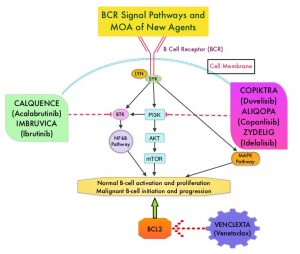
The pro-survival (anti-apoptotic) protein BCL2 is over expressed by CLL cells and regulates clonal selection and cell survival. A new class of anticancer agents known as BH3-mimetic drugs mimic the activity of the physiologic antagonists of BCL2 and related proteins and promote apoptosis (programmed cell death). VENCLEXTA® is a second generation, oral, selective, small molecule inhibitor of BCL2 and restores the apoptotic processes in tumor cells.BCR-Signal-Pathways-and-MOA-of-New-Agents

CLL14 Trial is a prospective, multicenter, open-label, randomized Phase III study conducted in close collaboration with the German CLL Study Group (DCLLSG). This study was designed to evaluate the efficacy and safety of a fixed duration combination of VENCLEXTA® and GAZYVA® (Obinutuzumab) versus GAZYVA® and Chlorambucil in previously-untreated patients with CLL and coexisting medical conditions. In this trial, 432 treatment-naïve patients with CLL were randomized in a 1:1 ratio to receive fixed duration of 12 months of VENCLEXTA® in combination with six cycles of GAZYVA®, or 6 cycles of GAZYVA® in combination with Chlorambucil. Both treatment groups were well balanced and the median patient age was 72 years. The Primary endpoint was Progression Free Survival (PFS) assessed by an Independent Review Committee. Secondary endpoints included Minimal Residual Disease (MRD) status, Overall Response Rate, Complete Response, Complete Remission with Incomplete Hematologic Recovery (CRi), Overall Survival, duration of response, Time to Next CLL Treatment, and safety.

The median PFS was not reached in either treatment groups after a median follow-up of 28 months. The trial demonstrated a statistically significant improvement in PFS for patients who received VENCLEXTA® plus GAZYVA®, compared with those who received GAZYVA® plus Chlorambucil (HR 0.33; P<0.0001), suggesting a 67% reduction in the risk of progression or death with the VENCLEXTA® plus GAZYVA® combination. The Overall Response Rate was 85% in VENCLEXTA® plus GAZYVA® group compared to 71% in GAZYVA® plus Chlorambucil group (P=0.0007). Based on this data, the FDA in May 2019 approved VENCLEXTA® (Venetoclax) as frontline treatment for adult patients with Chronic Lymphocytic Leukemia or Small Lymphocytic Lymphoma (SLL).

The authors in this presentation provided updated efficacy and safety data from the ongoing follow up of the CLL14 study, with all patients off study treatment for at least 3 years. After a median follow-up of 52.4 months, PFS continued to be superior for VENCLEXTA® plus GAZYVA® group, compared to GAZYVA® plus Chlorambucil (median Not Reached versus 36.4 months; HR=0.33 P<0.0001). At 4 years after randomization, the estimated PFS rate was 74.0% in the VENCLEXTA® plus GAZYVA® arm and 35.4% in the GAZYVA® plus Chlorambucil arm. This benefit was noted across all clinical and biological risk groups, including patients with TP53 mutation/deletion (4-year PFS 53.0% versus 20.8%) and unmutated IGHV status (4-year PFS 68.0% versus 19.8%). Time to Next Treatment was significantly longer in the VENCLEXTA® plus GAZYVA® group, compared to GAZYVA® plus Chlorambucil group (4-year TTNT 81.1% versus 59.9%; HR=0.46, P<0.0001). Further, majority of patients received and responded to BTK inhibitor monotherapy as a second-line treatment after progressive disease in both the treatment groups.

Assessment of MRD in peripheral blood 30 months after the end of treatment showed that 26.9% of patients in the VENCLEXTA® group still had undetectable MRD (less than 10-4), compared with 3.2% in the GAZYVA® plus Chlorambucil group. The median OS has not yet been reached in either treatment groups. No new safety signals were observed.

It was concluded that the fixed duration combination of VENCLEXTA® plus GAZYVA® continued to confer a PFS advantage over GAZYVA® plus Chlorambucil, for patients with previously untreated CLL, and remains an effective treatment for all patients with CLL and with coexisting conditions.

Venetoclax-obinutuzumab for previously untreated chronic lymphocytic leukemia: 4-year follow-up analysis of the randomized CLL14 study. Al-Sawaf O, Zhang C, Robrecht S, et al. Presented at: European Hematology Association 2021 Virtual Congress; June 9-17, 2021. Abstract S146.

Stereotactic Ablative Radiotherapy Non-Inferior to Surgery in Operable Stage I Non Small Cell Lung Cancer

SUMMARY: The American Cancer Society estimates that for 2021, about 235,760 new cases of lung cancer will be diagnosed and 131,880 patients will die of the disease. Lung cancer is the leading cause of cancer-related mortality in the United States. Non-Small Cell Lung Cancer (NSCLC) accounts for approximately 85% of all lung cancers. Of the three main subtypes of NSCLC, 30% are Squamous Cell Carcinomas (SCC), 40% are Adenocarcinomas and 10% are Large Cell Carcinomas. With changes in the cigarette composition and decline in tobacco consumption over the past several decades, Adenocarcinoma now is the most frequent histologic subtype of lung cancer. Approximately 15% of patients present with early stage (T1-2 N0) disease, and these numbers are likely to increase with the implementation of Lung Cancer screening programs. Patients with early stage disease unless medically unfit, undergo surgical resection with a curative intent. Those who are not surgical candidates are often treated with conventional Radiation Therapy, over a period of 4 to 6 weeks.

Dating back to the 1930’s, the only hope for curing lung cancer has been surgery. However, important advances in the field of medical physics, computer science, and engineering have enabled significant progress in the field of Radiation Oncology, by better targeting the tumor and escalating the daily treatment doses. Surgery for Stage I NSCLC is now being challenged by these new Radiation Therapy techniques.

Stereotactic Ablative Radiotherapy (SABR) is a non-surgical procedure that allows delivery of significantly higher doses of precisely focused radiation to the tumor, compared to conventional Radiation Therapy, with less collateral damage to the surrounding normal tissue. The technologies used for SABR include GAMMA KNIFE® which uses highly focused gamma rays, Proton Beam therapy which uses ionized Hydrogen or Protons, Linear Accelerator (LINAC) and CYBER KNIFE® which use Photons, to target the tumor tissue. Because SABR is fractionated and delivered over 1-5 days, the short-and long-term side effects of radiation therapy are decreased and may allow higher total dosage to be given.

In a previously published pooled analysis of two independent, randomized, Phase III trials of SABR in patients with operable, clinical T1–2a (<4 cm), N0M0, Stage I NSCLC (STARS and ROSEL), Overall Survival (OS) was higher after Stereotactic Ablative Radiotherapy (SABR) than with surgery. This analysis had notable limitations and was closed early due to slow accrual. In the present study, the SABR group in the STARS trial was re-accrued with a larger sample size and the authors reported long-term results of the revised STARS trial, along with a protocol-specified propensity-matched comparison with a prospectively registered, contemporary institutional cohort of patients, who underwent Video-Assisted Thoracoscopic Surgical Lobectomy with Mediastinal Lymph Node Dissection (VATS L-MLND).

This single-arm prospective trial done at the University of Texas MD Anderson Cancer Center did not include patients from the previous pooled analysis and enrolled 80 patients (N=80) with newly diagnosed and histologically confirmed NSCLC with N0M0 disease (squamous cell, adenocarcinoma, large cell, or NSCLC not otherwise specified), and a tumor diameter of 3 cm or less. SABR dosing for peripheral lesions was 54 Gy in three fractions and 50 Gy in four fractions for central tumors, with simultaneous integrated boost to gross tumor totaling 60 Gy.

For the propensity-matching analysis, the researchers used a surgical cohort from the MD Anderson Department of Thoracic and Cardiovascular Surgery’s prospectively registered, institutional review board-approved database of all patients with clinical Stage I NSCLC who underwent VATS L-MLND during the period of enrolment in this trial. Propensity matching consisted of determining a propensity score using a several covariates such as age, tumor size, histology, Performance Status, and the interaction of age and sex. The Primary endpoint was the 3-year Overall Survival. Non-inferiority could be claimed if the 3-year Overall Survival rate after SABR was lower than that after VATS L-MLND by 12% or less and the upper bound of the 95% CI of the Hazard Ratio (HR) was less than 1.965.

At a median follow-up time was 5.1 years, the OS with SABR was 91% at 3 years and 87% at 5 years. The OS in the propensity-matched VATS L-MLND cohort was 91% at 3 years and 84% at 5 years. Non-inferiority was claimed since the 3-year OS after SABR was not lower than that observed in the VATS L-MLND group. There was no significant difference in OS between the two patient cohorts from a multivariable analysis (HR=0.86; P=0•65). SABR was well tolerated with no Grade 4-5 toxicities.

It was concluded from this study that long term survival after SABR is non-inferior to VATS L-MLND for operable Stage IA Non Small Cell Lung Cancer. SABR remains promising for this patient group and the authors strongly recommend a multidisciplinary management approach .

Stereotactic ablative radiotherapy for operable stage I non-small-cell lung cancer (revised STARS): long-term results of a single-arm, prospective trial with prespecified comparison to surgery. Chang JY, Mehran RJ, Feng L, et al. Lancet Oncol. 2021;22:1448-1457.

Chemoradiotherapy Followed by Consolidation Chemotherapy as Total Neoadjuvant Therapy in Locally Advanced Rectal Cancer

SUMMARY: The American Cancer Society estimates that 45,230 new cases of rectal cancer will be diagnosed in the US in 2021. Based on the information from the SEER database, the 5-year relative survival rates for rectal cancer, all SEER stages combined is 67%.

Management of invasive locally advanced rectal cancer (LARC), defined as Stage II (T3-4, N0) or Stage III (T1-4, N+) disease, mandates a multidisciplinary approach, and neoadjuvant chemoradiation therapy (CRT) followed by Total Mesorectal Excision (TME) and adjuvant chemotherapy is often recommended , whereas standard therapy for early-stage lesions involves surgery with or without adjuvant chemoradiation. The trimodality treatment approach was established as the standard of care for LARC based on the findings from the landmark German trial. Preoperative neoadjuvant CRT decreased the local recurrence rate (7.1% vs 10.1%; P=.048) and was associated with lower rates of treatment-related toxicity. Long course Radiation Therapy (RT) remains the preferred approach in the United States, with short course RT as an alternative in selected patients. With regards to chemotherapy, 4 months of adjuvant systemic chemotherapy following 2 months of Fluoropyrimidine-based chemotherapy with concurrent RT and surgery, is the recommended guideline by the National Comprehensive Cancer Network.

Even though the current standard of care for LARC have demonstrated a significant decrease in local recurrence rates from 25% to less than 10%, the high rates of distant relapse of approximately 30% indicate that there is a need for the further optimization of treatment sequencing. Patients with rectal cancer should undergo accurate staging with MRI, as this can better determine the proximity of the primary tumor to the mesorectal fascia, the presence of extramural vascular invasion, and involvement of the extramesorectal pelvic lymph nodes and anterior peritoneal reflection, compared to endoscopic rectal ultrasound (ERUS).

More recently, optimizing the delivery of trimodality treatment by intensifying neoadjuvant treatment has gained popularity. This strategy called Total Neoadjuvant Therapy (TNT) involves moving chemotherapy from the postoperative (adjuvant) to the preoperative setting. The potential benefits of TNT include earlier administration of full doses of systemic treatment with fewer adverse events and better compliance, assessment of the tumor response after neoadjuvant therapy, down staging tumors to increase the likelihood of pathological Complete Response (pCR) and complete resection, opportunities for the selective omission of Radiation Therapy (RT) and potential nonoperative management through a Watch and Wait strategy. Further, earlier administration of uninterrupted systemic chemotherapy can potentially eradicate occult micrometastases and help assess chemosensitivity.

For patients receiving TNT, the optimal sequence of induction chemotherapy followed by ChemoRadiotherapy (CRT) versus CRT followed by consolidation chemotherapy, before Total Mesorectal Excision surgery, has remained unclear. Only two randomized trials, the Organ Preservation in Rectal Adenocarcinoma (OPRA) in the US, and the German Randomized Phase II Trial of Chemoradiotherapy Plus Induction or Consolidation Chemotherapy as Total Neoadjuvant Therapy for Locally Advanced Rectal Cancer (CAO/ARO/AIO-12), have investigated this approach.

The CAO/ARO/AIO-12 is a multicenter, randomized, Phase II trial, which included 306 eligible patients with rectal adenocarcinoma, up to 12 cm above the anal verge based on rigid rectoscopy. Enrolled patients had either clinical T3 tumor less than 6 cm from the anal verge, clinical T3 tumor in the middle third of the rectum (6 cm or more, up to 12 cm) with extramural tumor spread into the mesorectal fat of more than 5 mm (more than clinical T3b), clinical T4 tumors, or lymph node involvement, based on MRI. All enrolled patients had a CT of the chest and abdomen to exclude distant metastases.

Patients were randomly assigned to either Group A (N=156) for induction chemotherapy before CRT, or to Group B (N=150) for consolidation chemotherapy after CRT. Radiation therapy consisted of IMRT to the primary tumor and to mesorectal, presacral, and internal iliac lymph nodes, to a total dose of 50.4 Gy in 28 fractions. Concurrent chemotherapy with radiotherapy consisted of Fluorouracil 250 mg/m2 IV as a Continuous Infusion on days 1 thru 14 and days 22 thru 35, along with Oxaliplatin 50 mg/m2 IV, given as a 2-hour infusion on days 1, 8, 22, and 29 of radiotherapy. Induction and consolidation chemotherapy consisted of Oxaliplatin 100 mg/m2 IV, as a 2-hour infusion, followed by a Leucovorin 400 mg/m2 IV, given as a 2-hour infusion, followed by Fluorouracil 2400 mg/m2 IV, given as a continuous 46-hour infusion and repeated on day 15, for a total of 3 cycles. All patients underwent Total Mesorectal Excision (TME) independent of tumor response on approximately day 123 after initiation of TNT. Adjuvant chemotherapy after TME was not recommended. The Primary end point was pathological Complete Response (pCR) and Secondary end points included Disease Free Survival (DFS), cumulative incidence of locoregional recurrence and distant metastases, Overall Survival (OS), chronic toxicities, Quality of Life and stool incontinence.

The authors first reported the results of this study in 2019, and it was shown that up-front CRT followed by consolidation chemotherapy resulted in a higher pCR (25% versus 17%; combined pCR and clinical Complete Response 28% versus 21%).The rates of CRT-related Grade 3 or 4 toxicity were lower in the consolidation chemotherapy group (27% versus 37%) and compliance with CRT was better. However, compliance with chemotherapy was worse in the consolidation chemotherapy group than in the induction chemotherapy group.

The researchers in this publication presented long-term outcomes of this trial, including the secondary outcomes of DFS, chronic toxicity, Quality of Life (QoL), and stool incontinence. After a median follow-up of 43 months, the 3-year DFS was 73% in both groups (HR=0.95; P=0.82). The 3-year cumulative incidence of locoregional recurrence (6% versus 5%) and distant metastases (18% versus 16%) were not significantly different between the two treatment groups. At 3 years, chronic Grade 3-4 toxicities occurred in 11.8% of patients in group A and 9.9% of patients in group B. The Quality of Life score decreased after Total Mesorectal Excision but returned to pretreatment levels 1 year after randomization with no difference between the treatment groups. Stool incontinence deteriorated one year after randomization in both groups and only improved slightly at 3 years, but never reached baseline levels.

It was concluded from the secondary analysis of this randomized trial that CRT followed by chemotherapy before TME resulted in higher pathological Complete Response, without compromising DFS, toxicity, QoL, or stool incontinence. Based on these findings, the authors proposed that CRT followed by consolidation chemotherapy is the preferred Total Neoadjuvant Therapy sequence, if organ preservation is a priority.

Chemoradiotherapy Plus Induction or Consolidation Chemotherapy as Total Neoadjuvant Therapy for Patients With Locally Advanced Rectal Cancer: Long-term Results of the CAO/ARO/AIO-12 Randomized Clinical Trial. Fokas E, Schlenska-Lange A, Polat B, et al. for the German Rectal Cancer Study Group. JAMA Oncol. Published online November 18, 2021. doi:10.1001/jamaoncol.2021.5445.