Ovarian Ablation or Suppression May Lower the Risk of Breast Cancer Recurrence

SUMMARY: Breast cancer is the most common cancer among women in the US and about 1 in 8 women (12%) will develop invasive breast cancer during their lifetime. It is estimated that approximately 300,590 new cases of breast cancer will be diagnosed in 2023 and about 43,700 individuals will die of the disease, largely due to metastatic recurrence. Breast cancer is the second leading cause of cancer death in women, in the U.S. About 70% of breast tumors express Estrogen Receptors and/or Progesterone Receptors, and HR-positive/HER2-negative breast cancer is the most frequently diagnosed molecular subtype. About 90% of all breast cancers are detected at an early stage, and these patients are often cured with a combination of surgery, radiotherapy, chemotherapy, and hormone therapy.

It has been hypothesized that estrogen in breast cancer acts as a catalyst/promoter for cancer growth, by stimulating the division and proliferation of breast tissue and increasing the risk for cancer causing mutations. A recently published study (Nature 2023;618:1024–1032) suggests that estrogen might be involved in the genomic reshuffling that gave rise to cancer-gene activation in breast cancer, acting as an initiator as well.

The researchers in this study postulated that suppressing ovarian function of women with breast cancer may improve outcome by preventing estrogenic stimulation of any residual/microscopic cancer, particularly among pre-menopausal women with Estrogen Receptor (ER)-positive tumors. To further clarify this benefit, the researchers from the Early Breast Cancer Trialists’ Collaborative Group (EBCTCG) conducted a patient-level meta-analysis of 14,993 pre-menopausal women in 25 randomized trials, that compared ovarian ablation or suppression with no ovarian ablation or suppression. Primary analyses included only premenopausal women age less than 55 years, with ER-positive or unknown tumors, stratified into those who received no chemotherapy, or remained premenopausal following chemotherapy, and those whose menopausal status following chemotherapy was not ascertained.

The following observations were noted from this meta-analysis:

Fewer breast cancer recurrences were seen overall with ovarian ablation/suppression than control (RR=0.82, P< 0.0001).

• Among women receiving no chemotherapy or remaining premenopausal after chemotherapy (N=7,213), similar benefits were seen and the reduction in recurrent breast cancer was significant with ovarian ablation/suppression than control. The breast cancer recurrence rate at 15 years was 39.3% in the control group versus 29.5% in the ovarian ablation or suppression group, with an absolute benefit of 9.8% and a Rate Ratio (RR) of 0.71 (P<0.0001).

Breast cancer mortality and all-cause mortality in the ovarian ablation or suppression group at 15 years, were improved by 8.0% (20.9% versus 28.9%; RR 0.69, P<0.0001) and 7.2% (26.0% versus 33.1%; RR = 0.73, P< 0.0001), respectively, with no increase in deaths without recurrence (RR = 0•88, P=0.33).

• Among those women who were premenopausal before chemotherapy and whose menopausal status was uncertain after chemotherapy (N=7,786), the rate of recurrence at 15 years was 43.1% in those who received ovarian ablation/suppression and 44.4% in the control group (RR=0.91; P =0.03).

Recurrence reductions were significantly larger among premenopausal women under 45 years, than among those 45-54 years, and did not differ significantly by tumor characteristics. Among premenopausal women under 45 years (N=4,437), the recurrence rate was 41.3% in the control group and 30.4% with ovarian ablation or suppression, representing a 15-year benefit of 10.9% and a Rate Ratio of 0.66 (P<0.00001). Among those women 45-54 years (N=2,776), the recurrence rate was 36.1% in the control group and 28.6% with ovarian ablation or suppression, suggesting a 15-year benefit of 7.5% and Rate Ratio of 0.82 (P=0.02).

• Among those taking Tamoxifen, the benefit with ovarian ablation or suppression was less, and was only 4.5% (RR = 0.80; P =0.002).

The authors concluded that ovarian ablation or suppression in pre-menopausal women less than 45 years with ER-positive breast cancer, substantially reduces the 15-year risk of recurrence and death from breast cancer, without increasing mortality from other causes.

Effects of ovarian ablation or suppression on breast cancer recurrence and survival: Patient-level meta-analysis of 14,993 pre-menopausal women in 25 randomized trials. Gray RG, Bradley R, Braybrooke J, et al. J Clin Oncol 41, 2023 (suppl 16; abstr 503)

FDA Approves Quizartinib for Newly Diagnosed Acute Myeloid Leukemia

SUMMARY: The FDA on July 20, 2023 approved Quizartinib (VANFLYTA®) with standard Cytarabine and Anthracycline induction and Cytarabine consolidation, and as maintenance monotherapy following consolidation chemotherapy, for the treatment of adult patients with newly diagnosed Acute Myeloid Leukemia (AML) that is FLT3 Internal Tandem Duplication (ITD)-positive, as detected by an FDA-approved test. FDA also approved LeukoStrat CDx FLT3 Mutation Assay as a companion diagnostic for Quizartinib.

The American Cancer Society estimates that in 2023, 20,380 new cases of Acute Myeloid Leukemia (AML) will be diagnosed in the United States and 11,310 patients will die of the disease. AML is one of the most common types of leukemia in adults and can be considered as a group of molecularly heterogeneous diseases with different clinical behavior and outcomes. A significant percentage of patients with newly diagnosed AML are not candidates for intensive chemotherapy, or have disease that is refractory to standard chemotherapy. Even with the best available therapies, the 5-year Overall Survival in patients 65 years of age or older is less than 5%. Cytogenetic analysis has been part of routine evaluation when caring for patients with AML. By predicting resistance to therapy, tumor cytogenetics will stratify patients based on risk, and help manage them accordingly. Even though cytotoxic chemotherapy may lead to long term remission and cure in a minority of patients with favorable cytogenetics, patients with high-risk features such as unfavorable cytogenetics, molecular abnormalities, prior myelodysplasia, and advanced age, have poor outcomes with conventional chemotherapy alone. More importantly, with the understanding of molecular pathology of AML, personalized and targeted therapies are becoming an important part of the AML treatment armamentarium.

The Fms-Like Tyrosine kinase 3 (FLT3) protein is a receptor tyrosine kinase in the PDGF family of growth factor receptors located on the hematopoietic stem cell surface (transmembrane). FLT3 normally promote cell survival, growth, and differentiation. FLT3 plays an important role in both normal and malignant hematopoiesis by activating key signaling pathways. Activating mutations in the FLT3 receptor is the most common genetic abnormality in AML. Approximately 25% of patients with newly diagnosed AML have FLT3-ITD mutations and approximately 7% have point mutations in the Tyrosine Kinase Domain (TKD). FLT3-ITD (Internal Tandem Duplication) mutation is caused by tandem duplication within the coding region of the gene. The presence of FLT3-ITD mutations can negate the benefit of any other favorable molecular and cytogenetic features. Patients with FLT3-ITD mutations have poor outcomes with shorter remission duration and significantly decreased Leukemia Free and Overall Survival.

Quizartinib is an oral, highly potent, selective, Type 2 FLT3 inhibitor. This agent in combination with chemotherapy showed antitumor activity with an acceptable safety profile in patients with FLT3-ITD-positive newly diagnosed AML.

QuANTUM-First is a randomized, double-blind, placebo controlled, global, Phase III trial in which the efficacy of Quizartinib with chemotherapy was evaluated in patients with newly diagnosed FLT3-ITD positive AML aged 18–75 years. In this study, 539 patients (N=539) with newly diagnosed FLT3-ITD positive AML were randomly assigned 1:1 to receive chemotherapy plus Quizartinib (N=268) or placebo (N=271). Treatment consisted of induction with standard 7 plus 3 induction regimen of Cytarabine 100 mg/m2 daily (or 200 mg/m2 daily per institutional standard) by continuous IV from Days 1-7 and anthracycline (Daunorubicin 60 mg/m2 daily or Idarubicin 12 mg/m2 daily, by IV infusion on Days 1, 2, and 3, then Quizartinib 40 mg orally or placebo once daily, starting on day 8, for 14 days. Patients in complete remission or complete remission with incomplete neutrophil or platelet recovery received standard consolidation with high-dose Cytarabine plus Quizartinib (40 mg orally daily) or placebo, allo- Hematopoietic Stem Cell Transplantation (HSCT), or both as consolidation therapy, followed by continuation of single-agent Quizartinib or placebo for up to 3 years. There was no re-randomization at the initiation of post-consolidation therapy. Patients who proceeded to HSCT initiated maintenance therapy after HSCT recovery. FLT3-ITD status was determined prospectively with a clinical trial assay and verified retrospectively with the companion diagnostic LeukoStrat CDx FLT3 Mutation Assay. This study included patients aged 18 to 75 years, 55% male and 45% female, with newly diagnosed primary or secondary AML harboring a FLT3-ITD activating mutation, with an allelic ratio of 3% or more. The median age was 56 years. The aim of this study was to assess the effect of Quizartinib versus placebo on Overall Survival in patients with FLT3-ITD-positive newly diagnosed AML. The Primary end point of the trial was Overall Survival (OS). Secondary end points included Event-Free Survival (EFS), post induction rates of Complete Remission (CR) rate, composite CR (CRc) rate, Safety, and pharmacokinetics.

At a median follow up of 39.2 months, the median Overall Survival was 31.9 months for Quizartinib versus 15.1 months for placebo (HR=0.78; P=0.032), a 22% reduction in the risk of death. The CR rate in the Quizartinib group was 55%, with median response duration of 38.6 months, whereas the CR rate in those receiving placebo was 55% with median response duration of 12.4 months. Approximately 42% of patients treated with Quizartinib versus 38% treated with placebo were MRD negative at the time of Complete Remission or Complete Remission with incomplete neutrophil or platelet recovery. However, patients in both groups who were MRD negative had improved Overall Survival (HR 0.57), compared with those who remained MRD positive. The most common Grade 3 or 4 adverse events were febrile neutropenia, hypokalaemia, and pneumonia in both groups, and neutropenia in the Quizartinib group.

It was concluded that the addition of Quizartinib to standard chemotherapy with or without allo-HSCT, followed by continuation monotherapy for up to 3 years, resulted in improved Overall Survival in adults patients with FLT3-ITD-positive newly diagnosed AML, and provides a new, effective, and generally well tolerated treatment option for this patient group. The authors added that this is the first time a FLT3 inhibitor was studied in patients aged 18-75 years and is specifically approved for patients who have the worst FLT3 mutation, the ITD mutation.

Quizartinib plus chemotherapy in newly diagnosed patients with FLT3-internal-tandem-duplication-positive acute myeloid leukaemia (QuANTUM-First): a randomised, double-blind, placebo-controlled, phase 3 trial. Erba HP, Montesinos P, Kim H-J, et al. on behalf of the QuANTUM-First Study Group. The Lancet 2023;401:1571-1583.

Late Breaking Abstract – ASCO 2023: Chemotherapy De-escalation using PET Response-Adapted Strategy in Patients with HER2-positive Early Breast Cancer

SUMMARY: Breast cancer is the most common cancer among women in the US and about 1 in 8 women (12%) will develop invasive breast cancer during their lifetime. It is estimated that approximately 300,590 new cases of breast cancer will be diagnosed in 2023 and about 43,700 individuals will die of the disease, largely due to metastatic recurrence. Breast cancer is the second leading cause of cancer death in women, in the U.S.

The HER or erbB family of receptors consist of HER1, HER2, HER3 and HER4. Approximately 15-20% of invasive breast cancers overexpress HER2/neu oncogene, which is a negative predictor of outcomes without systemic therapy. Adjuvant and neoadjuvant chemotherapy given along with anti-HER2 targeted therapy reduces the risk of disease recurrence and death, among patients with HER2-positive, early stage, as well as advanced metastatic breast cancer.

Trastuzumab is a humanized monoclonal antibody targeting HER2. It binds to the extracellular subdomain IV of the receptor and disrupts ligand independent HER2 downstream cell signaling pathways. Pertuzumab is a recombinant, humanized, monoclonal antibody that binds to the HER2 subdomain II and blocks ligand dependent HER2 heterodimerization with other HER receptors. Thus Trastuzumab along with Pertuzumab provide a more comprehensive blockade of HER2 driven signaling pathways. Dual HER2 blockade with Trastuzumab and Pertuzumab, given along with chemotherapy (with or without endocrine therapy), as first line treatment, in HER2 positive metastatic breast cancer patients, was shown to significantly improve Progression Free Survival (PFS) as well as Overall Survival (OS). The superior benefit with dual HER2 blockade has been attributed to differing mechanisms of action and synergistic interaction between HER2 targeted therapies.

Pathological Complete Response (pCR) after neoadjuvant therapy has strong prognostic significance in HER2+ breast cancer, and pCR rates in HER2+/HR- negative tumors exceed those in HER2+/HR+ tumors, and this in turn correlates with superior Event Free Survival. The FDA approved anti-HER2 dual blockade with Pertuzumab and Trastuzumab, given along with chemotherapy for the neoadjuvant treatment of patients with HER2-positive, locally advanced, inflammatory, or early stage breast cancer, based on the NeoSphere trial, and for metastatic disease based on positive survival results in the CLEOPATRA trial. The role of chemotherapy free anti-HER2 dual blockade however has remained unclear.

PHERGain is a multinational, multicenter, randomized, open-label, non-comparative, Phase II trial, designed to explore the feasibility of dual HER2 blockade with a chemotherapy de-escalation strategy, using a response-adapted design. This study design allowed the identification of treatment responders earlier in the study, and non-responders were switched to Standard-of-Care treatment. In this study, 356 patients with Stage I-IIIA, invasive, HER2-positive operable breast cancer, with tumor size 1.5 cm or more, and with at least one breast lesion evaluable by FDG-PET, were included. Patients were randomized 1:4 to receive either Docetaxel 75 mg/m2 IV, Carboplatin AUC 6 mg/mL IV, Trastuzumab 600 mg SC given as a fixed dose, and Pertuzumab 840 mg IV given as a loading dose, followed by 420 mg IV maintenance doses (TCHP) – Group A (N=71) or Trastuzumab and Pertuzumab alone (HP) – Group B (N=285). Patients were stratified by Hormone Receptor status and Hormone Receptor-positive patients allocated to Group B were additionally given Letrozole if postmenopausal (2.5 mg/day orally) or Tamoxifen if premenopausal (20 mg/day orally). Centrally reviewed FDG-PET scans were done before randomization and after two treatment cycles. Patients assigned to Group A completed six cycles of treatment (given every 3 weeks) regardless of FDG-PET results. Patients assigned to Group B initially received two cycles of Trastuzumab and Pertuzumab. FDG-PET responders (reduction in breast lesions of at least 40% from baseline) in Group B continued this treatment for six additional cycles. FDG-PET non-responders in this group were switched to six cycles of Docetaxel, Carboplatin, Trastuzumab, and Pertuzumab (TCHP). Surgery was performed 2-6 weeks after the last dose of study treatment. Adjuvant treatment was selected according to the neoadjuvant treatment administered, pathological response, hormone receptor status, and clinical stage at diagnosis. The co-Primary endpoints were the proportion of FDG-PET responders in Group B with a pathological Complete Response in the breast and axilla (ypT0/is ypN0), as determined by a local pathologist after surgery, following eight cycles of treatment, as well as 3-year invasive Disease-Free Survival (DFS) of patients in Group B. In an earlier analysis of this study, at a median follow-up was 5.7 months, 80% of the patients in Group B were FDG-PET responders, of whom 38% had a pathological Complete Response, achieving the first Primary endpoint (Perez-Garcia JM, Lancet Oncol 2021).

The researchers herein presented the results of the second Primary endpoint, 3-year invasive DFS, among patients included in Group B who underwent surgery based on an Intent-to-Treat (ITT) analysis. In Group A, 89% proceeded to surgery and 93.7% proceeded to have surgery in Group B. The 3-year invasive DFS among the 80% of patients in Group B who were FDG-PET responders was 95.4%, meeting the second Primary endpoint (P<0.001). Further, a subgroup analysis showed that of the patients in Group B who were FDG-PET responders and who also achieved a pathological Complete Response (38%), none received chemotherapy at any point in the 3 years they were in the study. These patients had a 3-year invasive DFS of 98.8%, and only one patient experienced invasive event (locoregional ipsilateral recurrence).
As expected, treatment-related Adverse Events and serious Adverse Events were significantly higher in patients assigned to Group A than to Group B, and Group B patients with pathological Complete Response had the lowest incidence of Grade 3 or more Adverse Events.

The authors concluded that among patients with HER2-positive early operable breast cancer, a PET-based, pathological Complete Response-adapted strategy was associated with a substantial 3-year invasive Disease Free Survival. The authors added that this treatment approach identifies about a third of HER2-positive early breast cancer patients who may safely omit chemotherapy and avoid the risk of treatment-related toxicities.

3-year invasive disease-free survival (iDFS) of the strategy-based, randomized phase II PHERGain trial evaluating chemotherapy (CT) de-escalation in human epidermal growth factor receptor 2-positive (HER2[+]) early breast cancer (EBC). Cortes J, Pérez-García JM, Ruiz-Borrego M, J Clin Oncol 41, 2023 (suppl 17; abstr LBA506)

Late Breaking Abstract – ASCO 2023: Tumor Treating Fields Plus Standard of Care Improves Overall Survival in Patients with Metastatic Non-Small Cell Lung Cancer

SUMMARY: Lung cancer is the second most common cancer in both men and women and accounts for about 13% of all new cancers and 21% of all cancer deaths. The American Cancer Society estimates that for 2023, about 238,340 new cases of lung cancer will be diagnosed and 127,070 patients will die of the disease. Lung cancer is the leading cause of cancer-related mortality in the United States. Non-Small Cell Lung Cancer (NSCLC) accounts for approximately 85% of all lung cancers. Of the three main subtypes of NSCLC, 30% are Squamous Cell Carcinomas (SCC), 40% are Adenocarcinomas and 10% are Large Cell Carcinomas. With changes in the cigarette composition and decline in tobacco consumption over the past several decades, Adenocarcinoma now is the most frequent histologic subtype of lung cancer.

Tumor Treating Fields (TTFields) delivery system is a non-invasive novel external therapeutic device that slows and reverses tumor growth by disrupting mitosis. The battery operated portable at-home TTF delivery system generates low intensity, intermediate frequency, alternating electrical fields delivered locoregionally to the tumors through 2 pairs of arrays applied to the chest. These electrical fields exert selective toxicity in dividing cells by interfering with organelle assembly in the cell and thereby facilitates apoptosis (programmed cell death), by preventing cell division. The non-dividing cells are not affected by these electrical fields. Patients wear the device for at least 18 hours a day and for at least four weeks. Currently, TTF therapy is approved for Glioblastoma and Malignant Pleural Mesothelioma. Preclinical NSCLC studies have shown that TTFields enhance the antitumor immune response, through disruption of mitosis and subsequent induction of immunogenic cell death. Further, TTFields synergize with taxanes and Immune Checkpoint Inhibitors (ICIs). This was the rationale for the development and design of the LUNAR Phase III trial.

The LUNAR study is a global, randomized, Phase III trial in which the safety and efficacy of Tumor Treating Fields therapy with Standard of Care, was compared to Standard of Care alone, in patients with metastatic Non Small Cell Lung Cancer (NSCLC), who had progression on or after Platinum-based chemotherapy. In this study, 276 eligible patients (N=276) were randomized 1:1 to receive either Tumor Treating Fields therapy (150 kHz) plus Standard of Care, which included investigator’s choice of an Immune Checkpoint Inhibitor (ICI) or Docetaxel, or Standard of Care alone. To be eligible for this study, patients had to be 22 years or older, have metastatic NSCLC, should have progressed on or after a platinum-based therapy, and have an ECOG performance status of 0-2. Both treatment groups were well balanced. The median age was 64 years, 65% were male, 96% of patients had an ECOG PS of 0-1, 56% had non-squamous histology, 89% had one prior line of systemic therapy and 31% received prior therapy with ICI. Patients were followed every 6 weeks and continued on therapy until disease progression or intolerable toxicities. The Primary endpoint was Overall Survival (OS). Secondary endpoints included were OS in ICI and Docetaxel subgroups, Progression Free Survival (PFS) and toxicities.

This study met its Primary end point of Overall Survival and OS was significantly extended with Tumor Treating Fields therapy plus Standard of Care versus Standard of Care. After a minimum follow up of 12 months, the median Overall Survival with Tumor Treating Fields therapy plus Standard of Care was 13.2 months versus 10.0 months with Standard of Care alone (HR=0.74; P=0.037) and 1-year survival rates were 53% and 42% respectively (P=0.040). In patients receiving an Immune Checkpoint Inhibitor (N=134), the addition of Tumor Treating Fields therapy significantly improved median OS versus ICI alone (18.5 months versus 10.6 months; HR=0.63; P=0.032). In those patients treated with Docetaxel, the median OS was numerically higher at 11.1 months with Tumor Treating Fields therapy plus Docetaxel versus 8.9 months with Docetaxel alone (HR=0.87). There was no significant difference in the median PFS between the two treatment groups and were 4.8 months and 4.1 months respectively. The rate of Adverse Events was similar between the treatment groups and majority of the Tumor Treating Fields associated toxicities were Grade 1 and 2 local skin irritations.

The authors concluded that in this Phase III study, the addition of Tumor Treating Fields therapy to Standard of Care therapy significantly extended Overall Survival in patients with metastatic NSCLC following platinum failure, without increasing systemic toxicities, and Tumor Treating Fields therapy may be a potentially paradigm-shifting new treatment modality.

Tumor treating fields (TTFields) therapy with standard of care (SOC) in metastatic non-small cell lung cancer (mNSCLC) following platinum failure: Randomized phase 3 LUNAR study. Leal T, Kotecha R, Ramlau R, et al. J Clin Oncol 41, 2023 (suppl 17; abstr LBA9005)

Late Breaking Abstract – ASCO 2023: Biomarker-Driven ELAHERE® Improves Survival in Platinum-Resistant Ovarian Cancer

SUMMARY: It is estimated that in the United States, approximately 19,710 women will be diagnosed with ovarian cancer in 2023, and 13,270 women will die of the disease. Ovarian cancer ranks fifth in cancer deaths among women, and accounts for more deaths than any other cancer of the female reproductive system. Approximately 75% of the ovarian cancer patients are diagnosed with advanced disease. About 85% of all ovarian cancers are epithelial in origin, and 70% of all epithelial ovarian cancers are High-Grade serous adenocarcinomas. Patients with newly diagnosed advanced ovarian cancer are often treated with platinum-based chemotherapy following primary surgical cytoreduction. Approximately 70% of these patients will relapse within the subsequent 3 years and are incurable, with a 5-year Overall Survival (OS) rate of about 20-30%. Treatment options for patients with platinum-resistant ovarian cancer are limited, and patients are often treated with single-agent chemotherapy, with an Overall Response Rate (ORR) of between 4% and 13%, short duration of response, and significant toxicities.

Approximately 35-40% of ovarian cancer patients express high levels of Folate Receptor alpha (FR alpha), and this expression correlates with advanced stages of disease and more malignant phenotypes. There is limited expression of Folate Receptor alpha in normal tissues and is limited to the choroid plexus, proximal renal tubules, placenta, and endometrium. Testing for Folate Receptor alpha can be performed on fresh or archived tissue.

ELAHERE® (Mirvetuximab soravtansine-gynx) is a first-in-class Antibody Drug Conjugate (ADC), directed against FR alpha, a cell-surface protein highly expressed in ovarian cancer. It is comprised of a Folate Receptor alpha-binding antibody, cleavable linker, and the maytansinoid payload DM4, which is a potent tubulin inhibitor, disrupting microtubule formation, and thereby designed to kill the targeted cancer cells. Microtubules are major components of the cytoskeleton that give shape and structure to cells. ELAHERE® is the first FDA approved ADC for platinum-resistant disease. In the single-arm SORAYA trial, ELAHERE® demonstrated an ORR of 31.7% and median Duration of Response of 6.9 months, in patients with platinum-resistant ovarian cancer and prior Bevacizumab exposure. These response rates were consistently seen regardless of the number of prior therapies or the use of a prior PARP inhibitor. As a result, the FDA in November 2022 granted accelerated approval to ELAHERE®.

MIRASOL is a confirmatory randomized Phase III trial, conducted to evaluate the efficacy and safety of ELAHERE® versus Standard-of-Care chemotherapy, in patients with pretreated, platinum-resistant ovarian, peritoneal, or fallopian tube cancer, whose tumors express high levels of FR alpha. In this study, 453 eligible patients (N=453) were randomized 1:1 to receive ELAHERE® 6 mg/kg (based on adjusted ideal body weight) IV infusion once every three weeks, until disease progression or unacceptable toxicity (N=227), or investigators choice of single-agent chemotherapy – Paclitaxel, Pegylated Liposomal Doxorubicin, or Topotecan (N=226)). Both treatment groups were well balanced. Approximately 13% of patients had BRCA mutations, 14% of patients had one prior line of therapy, 39% had two prior lines and 47% had three prior lines of therapy. About 62% received prior Bevacizumab and 55% received prior therapy with PARP inhibitors. The Primary efficacy endpoint was Progression Free Survival (PFS). Secondary endpoints included Overall Response Rate (ORR), Overall Survival (OS), and Patient-Reported Outcomes in hierarchical order, as well as Safety and tolerability. The median follow up was 13.1 months.

This study met its Primary and key Secondary endpoints with statistically significant improvement in PFS, ORR and OS. The PFS in the ELAHERE® group was 5.62 months compared to 3.98 months in the chemotherapy group (HR=0.65; P<0.0001). The ORR was also higher in the ELAHERE® group at 42% compared with 16% in the chemotherapy group (P<0.0001). The median Overall Survival rate was 16.46 months among patients who received ELAHERE® compared with 12.75 months among those who received single-agent chemotherapy (P=0.0046). The PFS and OS outcomes favored the ELAHERE® group, irrespective of prior exposure to Bevacizumab. Treatment with ELAHERE® was associated with a lower rate of Grade 3 or more Adverse Events and a lower discontinuation rate (9% compared with 16% for the chemotherapy group). The most common adverse reactions including laboratory abnormalities associated with ELAHERE® were vision impairment, keratopathy, fatigue, nausea, peripheral neuropathy, increase in ALT and AST and cytopenias. Product labeling includes a boxed warning for ocular toxicity. The ocular events were reversible and primarily included low-grade blurred vision and keratopathy, which were managed with protocol-defined dose modifications. Approximately 60% of patients with symptoms had resolution prior to their next cycle of treatment, and less than 1% of patients discontinued therapy due to an ocular event.

It was concluded that treatment with ELAHERE® demonstrated a statistically significant improvement in Progression Free Survival and Overall survival, compared to chemotherapy, in patients with platinum-resistant ovarian cancer and high FR alpha expression, independent of Bevacizumab use, and may be the new standard-of-care for this patient group. ELAHERE® is the first FDA-approved Antibody Drug Conjugate and biomarker directed therapy for ovarian cancer, since the approval of PARP inhibitors.

Phase III MIRASOL (GOG 3045/ENGOT-ov55) study: Initial report of mirvetuximab soravtansine vs. investigator’s choice of chemotherapy in platinum-resistant, advanced high-grade epithelial ovarian, primary peritoneal, or fallopian tube cancers with high folate receptor-alpha expression. Moore KN, Angelergues A, Konecny GE, et al. J Clin Oncol 41, 2023 (suppl 17; abstr LBA5507)

Fixed Dose versus Standard Dose Capecitabine in Metastatic Breast Cancer

SUMMARY: Breast cancer is the most common cancer among women in the US and about 1 in 8 women (12%) will develop invasive breast cancer during their lifetime. It is estimated that approximately 300,590 new cases of breast cancer will be diagnosed in 2023 and about 43,700 individuals will die of the disease, largely due to metastatic recurrence. Breast cancer is the second leading cause of cancer death in women, in the U.S. Approximately 70% of breast tumors in patients with metastatic disease are Estrogen Receptor (ER) and/or Progesterone Receptor (PR) positive and HER2-negative. These patients are often treated with single agent endocrine therapy, endocrine therapy in combination with CDK4/6 inhibitor, or single agent chemotherapy. Resistance to hormonal therapy occurs in a majority of the patients.

Capecitabine (XELODA®) is one of the most frequently prescribed chemotherapeutic agents, for the treatment of breast cancer, and patients with metastatic breast cancer often receive Capecitabine following progression on anthracycline and taxane-based therapy. Capecitabine is preferred as it is not associated with alopecia or neuropathy, and can be administered orally. The FDA approved dosing schedule for Capecitabine is 1250 mg/m2 orally twice daily 14 days on, 7 days off. This dosing and schedule however is associated with poor tolerance and high discontinuation rates. Mathematical models suggest that a fixed, dose-dense schedule may be optimal for Capecitabine efficacy.

The X-7/7 is a randomized Phase II study in which the efficacy and tolerability of fixed-dose Capecitabine was compared with standard-dose Capecitabine, in patients with metastatic breast cancer. This study included 153 patients who were randomly assigned in a 1:1 ratio to receive either fixed-dose Capecitabine at 1500 mg orally twice daily, 7 days on followed by 7 days off (N=80) or the FDA approved standard-dose Capecitabine at 1250 mg/m2 twice daily, 14 days on followed by 7 days off (N=73). Female patients with metastatic breast cancer, regardless of the number of prior lines of endocrine therapy or chemotherapy they had received, were included. HER-2 positive patients were allowed with concurrent Trastuzumab. Majority of patients included in this study had Hormonal Receptor (HR)-positive, HER2-negative disease, 11% were HER-2 positive, 11% were triple negative, and 65% of patients were chemotherapy-naïve. Patients were stratified by line of chemotherapy (first line or subsequent), measurable disease, and ER status. The Primary endpoint was 3-month Progression Free Survival (PFS). Additional endpoints included PFS and Overall Survival (OS).

It was noted that the fixed dosing schedule of Capecitabine was associated with less toxicity and similar survival when compared with the standard dosing schedule. The 3-month PFS was similar at 76% in both the fixed-dose group and standard-dose group (HR=1.01; P=0.99). Landmark analysis of PFS at 12, 24 and 36 months for fixed-dose versus standard-dose Capecitabine was 39% versus 50% at 12 months (P=0.23), 25% versus 23% at 24 months (P=0.77), and 11% versus 0% at 36 months (P=0.24), respectively. The restricted mean PFS at 36 months was 13.9 months in the fixed-dose group versus 14.6 months in the standard-dose group (HR=1.31; P=0.24). The restricted mean OS at 36 months was 21.2 months versus 19.6 months, respectively (HR=0.80; P=0.27)

Patients receiving fixed-dose Capecitabine were less likely to experience Grade 2-4 toxicities than those receiving standard-dose Capecitabine (25% versus 49.3%, P=0.0018). Treatment discontinuation due to toxicities was significantly lower with fixed-dose Capecitabine compared with standard-dose Capecitabine (7.5% versus 28.8%, respectively, P<0.0006).

It was concluded that fixed dose Capecitabine 1500 mg orally twice daily 7 days on followed by 7 days off, has less toxicity and may improve tolerability without compromising efficacy, compared to the standard BSA-based dosing 14 days on followed by 7 days off. For patients receiving Capecitabine in an adjuvant setting with a curative intent (e.g. CREATE-X trial), standard BSA-based dosing and schedule is appropriate.

Randomized trial of fixed dose capecitabine compared to standard dose capecitabine in metastatic breast cancer: the X-7/7 tria. Khan QJ, Bohnenkamp C, Monson T, et al. DOI:10.1200/JCO.2023.41.16_suppl.1007 Journal of Clinical Oncology 41, no. 16_suppl (June 01, 2023) 1007-1007.

Clinical Pearls on Abemaciclib

Written by: Debra Patt, MD, PhD, MBA

In our lifetime, the CDK 4/6 inhibitors have improved the quality of life and progression-free survival for patients with estrogen receptor (ER)-positive/human epidermal growth factor 2- (HER2)-negative breast cancer more than any other drug. Giving patients the opportunity for treatment allows them to realize the dream of modern cancer therapy. Over time, these drugs continue to show great promise in the metastatic setting and in high-risk adjuvant breast cancer patients. Understanding their optimal use and managing their toxicity will get us closer to supporting our patients to live well without cancer. This article will address abemaciclib in metastatic breast cancer and also its use in early-stage breast cancer, including the update of FDA guidance and also data including 4-year follow up.

Abemaciclib in Metastatic Breast Cancer

The first CDK4/6 inhibitor palbociclib, was approved by the FDA in 2016, followed by ribociclib and abemaciclib which were approved the following year. These drugs as a class have made a palpable difference in the lives of breast cancer patients. They have not only improved progression-free and overall survival but have also allowed patients with advanced cancer to live with the disease without the burden of highly toxic intravenous chemotherapy. In that way, many patients control their cancer just like hypertension or other chronic illnesses, with pills that have minimal impact on their quality of life.

The three CDK4/6 inhibitors are often discussed comparatively, but we do not yet have direct comparative data, limiting decisions on therapy to our understanding of each of them individually and their efficacy and toxicity profiles.

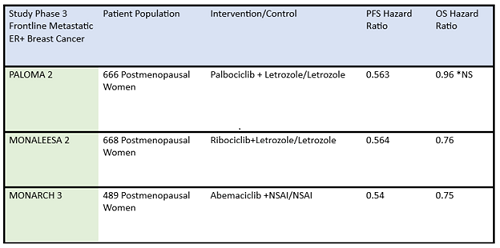
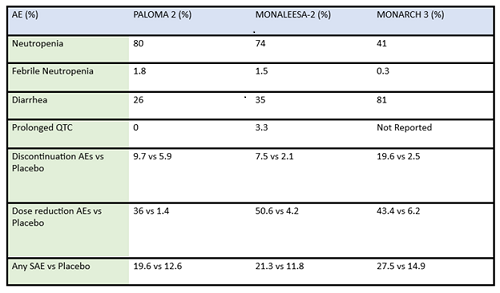
Some differences of importance across the drugs in the metastatic setting are efficacy and toxicity. See Table 1 for the designs of the metastatic trials and their efficacy in comparison to the control arms. In addition, there are important differences in adverse effect profiles, seen in Table 2. It is notable that in the frontline trials, many patients were managed with dose reduction. This is an important point that will be touched upon again and again, that there is no compelling evidence that efficacy is sacrificed when dose reduction is managed to abate toxicity. More specifically, given the absence of data on dose response curves and the high rates of discontinuation due to toxicity, practitioners should be eager to manage symptoms with supportive care medications and dose reduction. Specifically, when we initiate patients on treatment with abemaciclib, they should be followed closely—initially, weekly or every other week—and dose should be reduced rapidly as indicated to manage symptoms. Similarly empowering patients with education and administering anti-diarrheal therapy to manage toxicity with initial prescribing can go a long way to assist in symptom control. Taking these actions up front could prevent early discontinuation of effective therapy.

Table 1: Summary data of efficacy of frontline CDK4/6 inhibitors in postmenopausal ER-positive breast cancer patients.
Frontline-Metastatic-ER-Positive-Breast-Cancer

ER+, estrogen receptor positive; NS, not significant; NSAI, nonsteroidal aromatase inhibitor; OS, overall survival; PFS, progression-free survival
*Paloma 2 hazard ratio for OS was not statistically significant

Table 2: Summary of adverse events (AE) and serious adverse events (SAE) of frontline CDK4/6 inhibitors in post-menopausal ER-positive breast cancer patients
There are some key differences in how CDK4/6 inhibitors are used in the metastatic setting: activity in combination vs as a single agent, penetration of the blood brain barrier, and evidence for benefit from treatment after progressing on another drug in the same class. For example, abemaciclib is FDA approved as a single agent showing activity with doses at 200mg every 12 hours for patients with metastatic ER-positve/HER2-negative breast cancer1. Abemaciclib has activity in the central nervous system, and is included in the ASCO guidelines among the active agents in ER-positive/HER2-amplified breast cancer with brain metastasis2. Abemaciclib may be an effective therapy after treatment with palbociclib, as a recent cohort of 52 patients previously treated with palbociclib exhibited a clinically meaningful benefit from subsequent therapy with abemaciclib3.

Abemaciclib in Adjuvant High-Risk ER-Positive/HER2-Negative Breast Cancer

Observing the success in patients with metastatic breast cancer, we are seeking to understand if treatment is beneficial in earlier lines of therapy. The MONARCH E trial, evaluating the efficacy and safety of abemaciclib in combination with endocrine blockade in patients with node-positive high-risk ER-positive breast cancer, demonstrated an improvement in disease-free survival. This has been a clinically meaningful addition to our armamentarium of treatment, although careful consideration of management is important as early failure to manage adverse effects can lead to early discontinuation. According to the 4-year follow-up data from MONARCH E, the median invasive disease-free survival benefit previously reported of HR=0.664 (95% CI 0.578-0.762, nominal p<0.0001) was persistent and the absolute difference in invasive disease-free survival was 6.4% (85.8% in the endocrine therapy plus abemaciclib arm versus 79.4% in the endocrine only arm). Overall survival did not meet statistical significance, and the adverse effect profile reflected toxicities known to be associated with abemaciclib, including neutropenia, leukopenia, and diarrhea4. Adjuvant abemaciclib was approved by the FDA in 2021 and is currently approved in combination with endocrine therapy (tamoxifen or an aromatase inhibitor) for the adjuvant treatment of adult patients with HR-positive, HER2-negative, node-positive early breast cancer at high risk of recurrence. Of note, in March 2023, the FDA approval was expanded to remove Ki-67 >20% as a qualifying factor for approval. Patients defined as high risk included those having ≥4 pathologically involved axillary lymph nodes or 1-3 axillary lymph nodes and either tumor grade 3 or tumor size >5cm.

Abemaciclib causes GI toxicity in the form of cramping and diarrhea. Frequently, patients are afflicted with this toxicity, and if they are not optimally managed with anti-diarrheal agents and dose reductions, the patients will prematurely discontinue effective therapy. This is a particular problem in the adjuvant patients: they have often already completed systemic chemotherapy, and their therapeutic enthusiasm wanes as they have completed what they often (incorrectly) perceive as the more important part of therapy. Critical attention to symptom management, patient education, and dose reduction are important, as prescribing at the FDA approved dose will sometimes cause intolerable adverse effects, and early dose reduction will likely lead to reduction of adverse effects and improved compliance with the adjuvant treatment strategy. With all of the CDK4/6 inhibitors there is a large amount of inter-individual variability in exposure, yet in contrast to palbociclib and ribociclib, abemaciclib has three active metabolites that all have clinical activity5. As we don’t have a robust amount of clinical data on dose response to abemaciclib, there has been some hesitation among practitioners to implement strategies to manage toxicity early with dose reduction. Anecdotally, some strategies that have been effective in managing adverse effects include giving a smaller allocation of the drug and seeing the patient 1 and 2 weeks out in follow up, quickly reducing the dose, and sometimes even starting at a lower dose initially. In addition, partnering a new therapy regimen with patient education and loperamide to manage adverse effects can assist in helping patients avoid and manage severe toxicity.

The biggest challenge I have anecdotally observed in clinical practice in patients benefitting from adjuvant abemaciclib is that qualifying patients often don’t have it prescribed for them as part of their adjuvant therapy. Adjuvant abemaciclib was approved in 2021 by the FDA, and while adoption does take time, adoption in clinical practice has been variable.

Clinical Take Aways: When prescribing abemaciclib in patients with metastatic breast cancer, patient education, up-front management of diarrhea, and close follow-up for dose modification and symptom management needs are critical. When prescribing abemaciclib in patients with high-risk ER-positive HER2-negative breast cancer, education, close follow-up, dose modification, and prescribing loperamide to accompany the therapy are also important. Above all, be sure to discuss with high-risk patients the opportunity to reduce their risk with appropriate therapy and the importance of therapy adherence in achieving favorable outcomes.

References
1) Dickler MN, Tolaney SM, Rugo HS, Cortés J, Diéras V, Patt D, Wildiers H, Hudis CA, O’Shaughnessy J, Zamora E, Yardley DA, Frenzel M, Koustenis A, Baselga J. MONARCH 1, A Phase II Study of Abemaciclib, a CDK4 and CDK6 Inhibitor, as a Single Agent, in Patients with Refractory HR+/HER2- Metastatic Breast Cancer. Clin Cancer Res. 2017 Sep 1;23(17):5218-5224. doi: 10.1158/1078-0432.CCR-17-0754. Epub 2017 May 22. Erratum in: Clin Cancer Res. 2018 Nov 1;24(21):5485. PMID: 28533223; PMCID: PMC5581697.
2) Giordano SH, Franzoi MAB, Temin S, Anders CK, Chandarlapaty S, Crews JR, Kirshner JJ, Krop IE, Lin NU, Morikawa A, Patt DA, Perlmutter J, Ramakrishna N, Davidson NE. Systemic Therapy for Advanced Human Epidermal Growth Factor Receptor 2-Positive Breast Cancer: ASCO Guideline Update. J Clin Oncol. 2022 Aug 10;40(23):2612-2635. doi: 10.1200/JCO.22.00519. Epub 2022 May 31. PMID: 35640077.
3) Navarro-Yepes J, Kettner NM, Rao X, Bishop CS, Bui TN, Wingate HF, Singareeka Raghavendra A, Wang Y, Wang J, Sahin AA, Meric-Bernstam F, Hunt KK, Damodaran S, Tripathy D, Keyomarsi K. Abemaciclib is effective in palbociclib-resistant hormone receptor-positive metastatic breast cancers. Cancer Res. 2023 Jun 29:CAN-23-0705. doi: 10.1158/0008-5472.CAN-23-0705. Epub ahead of print. PMID: 37384539.
4) Johnston SRD, Toi M, O’Shaughnessy J, Rastogi P, Campone M, Neven P, Huang CS, Huober J, Jaliffe GG, Cicin I, Tolaney SM, Goetz MP, Rugo HS, Senkus E, Testa L, Del Mastro L, Shimizu C, Wei R, Shahir A, Munoz M, San Antonio B, André V, Harbeck N, Martin M; monarchE Committee Members. Abemaciclib plus endocrine therapy for hormone receptor-positive, HER2-negative, node-positive, high-risk early breast cancer (monarchE): results from a preplanned interim analysis of a randomised, open-label, phase 3 trial. Lancet Oncol. 2023 Jan;24(1):77-90. doi: 10.1016/S1470-2045(22)00694-5. Epub 2022 Dec 6. PMID: 36493792.
5) Groenland SL, Martínez-Chávez A, van Dongen MGJ, Beijnen JH, Schinkel AH, Huitema ADR, Steeghs N. Clinical Pharmacokinetics and Pharmacodynamics of the Cyclin-Dependent Kinase 4 and 6 Inhibitors Palbociclib, Ribociclib, and Abemaciclib. Clin Pharmacokinet. 2020 Dec;59(12):1501-1520. doi: 10.1007/s40262-020-00930-x. PMID: 33029704.

Late Breaking Abstract – ASCO 2023: First Line versus Second Line Use of CDK4/6 Inhibitors in Advanced HR-Positive/HER-Negative Breast Cancer

SUMMARY: Breast cancer is the most common cancer among women in the US and about 1 in 8 women (12%) will develop invasive breast cancer during their lifetime. It is estimated that approximately 300,590 new cases of breast cancer will be diagnosed in 2023 and about 43,700 individuals will die of the disease, largely due to metastatic recurrence. Breast cancer is the second leading cause of cancer death in women, in the U.S.

About 70% of breast tumors express Estrogen Receptors and/or Progesterone Receptors, and HR-positive/HER2-negative breast cancer is the most frequently diagnosed molecular subtype. About 90% of all breast cancers are detected at an early stage, and these patients are often cured with a combination of surgery, radiotherapy, chemotherapy, and hormone therapy. However approximately 20% of patients will experience local recurrence or distant relapse during the first 10 years of treatment. This may be more relevant for those with high risk disease, among whom the risk of recurrence is even greater during the first 2 years while on adjuvant endocrine therapy, due to primary endocrine resistance. More than 75% of the early recurrences are seen at distant sites. Factors associated with high risk of recurrence in HR-positive, HER2-negative early breast cancer include positive nodal status, the number of positive nodes, large tumor size (5 cm or more), and high tumor grade (Grade 3).

Cyclin Dependent Kinases (CDKs) play a very important role to facilitate orderly and controlled progression of the cell cycle. Genetic alterations in these kinases and their regulatory proteins have been implicated in various malignancies. CDK 4 and 6 phosphorylate RetinoBlastoma protein (RB), and initiate transition from the G1 phase to the S phase of the cell cycle. RetinoBlastoma protein has antiproliferative and tumor-suppressor activity. Phosphorylation of RB protein nullifies its beneficial activities. CDK4 and CDK6 are activated in HR-positive breast cancer, by binding to D-cyclins in the ER-positive breast cancer cell, promoting breast cancer cell proliferation. Further, there is evidence to suggest that endocrine resistant breast cancer cell lines depend on CDK4 for cell proliferation. The understanding of the role of CDKs in the cell cycle, has paved the way for the development of CDK inhibitors.

It has been shown that CDK4/6 inhibitors in combination with endocrine therapy improves Progression Free Survival (PFS) as well as Overall Survival (OS) when given as initial treatment (first-line) and after prior endocrine monotherapy (second-line), in patients with HR-positive, HER2-negative advanced breast cancer. Treatment guidelines recommend first-line use of CDK4/6 inhibitors along with endocrine therapy, but evidence of superiority of first-line use over second-line based on a head-to-head comparison is lacking.

SONIA is a real-world, randomized, investigator-initiated, nationwide, Phase III trial, conducted to evaluate the efficacy, safety and cost-effectiveness of CDK4/6 inhibitors added to either first or second-line endocrine therapy, in patients with HR-positive, HER2-negative advanced breast cancer, who have received no prior therapy for their advanced disease. In this study, 1050 pre and postmenopausal women (N=1050) with measurable or evaluable disease, who received no prior therapy for advanced breast cancer, were randomized 1:1 to receive first-line treatment with a non-steroidal Aromatase Inhibitor and a CDK4/6 inhibitor, followed upon progression by Fulvestrant (strategy A) or first-line treatment with a non-steroidal Aromatase Inhibitor, followed upon progression by Fulvestrant and CDK4/6 inhibitor (strategy B). Both treatment groups were well balanced. Neoadjuvant/adjuvant therapy was allowed if the disease-free interval after non-steroidal Aromatase Inhibitor therapy was more than 12 months. The choice of CDK4/6 inhibitor was a stratification factor and was left to the discretion of the treating physician. The Primary endpoint was time from randomization to second objective disease progression, as assessed by local investigators, or death (PFS2). Secondary endpoints include Overall Survival (OS), Safety, Quality of Life, and cost-effectiveness.

At a median follow-up was 37.7 months, the median duration of CDK4/6 inhibitor treatment/usage was 24.6 months in the first-line group and 8.1 months in the second-line group. The median PFS with strategy A as expected was significantly longer in the CDK4/6 inhibitor group than in the non-steroidal Aromatase Inhibitor group (24.7 months and 16.1 months respectively, HR=0.59; P<0.0001).  However, with regards to PFS2, there was no significant difference between the two treatment groups. The median PFS2 was 31.0 months with strategy A versus 27.8 months with strategy B (HR=0.89; P=0.14) and this similar PFS2 treatment effect was consistent across pre-defined subgroups. There was no significant difference in Overall Survival between the two treatment groups (HR=0.98; P=0.83).

There were more grade 3 or 4 adverse events when CDK4/6 inhibitors were used in the first-line setting and the use of strategy A increased the cost of treatment by an average of $200,000 per patient. Quality of life, as measured by Functional Assessment of Cancer Therapy – Breast (FACT-B) total score, was not different between the 2 arms.

It was concluded that first-line use of CDK4/6 inhibitor along with endocrine therapy does not provide statistically significant and clinically meaningful Progression Free Survival benefit compared to second-line use in women with HR-positive and HER2-negative advanced breast cancer. The authors added that second-line use may thus be a preferred option for the majority of these patients, as the use in first-line prolongs the time on CDK4/6 inhibitors by over 16 months and increases toxicity and cost of treatment. It should however be noted that in this study, patients received single-agent Fulvestrant as second-line treatment which may not be the standard treatment intervention, given the approval of Alpelisib for patients with PIK3CA mutations. Treatment selection based on biomarkers testing therefore is important. Based on the SONIA trial data, offering endocrine therapy alone in the first line setting may not be inappropriate for favorable risk patients without high visceral tumor burden.

Primary outcome analysis of the phase 3 SONIA trial (BOOG 2017-03) on selecting the optimal position of cyclin-dependent kinases 4 and 6 (CDK4/6) inhibitors for patients with hormone receptor-positive (HR+), HER2-negative (HER2-) advanced breast cancer (ABC). Sonke GS, Van Ommen-Nijhof A, Wortelboer N, et al. DOI: 10.1200/JCO.2023.41.17_suppl. LBA1000 Journal of Clinical Oncology 41, no. 17_suppl (June 10, 2023) LBA1000

Late Breaking Abstract – ASCO 2023: Superior Outcomes with First Line Nivolumab versus Brentuximab Vedotin in Advanced Classical Hodgkin Lymphoma

SUMMARY: The American Cancer Society estimates that in the United States for 2023, about 8830 new cases of Hodgkin Lymphoma will be diagnosed and about 900 patients will die of the disease. Hodgkin Lymphoma is classified into two main groups – Classical Hodgkin Lymphomas and Nodular Lymphocyte Predominant type, by the World Health Organization. The Classical Hodgkin Lymphomas include Nodular sclerosing, Mixed cellularity, Lymphocyte rich, Lymphocyte depleted, subtypes and accounts for approximately 10% of all malignant lymphomas. Nodular sclerosis Hodgkin lymphoma histology, accounts for approximately 80% of Hodgkin Lymphoma cases in older children and adolescents in the United States. Classical Hodgkin Lymphoma is a malignancy of primarily B lymphocytes and is characterized by the presence of large mononucleated Hodgkin and giant multinucleated Reed-Sternberg (RS) cells collectively known as Hodgkin and Reed-Sternberg cells (HRS).

For patients with Hodgkin Lymphoma, the goal of first-line chemotherapy is cure. A positive PET scan following first-line chemotherapy is indicative of incomplete response with residual disease and warrants subsequent chemotherapy or radiation. Advanced stage (Stage III-IV) Classical Hodgkin lymphoma has a cure rate of approximately 70-80% when treated in the first-line setting with a combination of Doxorubicin, Bleomycin, Vinblastine, and Dacarbazine (ABVD). This regimen which was developed more than 40 years ago is less expensive, easy to administer, is generally well tolerated and is often used in first line setting. Nonetheless, this regimen which contains Bleomycin can cause pulmonary toxicity, the incidence of which is higher in older patients and in those who receive consolidation radiotherapy to the thorax.

Brentuximab Vedotin (ADCETRIS®) is an Antibody-Drug Conjugate (ADC) that targets CD30, which is a surface antigen, expressed on Reed-Sternberg cells, in patients with Classical Hodgkin lymphoma. This ADC consists of an anti-CD30 monoclonal antibody linked to MonoMethyl Auristatin E (MMAE), an antimicrotubule agent. Upon binding to the CD30 molecule on the cancer cells, MMAE is released into the cancer cell, resulting in cell death. In the ECHELON-1 study, frontline treatment with Brentuximab Vedotin (BV) in combination with Doxorubicin, Vinblastine and Dacarbazine (AVD) resulted in a significant improvement both in Progression Free Survival as well as Overall Survival, after a median follow up of 6 years. However, frontline BV adds toxicity, and 7-20% of patients still develop Relapsed/Refractory Hodgkin Lymphoma.

Preclinical studies suggest that HRS cells evade immune detection by exploiting the pathways associated with immune checkpoint, Programmed Death-1 (PD-1) and its ligands PD-L. Classical Hodgkin Lymphoma is an excellent example of how the tumor microenvironment influences cancer cells to proliferate and survive. The most common genetic abnormality in Nodular sclerosis subtype of Hodgkin lymphoma is the selective amplification of genes on the short arm of chromosome 9 (9p24.1) which includes JAK-2, with resulting increased expression of PD-1 ligands such as PDL1 and PDL2 on HRS cells, as well as increased JAK-STAT activity, essential for the proliferation and survival of Hodgkin Reed-Sternberg (HRS) cells. Infection with Epstein–Barr virus (EBV) similarly can increase the expression of PDL1 and PDL2 in EBV-positive Hodgkin lymphomas. It would therefore seem logical to block or inhibit immune check point PD-1 rather than both its ligands, PDL1 and PDL2.

Nivolumab (OPDIVO®) is a fully human, immunoglobulin G4 monoclonal antibody that binds to the PD-1 receptor and blocks its interaction with PD-L1 and PD-L2, thereby undoing PD-1 pathway-mediated inhibition of the immune response and unleashing the T cells.

SWOG S1826 was an open-label, randomized Phase III trial conducted to compare the combination of Nivolumab plus AVD to Brentuximab Vedotin plus AVD, in patients with advanced-stage classical Hodgkin Lymphoma (cHL). In this study, 976 newly diagnosed Stage III or IV cHL patients (N=976) were randomly assigned 1:1 to receive either 6 cycles of Nivolumab at 240 mg IV on days 1 and 15 (N=489) or Brentuximab Vedotin 1.2 mg/kg IV on days 1 and 15 (N=487). Both treatment groups also received AVD IV (Doxorubicin, Vinblastine, Dacarbazine ) on days 1 and 15, and treatment was repeated every 28 days for 6 cycles in the absence of disease progression or unacceptable toxicity. Granulocyte-Colony Stimulating Factor (G-CSF) Pegfilgrastim SC on days 2 and 16, or Filgrastim SC on days 6-10 and 21-25 was optional in the Nivolumab group (N-AVD) but was required in the Brentuximab Vedotin group (BV-AVD). Approximately 54% in the N-AVD group received G-CSF compared to 95% in the BV-AVD group. After completion of cycle 6, patients could receive radiation therapy at the discretion of the treating physician, to metabolically active residual lesions noted on the end of treatment PET. Less than 1% of patients had received radiotherapy. Patients were stratified by age, International Prognostic Score (IPS) and intent to use radiation therapy. The median age was 27 years, 76% were Caucasian, 55% were men, 64% had Stage IV disease and 32% had IPS of 4-7. The Primary endpoint was Progression Free Survival (PFS). Secondary endpoints included Overall Survival (OS), Event-Free Survival (EFS), Patient-Reported Outcomes (PROs), and Safety.

At the planned 2nd interim analysis, upon recommendation from the SWOG Data and Safety Monitoring Committee, the primary results were reported. With a median follow up of 12.1 months, PFS was superior in the N-AVD group compared to the BV-AVD group. The estimated 1 year PFS was 94% in the N-AVD group compared with 86% among patients treated with BV-AVD (HR=0.48; P=0.0005). The PFS benefit was consistent across treatment subgroups. This benefit was most pronounced among patients over 60 years of age, those with an IPS of 4-7 and those with Stage IV disease. The estimated 1 year EFS was 91% with N-AVD versus 84% with BV-AVD (HR=0.56; P=0.0019). The 1 year OS data were not mature and the OS rates were 99% versus 98% respectively. The rate of Grade 3 or more hematologic AEs were 48.4% after N-AVD, compared to 30.5% after BV-AVD. There was however no increase in infectious complications even though there was a higher rate of neutropenia in the N-AVD group. Hypo/Hyperthyroidism was more frequent after N-AVD whereas peripheral neuropathy was more common after BV-AVD.

The researchers concluded that in this largest Hodgkin Lymphoma study in National Clinical Trials Network (NCTN) history, Nivolumab in combination with AVD significantly improved Progression Free Survival, compared to Brentuximab Vedotin in combination with AVD, in patients with advanced stage Hodgkin Lymphoma, and may be the new standard therapy for this group of patients. Follow-up is ongoing to confirm the durability of PFS benefit, assess Overall Survival and Patient Reported Outcomes.

SWOG S1826, a randomized study of nivolumab(N)-AVD versus brentuximab vedotin(BV)-AVD in advanced stage (AS) classic Hodgkin lymphoma (HL). Herrer AF, LeBlanc ML, Castellino SM, et al. J Clin Oncol. 2023;41(suppl 17): DOI: 10.1200/JCO.2023.41.17_suppl.LBA4

Late Breaking Abstract – ASCO 2023: ENHERTU® Effective in Multiple HER2 Expressing Solid Tumors

SUMMARY: The HER or erbB family of receptors consist of HER1, HER2, HER3 and HER4. Approximately 15-20% of invasive breast cancers as well as advanced Gastric and GastroEsophageal (GE) junction cancers overexpress or have amplification of the HER2 oncogene. These patients often receive first line treatment with a combination of chemotherapy plus anti-HER2 antibody. Several other cancer types including gynecologic and urothelial cancers overexpress HER oncogene.

ENHERTU® (Trastuzumab Deruxtecan) is an Antibody-Drug Conjugate (ADC) composed of a humanized monoclonal antibody specifically targeting HER2, with the amino acid sequence similar to Trastuzumab, a cleavable tetrapeptide-based linker, and a potent cytotoxic Topoisomerase I inhibitor as the cytotoxic drug (payload). ENHERTU® has a favorable pharmacokinetic profile and the tetrapeptide-based linker is stable in the plasma and is selectively cleaved by cathepsins that are up-regulated in tumor cells. Unlike KADCYLA® (ado-Trastuzumab emtansine), another ADC targeting HER2, ENHERTU® has a higher drug-to-antibody ratio (8 versus 4), released payload easily crosses the cell membrane with resulting potent cytotoxic effect on neighboring tumor cells regardless of target expression, and the released cytotoxic agent (payload) has a short half-life, thus minimizing systemic exposure.

ENHERTU® is approved by the FDA for use in unresectable or metastatic HER2-positive breast cancer, HER2-low breast cancer, HER2-mutant non–small cell lung cancer, and locally advanced or metastatic HER2-positive gastric cancer. ENHERTU® in a Phase I trial, demonstrated clinically meaningful activity in multiple advanced solid tumors expressing HER2 oncogene.

DESTINY-PanTumor-02 is an international, open-label Phase II study conducted to evaluate the effectiveness of ENHERTU® in patients with HER2-expressing biliary tract, bladder, cervical, endometrial, ovarian, pancreatic, or other tumors. This study involved 267 patients (N=267) across 7 different cohorts, including 6 tumor-specific cohorts (urothelial bladder, biliary tract, cervical, endometrial, ovarian, and pancreatic cancers) as well as a rare tumor cohort that included several other tumor types for which ENHERTU® is currently either not available or not being investigated (including head and neck cancers and intestinal adenocarcinoma). Patients with breast, gastric, colorectal and non-small cell lung cancers were excluded. Patients in this study had HER2-expressing (IHC 3+ or IHC 2+) locally advanced or metastatic disease that progressed after at least one systemic treatment or that had no treatment options. Among those studied 75 patients were IHC 3+ and 125 were IHC 2+ by central testing. Study patients were treated with at least one dose of ENHERTU® 5.4 mg/kg IV every 3 weeks and efficacy and safety were analyzed in all patients who received one or more doses of ENHERTU®. The Primary endpoint was investigator-assessed confirmed Objective Response Rate (ORR). Secondary endpoints included Duration of Response (DOR), Disease Control Rate, Progression Free Survival (PFS), Overall Survival, and Safety.

At data cutoff and after a median follow-up, 9.7 months, the ORR among all patients was 37.1% with a median DOR of 11.8 months. In patients with IHC 3+ expression, the ORR was 61.3% and the median DOR was 22.1 months whereas among those patients with IHC 2+ expression, the ORR was 27.2% and the median DOR was 9.8 months.

Treatment with ENHERTU resulted in the following Objective Response Rates across different tumor types:
Endometrial cancer: 57.5% for all patients, 84.6% for IHC 3+, and 47.1% for IHC 2+
Cervical cancer: 50% for all patients, 75% for IHC 3+, 40% for IHC 2+
Ovarian cancer: 45% for all patients, 63.6% for IHC 3+, 36.8% for IHC 2+
Urothelial cancer: 39% for all patients, 56.3% for IHC 3+, 35% for IHC 2+
Biliary tract cancer: 22% for all patients, 56.3% for IHC 3+, 0% for IHC 2+
Pancreatic cancer: 4% for all patients, 0% for IHC 3+, 5.3% for IHC 2+

The most common treatment-related side effects were nausea, fatigue, and cytopenias and there were no new safety signals.

It was concluded from this study results that ENHERTU® is a potential new treatment option for patients with HER2-expressing solid tumors, based on the encouraging Objective Response Rate, durable clinical benefit, and a manageable safety profile, in this heavily pretreated population. The authors added that this is the first tumor-agnostic global study of ENHERTU® in a broad range of HER2-expressing solid tumors.

Efficacy and safety of trastuzumab deruxtecan (T-DXd) in patients (pts) with HER2-expressing solid tumors: DESTINY-PanTumor02 (DP-02) interim results. Meric-Bernstam F, Makker V, Oaknin A, et al. J Clin Oncol 41, 2023 (suppl 17; abstr LBA3000)