CAN-2409 in Advanced NSCLC: Turning Tumors into Vaccines

SUMMARY: The American Cancer Society estimates that for 2025, about 226,650 new cases of lung cancer will be diagnosed and 124,730 patients will die of the disease. Lung cancer is the leading cause of cancer-related mortality in the United States. Non-Small Cell Lung Cancer (NSCLC) accounts for approximately 85% of all lung cancers and Adenocarcinoma is now the most frequent histologic subtype of lung cancer.

A New Approach to Overcoming Resistance
For patients with advanced Non-Small Cell Lung Cancer (NSCLC), Immune Checkpoint Inhibitors (ICIs) have changed the treatment landscape. Yet, many patients develop resistance or fail to respond altogether, leaving clinicians with limited options. A novel gene therapy, CAN-2409, is offering a different strategy, one that uses the tumor itself as a source of immune activation.

How It Works: An In Situ Vaccination
CAN-2409 is an engineered, replication-defective adenovirus designed to deliver the Herpes Simplex Virus thymidine kinase (HSV-tk) gene directly into tumor cells. Once inside, the cells express HSV-tk. When patients take the oral prodrug Valacyclovir, the enzyme HSV-tk converts it into a toxic metabolite, selectively killing the tumor cells.

But the therapeutic effect goes far beyond cell death.

  • Immunogenic cell death releases tumor-specific antigens and creates a pro-inflammatory environment.
  • The adenovirus itself adds inflammatory cues.
  • Dendritic cells capture and present these antigens, training cytotoxic T cells to recognize the tumor.

The result is a two-step, multimodal effect: localized destruction followed by a systemic immune response. This “in situ vaccination” primes the immune system not just against the injected lesion, but also against distant metastases, creating the potential for durable control.

Clinical Trial in ICI-Refractory NSCLC
A Phase IIa open-label trial evaluated CAN-2409 plus Valacyclovir in patients with unresectable Stage III/IV NSCLC who had failed to respond adequately to anti-PD-(L)1 therapy. Patients continued on their checkpoint inhibitor therapy and received two intratumoral injections of CAN-2409 (5 × 10^11 vp) five to seven weeks apart via bronchoscopic or percutaneous injection into lung tumor, disease-positive lymph node, or peripheral metastasis, followed by oral prodrug Valacyclovir administered for 15 days. The median age was 67 yrs, 44% were female, 68% were on checkpoint inhibitor therapy alone and 32% were on checkpoint inhibitor therapy plus Pemetrexed regimen. Majority of patients (90%) had Stage IV disease, 46% had PD-L1 TPS < 1%, 91% were former or current smokers.

Participants were enrolled into two cohorts:

  • Cohort 1: Stable disease while on ICI therapy
  • Cohort 2: Progressive disease despite ICI therapy

The goal was to assess Overall Survival (OS), abscopal responses, and immune correlates.

Extended Follow-Up Results
Seventy-six patients were enrolled, of whom 46 patients were considered evaluable

At a median follow-up of 32.4 months, the findings were striking:

  • Median OS (all evaluable patients): 24.5 months
  • Median OS in Cohort 2 (progressive disease): 21.5 months
  • Long-term survival: 37% alive beyond 2 years
  • Histology-specific benefit: Patients with nonsquamous disease had longer OS than those with squamous histology (25.4 vs. 13.3 months).

Notably, patients with nonsquamous tumors showed greater expansion of cytotoxic T cells, B cells, and dendritic cells, suggesting that histology-linked biology may shape immune responsiveness to CAN-2409.

Evidence of Systemic Immune Activation
One of the most compelling signals came from the observation of abscopal responses. Among patients with multiple lesions, 69% experienced shrinkage at uninjected sites, confirming that local therapy could indeed drive a systemic anti-tumor effect.

Safety and Tolerability
Throughout extended follow-up, CAN-2409 maintained a favorable safety profile. The most common Treatment Related Adverse Events (TRAEs) were Grade 1/2, with fatigue, fever, and chills in 18-39% of patients. No dose-limiting toxicities or Grade 4 or more treatment-related AEs were noted. No new safety signals emerged, underscoring its feasibility as a repeat intratumoral intervention alongside checkpoint blockade.

Looking Ahead
These results highlight the promise of CAN-2409 as a next-generation immunotherapy platform for patients with advanced NSCLC resistant to ICIs. With durable survival in a subset of patients, particularly those with nonsquamous histology, the findings support the initiation of a larger, randomized trial to validate efficacy and refine patient selection strategies.

Key Takeaway for Oncology Practice
CAN-2409 represents a novel paradigm in NSCLC, transforming tumors into personalized vaccines that harness both direct cytotoxicity and immune training. For patients progressing on ICIs, this dual mechanism could offer a meaningful new avenue of durable disease control.

MA10.02 CAN-2409 With Continued Immune Checkpoint Inhibitor (ICI) in Patients With Stage III/IV NSCLC With Inadequate Response to ICI. Aggarwal C, Sterman D, Nicholas G, et al. Presented at the 2025 World Conference on Lung Cancer. September 6-9, 2025. Barcelona, Spain.

Low Dose Aspirin Reduces Recurrence in Colorectal Cancer Patients with PI3K Pathway Alterations

SUMMARY: ColoRectal Cancer (CRC) is the third most common cancer diagnosed in both men and women in the United States. The American Cancer Society estimates that approximately 154,270 new cases of CRC will be diagnosed in the United States in 2025 and about 52,900 patients will die of the disease. The lifetime risk of developing CRC is about 1 in 23. Among patients with Stage II-III CRC, 20-40% will develop metastatic disease.

The majority of CRC cases (about 75 %) are sporadic whereas the remaining 25 % of the patients have a family history of the disease. Only 5-6 % of patients with CRC with a family history background are due to inherited mutations in major CRC genes, while the rest are the result of accumulation of both genetic mutations and epigenetic modifications of several genes. Colorectal Cancer is a heterogeneous disease classified by its genetics, and even though the diagnosis of Colorectal Cancer in the US is dropping among people 65 years and older, the incidence has been rising in the younger age groups, with 12% of Colorectal Cancer cases diagnosed in people under age 50.

Aspirin (AcetylSalicylic Acid) has been studied as a chemopreventive agent for several decades and the temporal relationship between systemic inflammation and cancer has been a topic of ongoing investigation. The US Preventive Services Task Force (USPSTF) found adequate evidence that Aspirin use reduces the incidence of CRC in adults after 5-10 years of use, and recommends initiating low-dose Aspirin use for the primary prevention of CardioVascular Disease (CVD) and CRC, in adults aged 50-69 years, who have a 10% or greater 10-year CVD risk, are not at increased risk for bleeding, have a life expectancy of at least 10 years, and are willing to take low-dose Aspirin daily for at least 10 years.

Aspirin has been shown to lower the incidence of adenomas and CRC in high-risk patients. Additionally, observational studies suggest that treatment with Aspirin following diagnosis improves Disease-Free Survival (DFS) in unselected populations. Furthermore, retrospective findings indicate that somatic PIK3CA mutations predict treatment response to Aspirin. However this has not been validated in randomized trials.

The ALASCCA trial was designed to find the impact of Aspirin, on the recurrence of CRC with PI3K pathway mutations. The ALASCCA trial is a randomized, double-blind, multicenter, placebo-controlled trial conducted across 33 hospitals in Sweden, Denmark, Finland, and Norway. Researchers screened 3,508 patients diagnosed with Stage II or III colon cancer or Stage I, II, or III rectal cancer and identified 1,103 individuals with PI3K pathway mutations. Participants were categorized into two groups:

Group A (N=515): Patients with a PIK3CA mutation in exon 9 and/or 20.
Group B (N=588): Patients with other PI3K mutations, including PIK3CA mutations outside exon 9/20 or mutations in PIK3R1 or PTEN genes.

Of the 626 patients (419 with colon cancer and 207 with rectal cancer) who continued participation in this trial, 157 and 156 patients in Groups A and B respectively, received Aspirin 160 mg daily for 3 years, whereas 157 and 156 patients in each respective group received placebo. The median age was 66 years, 52% of patients were female, and majority of patients were white. Fifty percent of patients with both rectal and colon cancer had received neoadjuvant therapy. The Primary end point was Time to CRC recurrence (TTR) in Group A patients. Secondary end points included Disease Free Survival (DFS) and Overall Survival (OS) in Group A, DFS and OS in Group B, and Safety.

The study met its Primary end point and demonstrated that Aspirin use significantly reduced the risk of CRC recurrence. After 3 years of follow up in Group A, patients taking Aspirin had a 51% lower recurrence risk compared to the placebo group (HR=0.49; P=0.044). In Group B, patients taking Aspirin experienced a 58% reduction in recurrence risk versus the placebo group (HR=0.42; P=0.013). Overall, across all groups, Aspirin was associated with a 55% reduced risk of recurrence compared to placebo. There was no statistically significant difference in 3-year DFS rates among those who received Aspirin versus placebo in Group A (88.5% versus 81.4%, respectively; HR=0.61; P =0.091). There was however significantly improved DFS rates in Group B with Aspirin use (89.1% versus 78.7%, respectively; HR=0.51; P=0.17). Severe side effects of daily Aspirin use were rare.

The researchers concluded that this landmark study provides compelling evidence for the role of low-dose Aspirin in reducing colorectal cancer recurrence in patients with PI3K pathway mutations. By integrating precision medicine with a widely available drug, the ALASCCA trial sets the stage for a new standard in colorectal cancer management.

Low-Dose Aspirin for PI3K-Altered Localized Colorectal Cancer. Martling A, Myrberg IH, Nilbert M, et al.,  for the ALASCCA Study Group. N Engl J Med 2025;393:1051-1064.

OPDIVO® (nivolumab) + YERVOY® (ipilimumab) in the first-line treatment of unresectable or metastatic HCC1-5

Treating 1L unresectable or metastatic HCC? 3-year data may help you reassess your approach
Explore this 1L dual immunotherapy option for eligible patients

Expert opinion: Aiwu Ruth He, MD, PhD*
*Dr Aiwu Ruth He, MD, PhD, is a paid consultant of Bristol Myers Squibb (BMS) who was compensated by BMS for her contributions to this article.
Content sponsored by Bristol Myers Squibb

Unmet need in unresectable or metastatic HCC
Hepatocellular carcinoma (HCC) accounts for 75–85% of primary liver cancer cases and unresectable or metastatic HCC (uHCC) is associated with poor prognosis4,6. Thus, additional 1L treatments that prolong survival are needed. Approved 1L options, e.g. I-O + VEGFi and a dual I-O option, were evaluated against sorafenib alone, while OPDIVO® + YERVOY® was evaluated against investigator’s choice of lenvatinib or sorafenib, offering an alternative 1L immunotherapy option for uHCC1-5.

OPDIVO + YERVOY are associated with the following Warnings and Precautions2: severe and fatal immune-mediated adverse reactions including pneumonitis, colitis, hepatitis and hepatotoxicity, endocrinopathies, nephritis with renal dysfunction, dermatologic adverse reactions, other immune-mediated adverse reactions; infusion-related reactions; complications of allogeneic hematopoietic stem cell transplantation (HSCT); embryo-fetal toxicity; and increased mortality in patients with multiple myeloma when OPDIVO is added to a thalidomide analogue and dexamethasone, which is not recommended outside of controlled clinical trials.

Please see additional Important Safety Information for OPDIVO and YERVOY below, and U.S. Full Prescribing Information for OPDIVO and YERVOY.

OPDIVO + YERVOY in 1L treatment of unresectable or metastatic HCC
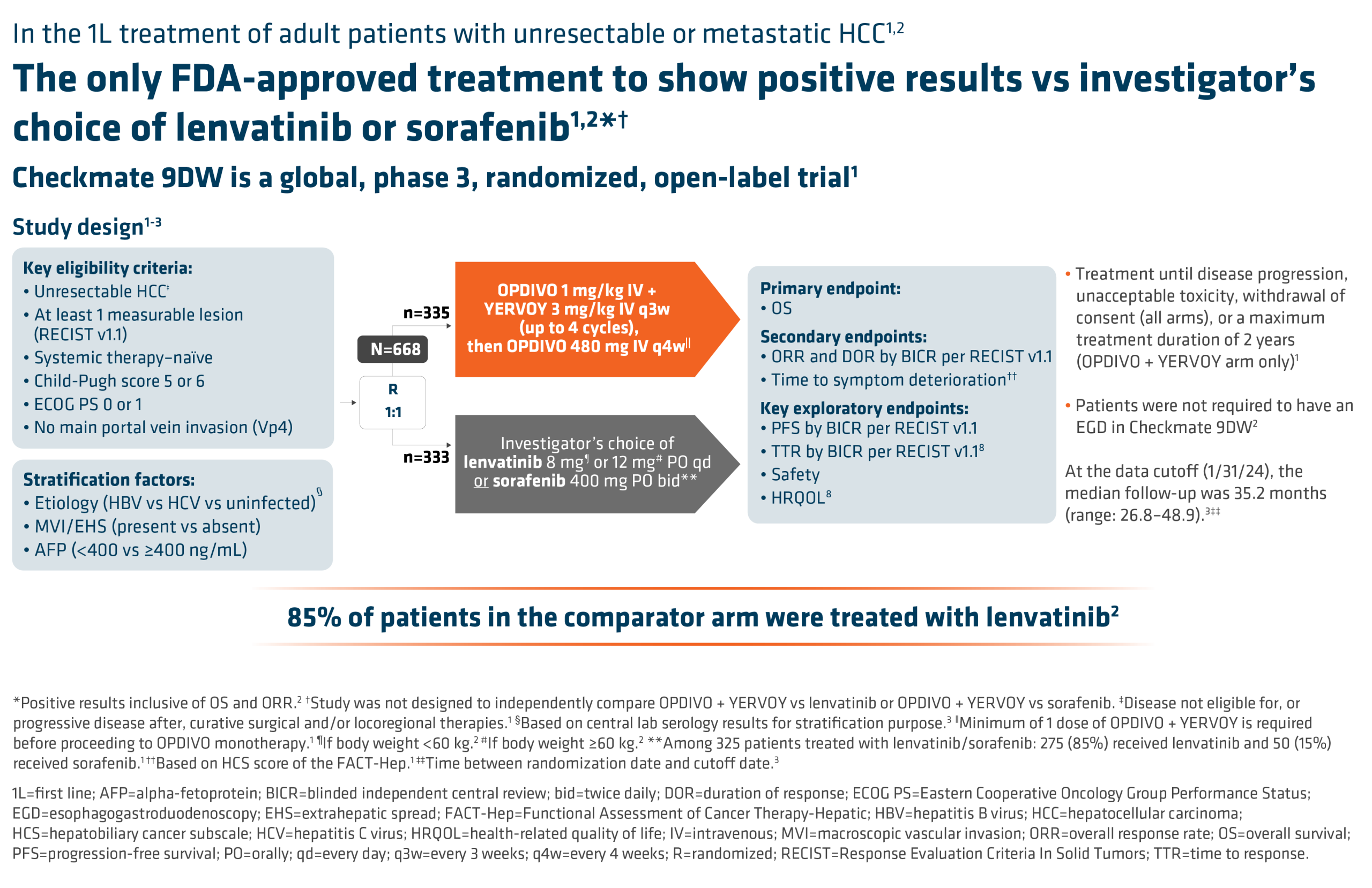
OPDIVO + YERVOY, a dual immune-checkpoint inhibitor combination studied in the global, randomized, phase 3 Checkmate 9DW trial, is the only FDA-approved treatment to show positive results* versus investigator’s choice of lenvatinib or sorafenib, in the 1L treatment of adult patients with uHCC1-5. Checkmate 9DW enrolled 668 patients with uHCC who were systemic-therapy–naïve, with at least 1 measurable lesion, Child-Pugh score 5 or 6, ECOG PS 0 or 1, and no main portal vein invasion (Vp4)1-3. An esophagogastroduodenoscopy (EGD) was not required2. Patients were randomized 1:1 to receive either OPDIVO (1 mg/kg) + YERVOY (3 mg/kg) q3w for up to 4 cycles followed by OPDIVO (480 mg IV) q4w or investigator’s choice of lenvatinib or sorafenib in the comparator arm1,2,5. YERVOY 3 mg/kg dosing in Checkmate 9DW was supported by Checkmate 0407.
HCC-Only-FDA-Approved-Treatment-Positive_Results

Efficacy and safety data for OPDIVO + YERVOY
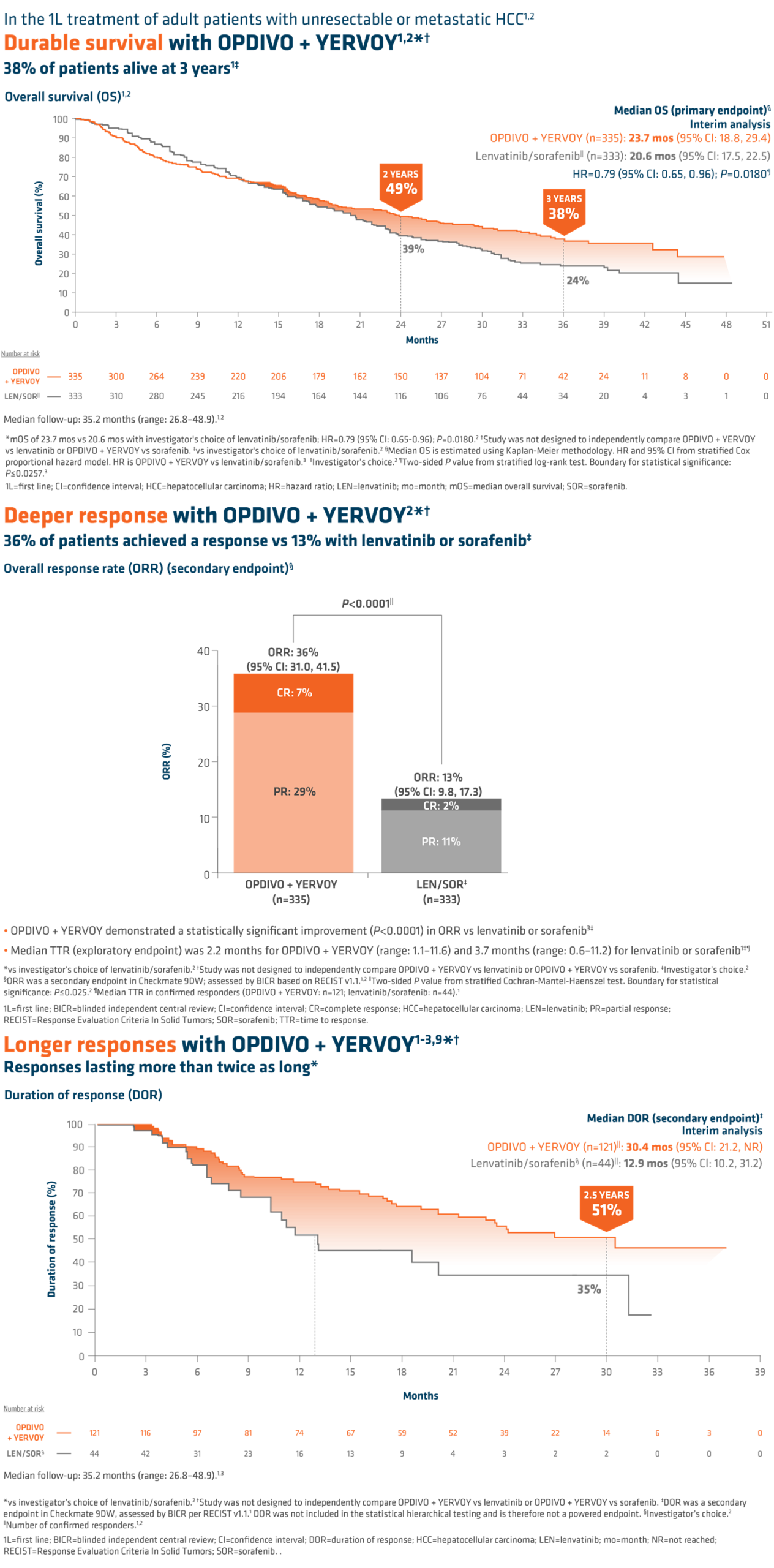
Median overall survival (mOS), the primary endpoint, was 23.7 months (95% CI: 18.8, 29.4) with OPDIVO + YERVOY versus 20.6 months (95% CI: 17.5, 22.5) with the comparator arm, with a hazard ratio of 0.79 (95% CI: 0.65, 0.96; P=0.018)1,2. Notably, 38% of patients were alive at 3 years with OPDIVO + YERVOY, compared to 24% with the comparator arm1-3,5. According to Dr. He, “The Checkmate 9DW design was unique because one of the comparator arm treatments was investigator’s choice of lenvatinib—a modern TKI, received by 85% of patients—making these results particularly meaningful.”

OPDIVO + YERVOY achieved a deeper overall response rate (ORR), a secondary endpoint, of 36%, versus 13% with the comparator arm (P<0.0001)1-3,5. “The ORR being higher than the comparator arm is great. When my patients are symptomatic with a high tumor burden, I choose treatments with a higher response rate than their comparator arms to ease their symptoms and potentially reduce liver stress. Furthermore, an exploratory analysis found median time to response was 2.2 months,” said Dr. He.

Responses lasted over twice as long with the median duration of response (mDOR) at 30.4 months (95% CI: 21.2, NR) versus 12.9 months (95% CI: 10.2, 31.2) with the comparator arm1-3,5. Dr. He shared, “The DOR is clinically meaningful. Some of my Checkmate 9DW patients are now off treatment after 2 years, with ongoing disease control.”
Durable-Survival-Durable-Responses-Longer-Responses

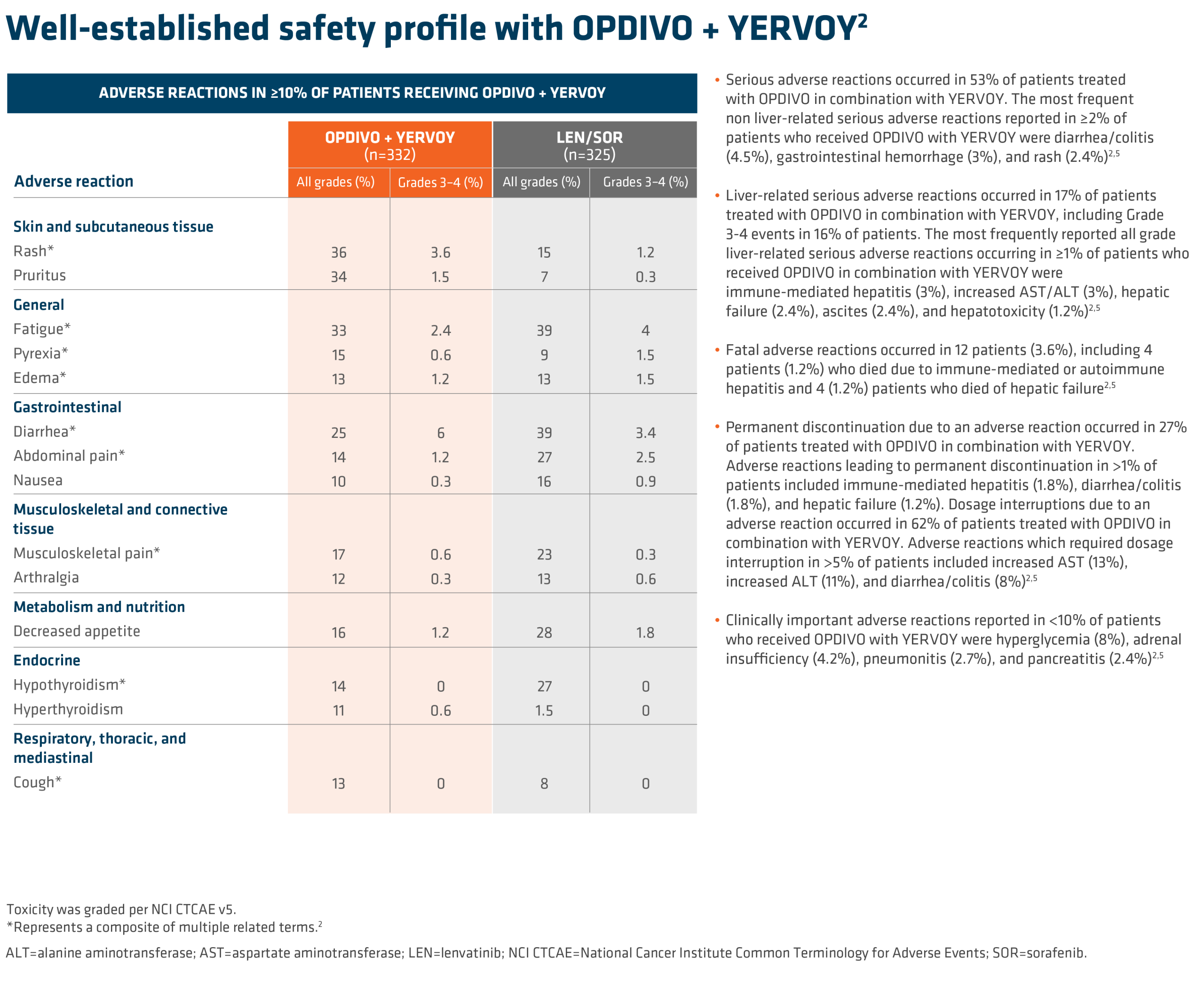
The safety profile of OPDIVO + YERVOY is well established2,5. Dr. He added, “No new IMARs were observed in Checkmate 9DW. I encourage patients to report side effects early, and I manage IMARs per established protocols including treatment holds and steroid use.”
Opdivo-Yervoy-Safety

Summary and conclusions
OPDIVO + YERVOY, a differentiated 1L option for treatment of uHCC, achieved durable survival, deeper and longer responses with a well-established safety profile. “For OPDIVO + YERVOY, I choose patients who are relatively robust, socially supported, and report side effects promptly. I’m excited about this 1L treatment and its demonstrated durable survival benefits,” noted Dr. He.

INDICATIONS

OPDIVO, in combination with YERVOY, is indicated for the first-line treatment of adult patients with unresectable or metastatic hepatocellular carcinoma (HCC).

IMPORTANT SAFETY INFORMATION

Severe and Fatal Immune-Mediated Adverse Reactions

  • Immune-mediated adverse reactions listed herein may not include all possible severe and fatal immune-mediated adverse reactions.
  • Immune-mediated adverse reactions, which may be severe or fatal, can occur in any organ system or tissue. While immune-mediated adverse reactions usually manifest during treatment, they can also occur after discontinuation of OPDIVO or YERVOY. Early identification and management are essential to ensure safe use of OPDIVO and YERVOY. Monitor for signs and symptoms that may be clinical manifestations of underlying immune-mediated adverse reactions. Evaluate clinical chemistries including liver enzymes, creatinine, adrenocorticotropic hormone (ACTH) level, and thyroid function at baseline and periodically during treatment with OPDIVO and before each dose of YERVOY. In cases of suspected immune-mediated adverse reactions, initiate appropriate workup to exclude alternative etiologies, including infection. Institute medical management promptly, including specialty consultation as appropriate.
  • Withhold or permanently discontinue OPDIVO and YERVOY depending on severity (please see section 2 Dosage and Administration in the accompanying Full Prescribing Information). In general, if OPDIVO or YERVOY interruption or discontinuation is required, administer systemic corticosteroid therapy (1 to 2 mg/kg/day prednisone or equivalent) until improvement to Grade 1 or less. Upon improvement to Grade 1 or less, initiate corticosteroid taper and continue to taper over at least 1 month. Consider administration of other systemic immunosuppressants in patients whose immune-mediated adverse reactions are not controlled with corticosteroid therapy. Toxicity management guidelines for adverse reactions that do not necessarily require systemic steroids (e.g., endocrinopathies and dermatologic reactions) are discussed below.

Immune-Mediated Pneumonitis

  • OPDIVO and YERVOY can cause immune-mediated pneumonitis. The incidence of pneumonitis is higher in patients who have received prior thoracic radiation. In patients receiving OPDIVO 1 mg/kg with YERVOY 3 mg/kg every 3 weeks, immune-mediated pneumonitis occurred in 7% (31/456) of patients, including Grade 4 (0.2%), Grade 3 (2.0%), and Grade 2 (4.4%).

Immune-Mediated Colitis

  • OPDIVO and YERVOY can cause immune-mediated colitis, which may be fatal. A common symptom included in the definition of colitis was diarrhea. Cytomegalovirus (CMV) infection/reactivation has been reported in patients with corticosteroid-refractory immune-mediated colitis. In cases of corticosteroid-refractory colitis, consider repeating infectious workup to exclude alternative etiologies. In patients receiving OPDIVO 1 mg/kg with YERVOY 3 mg/kg every 3 weeks, immune-mediated colitis occurred in 25% (115/456) of patients, including Grade 4 (0.4%), Grade 3 (14%) and Grade 2 (8%).

Immune-Mediated Hepatitis and Hepatotoxicity

  • OPDIVO and YERVOY can cause immune-mediated hepatitis. In patients receiving OPDIVO 1 mg/kg with YERVOY 3 mg/kg every 3 weeks, immune-mediated hepatitis occurred in 15% (70/456) of patients, including Grade 4 (2.4%), Grade 3 (11%), and Grade 2 (1.8%).

Immune-Mediated Endocrinopathies

  • OPDIVO and YERVOY can cause primary or secondary adrenal insufficiency, immune-mediated hypophysitis, immune-mediated thyroid disorders, and Type 1 diabetes mellitus, which can present with diabetic ketoacidosis. Withhold OPDIVO and YERVOY depending on severity (please see section 2 Dosage and Administration in the accompanying Full Prescribing Information). For Grade 2 or higher adrenal insufficiency, initiate symptomatic treatment, including hormone replacement as clinically indicated. Hypophysitis can present with acute symptoms associated with mass effect such as headache, photophobia, or visual field defects. Hypophysitis can cause hypopituitarism; initiate hormone replacement as clinically indicated. Thyroiditis can present with or without endocrinopathy. Hypothyroidism can follow hyperthyroidism; initiate hormone replacement or medical management as clinically indicated. Monitor patients for hyperglycemia or other signs and symptoms of diabetes; initiate treatment with insulin as clinically indicated.
  • In patients receiving OPDIVO 1 mg/kg with YERVOY 3 mg/kg every 3 weeks, adrenal insufficiency occurred in 8% (35/456) of patients, including Grade 4 (0.2%), Grade 3 (2.4%), and Grade 2 (4.2%).
  • In patients receiving OPDIVO 1 mg/kg with YERVOY 3 mg/kg every 3 weeks, hypophysitis occurred in 9% (42/456) of patients, including Grade 3 (2.4%) and Grade 2 (6%).
  • In patients receiving OPDIVO 1 mg/kg with YERVOY 3 mg/kg every 3 weeks, hyperthyroidism occurred in 9% (42/456) of patients, including Grade 3 (0.9%) and Grade 2 (4.2%).
  • In patients receiving OPDIVO 1 mg/kg with YERVOY 3 mg/kg every 3 weeks, hypothyroidism occurred in 20% (91/456) of patients, including Grade 3 (0.4%) and Grade 2 (11%).

Immune-Mediated Nephritis with Renal Dysfunction

  • OPDIVO and YERVOY can cause immune-mediated nephritis.

Immune-Mediated Dermatologic Adverse Reactions

  • OPDIVO can cause immune-mediated rash or dermatitis. Exfoliative dermatitis, including Stevens-Johnson syndrome (SJS), toxic epidermal necrolysis (TEN), and drug rash with eosinophilia and systemic symptoms (DRESS) has occurred with PD-1/PD-L1 blocking antibodies. Topical emollients and/or topical corticosteroids may be adequate to treat mild to moderate non-exfoliative rashes.
  • YERVOY can cause immune-mediated rash or dermatitis, including bullous and exfoliative dermatitis, SJS, TEN, and DRESS. Topical emollients and/or topical corticosteroids may be adequate to treat mild to moderate non-bullous/exfoliative rashes.
  • Withhold or permanently discontinue OPDIVO and YERVOY depending on severity (please see section 2 Dosage and Administration in the accompanying Full Prescribing Information).
  • In patients receiving OPDIVO 1 mg/kg with YERVOY 3 mg/kg every 3 weeks, immune-mediated rash occurred in 28% (127/456) of patients, including Grade 3 (4.8%) and Grade 2 (10%).

Other Immune-Mediated Adverse Reactions

  • The following clinically significant immune-mediated adverse reactions occurred at an incidence of <1% (unless otherwise noted) in patients who received OPDIVO monotherapy or OPDIVO in combination with YERVOY or were reported with the use of other PD-1/PD-L1 blocking antibodies. Severe or fatal cases have been reported for some of these adverse reactions: cardiac/vascular: myocarditis, pericarditis, vasculitis; nervous system: meningitis, encephalitis, myelitis and demyelination, myasthenic syndrome/myasthenia gravis (including exacerbation), Guillain-Barré syndrome, nerve paresis, autoimmune neuropathy; ocular: uveitis, iritis, and other ocular inflammatory toxicities can occur; gastrointestinal: pancreatitis to include increases in serum amylase and lipase levels, gastritis, duodenitis; musculoskeletal and connective tissue: myositis/polymyositis, rhabdomyolysis, and associated sequelae including renal failure, arthritis, polymyalgia rheumatica; endocrine: hypoparathyroidism; other (hematologic/immune): hemolytic anemia, aplastic anemia, hemophagocytic lymphohistiocytosis (HLH), systemic inflammatory response syndrome, histiocytic necrotizing lymphadenitis (Kikuchi lymphadenitis), sarcoidosis, immune thrombocytopenic purpura, solid organ transplant rejection, other transplant (including corneal graft) rejection.
  • In addition to the immune-mediated adverse reactions listed above, across clinical trials of YERVOY monotherapy or in combination with OPDIVO, the following clinically significant immune-mediated adverse reactions, some with fatal outcome, occurred in <1% of patients unless otherwise specified: nervous system: autoimmune neuropathy (2%), myasthenic syndrome/myasthenia gravis, motor dysfunction; cardiovascular: angiopathy, temporal arteritis; ocular: blepharitis, episcleritis, orbital myositis, scleritis; gastrointestinal: pancreatitis (1.3%); other (hematologic/immune): conjunctivitis, cytopenias (2.5%), eosinophilia (2.1%), erythema multiforme, hypersensitivity vasculitis, neurosensory hypoacusis, psoriasis.
  • Some ocular IMAR cases can be associated with retinal detachment. Various grades of visual impairment, including blindness, can occur. If uveitis occurs in combination with other immune-mediated adverse reactions, consider a Vogt-Koyanagi-Harada–like syndrome, which has been observed in patients receiving OPDIVO and YERVOY, as this may require treatment with systemic corticosteroids to reduce the risk of permanent vision loss.

Infusion-Related Reactions

  • OPDIVO and YERVOY can cause severe infusion-related reactions. Discontinue OPDIVO and YERVOY in patients with severe (Grade 3) or life-threatening (Grade 4) infusion-related reactions. Interrupt or slow the rate of infusion in patients with mild (Grade 1) or moderate (Grade 2) infusion-related reactions. In HCC patients receiving OPDIVO 1 mg/kg with YERVOY 3 mg/kg every 3 weeks, infusion-related reactions occurred in 8% (4/49) of patients.

Complications of Allogeneic Hematopoietic Stem Cell Transplantation

  • Fatal and other serious complications can occur in patients who receive allogeneic hematopoietic stem cell transplantation (HSCT) before or after being treated with OPDIVO or YERVOY. Transplant-related complications include hyperacute graft-versus-host-disease (GVHD), acute GVHD, chronic GVHD, hepatic veno-occlusive disease (VOD) after reduced intensity conditioning, and steroid-requiring febrile syndrome (without an identified infectious cause). These complications may occur despite intervening therapy between OPDIVO or YERVOY and allogeneic HSCT.
  • Follow patients closely for evidence of transplant-related complications and intervene promptly. Consider the benefit versus risks of treatment with OPDIVO and YERVOY prior to or after an allogeneic HSCT.

Embryo-Fetal Toxicity

  • Based on its mechanism of action and findings from animal studies, OPDIVO and YERVOY can cause fetal harm when administered to a pregnant woman. The effects of YERVOY are likely to be greater during the second and third trimesters of pregnancy. Advise pregnant women of the potential risk to a fetus. Advise females of reproductive potential to use effective contraception during treatment with OPDIVO and YERVOY and for at least 5 months after the last dose.

Increased Mortality in Patients with Multiple Myeloma when OPDIVO is Added to a Thalidomide Analogue and Dexamethasone

  • In randomized clinical trials in patients with multiple myeloma, the addition of OPDIVO to a thalidomide analogue plus dexamethasone resulted in increased mortality. Treatment of patients with multiple myeloma with a PD-1 or PD-L1 blocking antibody in combination with a thalidomide analogue plus dexamethasone is not recommended outside of controlled clinical trials.

Lactation

  • There are no data on the presence of OPDIVO or YERVOY in human milk, the effects on the breastfed child, or the effects on milk production. Because of the potential for serious adverse reactions in breastfed children, advise women not to breastfeed during treatment and for 5 months after the last dose.

Serious Adverse Reactions

  • In Checkmate 9DW, serious adverse reactions occurred in 53% of patients receiving OPDIVO with YERVOY (n=332). The most frequent non liver-related serious adverse reactions reported in ≥2% of patients who received OPDIVO with YERVOY were diarrhea/colitis (4.5%), gastrointestinal hemorrhage (3%), and rash (2.4%). Liver-related serious adverse reactions occurred in 17% of patients receiving OPDIVO with YERVOY, including Grade 3-4 events in 16% of patients. The most frequently reported all grade liver-related serious adverse reactions occurring in ≥1% of patients who received OPDIVO with YERVOY were immune-mediated hepatitis (3%), increased AST/ALT (3%), hepatic failure (2.4%), ascites (2.4%), and hepatotoxicity (1.2%). Fatal adverse reactions occurred in 12 (3.6%) patients who received OPDIVO with YERVOY; these included 4 (1.2%) patients who died due to immune-mediated or autoimmune hepatitis and 4 (1.2%) patients who died of hepatic failure.

Common Adverse Reactions

  • In Checkmate 9DW, the most common adverse reactions (≥20%) in patients receiving OPDIVO with YERVOY (n=332) were rash (36%), pruritus (34%), fatigue (33%), and diarrhea (25%).

Clinical Trials and Patient Populations

  • Checkmate 9DW – hepatocellular carcinoma, in combination with YERVOY.


By unsubscribing from OncoPrescribe.com below, you are not opting out of receiving email marketing communications from Bristol-Myers Squibb Company.

References

  1. Kudo M et al. Oral presentation at ASCO-GI 2025. Abstract 520.
  2. OPDIVO [package insert]. Princeton, NJ; Bristol-Myers Squibb Company.
  3. Galle PR et al. Oral presentation at ASCO 2024. Abstract LBA4008.
  4. American Cancer Society. https://www.cancer.org/cancer/liver-cancer/detection-diagnosis-staging/survival-rates.html. Accessed July 2025.
  5. YERVOY [package insert]. Princeton, NJ; Bristol-Myers Squibb Company.
  6. Yau T et al. 2025;405(10492):1851–1864.
  7. El-Khoueiry AB et al. Lancet. 2017;389(10088):2492–2502.
  8. Data on file. BMS-REF-NIVO-0335. Princeton, NJ: Bristol-Myers Squibb Company; 2025.
  9. Data on file. BMS-REF-NIVO-0326. Princeton, NJ: Bristol-Myers Squibb Company; 2025.

© 2025 Bristol-Myers Squibb Company. OPDIVO® and YERVOY® are registered trademarks of Bristol-Myers Squibb Company.

7356-US-2500331   08/2025


Hormonal Contraception and Breast Cancer Risk in BRCA1/2 Mutation Carriers

SUMMARY: Breast cancer is the most common cancer among women in the US and about 1 in 8 women (12%) will develop invasive breast cancer during their lifetime. It is estimated that in the US, approximately 316,950 new cases of female breast cancer will be diagnosed in 2025, and about 42,170 women will die of the disease, largely due to metastatic recurrence.

The tumor suppressor genes such as BRCA1 and BRCA2 help repair damaged DNA and thus play an important role in maintaining cellular genetic integrity, failing which these genetic aberrations can result in malignancies. Mutations in BRCA1 and BRCA2 account for about 20 to 25 percent of hereditary breast cancers and about 5 to 10 percent of all breast cancers. These mutations can be inherited from either of the parents and a child has a 50 percent chance of inheriting this mutation, and the deleterious effects of the mutations are seen even when a second copy of the gene in an individual is normal. Women with germline BRCA1 or BRCA2 mutations face markedly elevated lifetime risks of breast cancer, estimated at up to 70%. More than half of these cancers occur before the age of 50, underscoring the importance of informed counseling regarding risk-modifying exposures. One such factor is hormonal contraception, widely used for birth control and non-contraceptive health benefits, but also a potential contributor to breast cancer risk. The present study was conducted to assess the association between use of any hormonal contraception and breast cancer risk for BRCA1 and BRCA2 mutation carriers using individual participant data from four prospective cohorts.

Study Design
A large observational analysis pooled data from four prospective cohorts across Australia, New Zealand, Europe, Canada, and the United States (kConFab FUP, BCFR, RFS, and the UPenn Registry). The study included 3,882 women with BRCA1 mutations and 1,509 with BRCA2 mutations who were followed for a median of approximately six years. Associations between hormonal contraception use and breast cancer incidence were assessed using Cox regression modeling.

Key Findings

  • Hormonal Contraception use prevalence: 53% of BRCA1 carriers and 71% of BRCA2 carriers reported 1 year or more of use (median duration, 4.8 and 5.7 years, respectively). Hormonal contraceptives included birth control pills, patches, implants, injections, vaginal rings, and IUDs containing any hormones.
  • Cancer incidence: During follow-up, 488 BRCA1 and 191 BRCA2 carriers developed breast cancer during median follow-up of 5.9 and 5.6 years, respectively.
  • BRCA1 mutation carriers:
    • Ever use of hormonal contraception was associated with a 29% increased relative risk of breast cancer (HR, 1.29; 95% CI, 1.04–1.60).
    • Longer cumulative use conferred higher risk, with an estimated 3% increase in risk per additional year of use.
    • Current use and recent use were not independently significant, but a dose–response relationship emerged with duration.
  • BRCA2 mutation carriers: No significant association was observed between hormonal contraception use and breast cancer risk (HR for ever use, 1.07; 95% CI, 0.73–1.57). However, the relatively small number of events limits certainty.

Absolute Risk Implications

For BRCA1 carriers, small relative increases translate into substantial absolute risk shifts due to their high baseline susceptibility. For example, modeling suggested that an 18-year-old BRCA1 carrier with a family history of breast cancer would at age 58 face:

  • 51.3% lifetime risk without hormonal contraception use,
  • 56.6% with 5 years of use,
  • 62.0% with 10 years of use,
  • 67.3% with 15 years of use.

Shorter-term use was associated with minimal increases in absolute risk, whereas prolonged exposure yielded more clinically meaningful elevations.

Context and Clinical Considerations

  • Findings align with evidence in the general population showing modest increases in breast cancer risk with hormonal contraception use, though the higher baseline risk in BRCA1 carriers amplifies the absolute impact.
  • The lack of association for BRCA2 carriers should be interpreted cautiously due to limited statistical power.
  • Importantly, while oral contraceptives reduce tubo-ovarian cancer risk, this benefit may be less relevant for BRCA1/2 carriers who undergo guideline-recommended risk-reducing salpingo-oophorectomy by ages 35–45.
  • Study strengths include large BRCA1 cohort size, prospective data collection, and consistent findings across international cohorts. Limitations include observational design, potential misclassification of hormonal contraception type, and limited data beyond 15 years of use.

Take-Home Message for Oncologists
Hormonal contraceptives appear to increase breast cancer risk for BRCA1 mutation carriers, particularly with longer cumulative use, while evidence for BRCA2 remains inconclusive. When counseling patients, absolute risk estimates and individual values should guide decisions. Shorter-term use may be acceptable for some women, but prolonged use could confer risk increases that outweigh potential benefits.

Hormonal Contraception and Breast Cancer Risk for Carriers of Germline Mutations in BRCA1 and BRCA2. Phillips K-A, Kotsopoulos J,  Domchek SM, et al. J Clin Oncol. 2025;43:422-431

Statins as Potential Adjuvants in Immune Checkpoint Inhibitor Therapy: A Comprehensive Meta-Analysis

SUMMARY: Immune checkpoint inhibitors (ICIs) have dramatically transformed treatment landscape across multiple malignancies, producing durable responses in subsets of patients. By enhancing the ability of the immune system to identify and destroy cancer cells, ICIs have provided significant improvements in treatment outcomes across a range of tumor types. Despite these advances, resistance to ICIs remains a major barrier, driven by complex tumor-intrinsic and microenvironmental mechanisms. One area of growing interest is the role of lipid metabolism in cancer progression and immune evasion.

Cancer cells reprogram lipid metabolism to support survival under nutrient-deprived and hypoxic conditions, while stromal and immune cells in the Tumor MicroEnvironment (TME) also undergo lipid metabolic alterations that shape tumor-immune interactions. Targeting these pathways may represent a novel means to overcome immunosuppression and enhance response to ICIs.

Statins, widely prescribed for cardiovascular risk reduction, exhibit pleiotropic effects beyond lipid lowering, including modulation of PD-L1 expression, reprogramming of tumor-associated macrophages, and promotion of T-cell–mediated antitumor activity. These properties raise the possibility that statins may act synergistically with ICIs to improve patient outcomes.

Study Objective
Given the biologic rationale and conflicting results from prior studies, Liao and colleagues conducted a systematic review and meta-analysis to evaluate the prognostic impact of concomitant statin use in patients with cancer treated with ICIs. The goal was to determine whether this widely available and inexpensive class of drugs could augment the clinical benefits of immunotherapy.

Methods

  • Search strategy: Comprehensive searches of PubMed, EMBASE, Cochrane Library, Web of Science, and major oncology conference proceedings were conducted through June 20, 2024.
  • Inclusion criteria: Studies reporting Hazard Ratios (HRs) for Overall Survival (OS) and/or Progression-Free Survival (PFS) with statin use in ICI-treated patients.
  • Study pool: 25 retrospective studies (N=46,154) included in the meta-analysis.
  • Cancers represented: Non Small Cell Lung Cancer-NSCLC (8 studies), Renal Cell Carcinoma (3), Melanoma (1), Urothelial carcinoma (1), and Pan-cancer analyses (12).
  • Patient characteristics: Statin use prevalence ranged from 8.7% to 50%. Study regions included Asia, Europe, and the United States.
  • Endpoints: OS (in all 46,154 patients) and PFS (in 7,786 patients).
  • Quality: 15 studies classified as high quality, 10 classified as moderate according to the modified NOS (Newcastle-Ottawa Scale).

Key Findings

  • Overall Survival: Statin use was associated with a 20% reduction in mortality risk (HR 0.80; 95% CI, 0.71–0.92).
  • Progression-Free Survival: A consistent benefit was observed (HR 0.80; 95% CI, 0.69–0.92).
  • Subgroup analyses:
    • By cancer type: Survival advantage was most pronounced in Renal Cell Carcinoma, while benefits were less consistent in NSCLC and Melanoma.
    • By geography: OS benefit with statin use was noted in studies originating from Europe but not observed in studies conducted in Asia and US. Statin use was associated with improved PFS among Asian patients undergoing ICI therapy, but not observed in European and American patients.

Clinical Implications

  • Mechanistic plausibility: Statins may enhance immunotherapy by downregulating PD-L1 expression, shifting macrophage polarization from an M2 to M1 phenotype, and reducing systemic inflammation.
  • Accessibility: Statins are inexpensive, widely available, and well tolerated, positioning them as attractive adjuncts to ICIs.
  • Limitations:
    • All included studies were retrospective and observational.
    • Potential confounding (eg, baseline comorbidities, concomitant medications).
    • Lack of stratification by statin type, dose, or timing of initiation.
    • Evidence of publication bias.
  • Next steps: Well-designed Randomized Controlled Trials (RCTs) are essential to establish causality. A Phase II RCT investigating PD-1 inhibitors combined with statins in advanced NSCLC is already underway.

Conclusion
This meta-analysis provides the strongest evidence to date that concomitant statin therapy may improve both OS and PFS in patients with cancer receiving ICIs. While observational in nature, the findings highlight the potential of repurposing a widely used cardiovascular drug as an oncology adjuvant. If validated in prospective RCTs, statins could emerge as a low-cost, low-toxicity strategy to enhance immunotherapy efficacy across multiple cancer types, potentially shaping future treatment algorithms.

Takeaway for Oncologists
Concomitant statin use is associated with improved survival in ICI-treated patients across diverse cancers, with particular benefit seen in Renal Cell Carcinoma and in non-U.S. cohorts. Until prospective trials confirm these findings, clinicians should remain attentive to emerging data while considering statin therapy primarily for established cardiovascular indications.

Concomitant Statin Use and Survival in Patients With Cancer on Immune Checkpoint Inhibitors: A Meta-Analysis. Liao Y, Lin Y, Ye X, et al. JCO Oncol Pract. 2025;21:989-1000.

Elinzanetant Reduces Vasomotor Symptoms in Women Receiving Endocrine Therapy for HR-Positive Breast Cancer

SUMMARY: Breast cancer is the most common cancer among women in the US and about 1 in 8 women (12%) will develop invasive breast cancer during their lifetime. It is estimated that in the US, approximately 316,950 new cases of female breast cancer will be diagnosed in 2025, and about 42,170 women will die of the disease, largely due to metastatic recurrence.

Approximately 70% are Hormone Receptor (HR)–positive, and long-term endocrine therapy, typically 5 to 10 years of Tamoxifen or an Aromatase Inhibitor, with or without a GnRH analogue, substantially lowers recurrence and mortality. However, treatment-related Vasomotor Symptoms (VMS), such as hot flashes, are frequent and often more severe than those seen in natural menopause, particularly in younger women receiving GnRH suppression. These adverse effects diminish quality of life and contribute to nonadherence.

Because postmenopausal hormone therapy is contraindicated in this setting, current management options rely on lifestyle measures, behavioral strategies, or off-label medications (e.g., SSRIs, Gabapentin, Clonidine, Oxybutynin), each with limited evidence and tolerability concerns. Thus, effective nonhormonal therapies are a critical unmet need.

Elinzanetant and Mechanism of Action

Elinzanetant is a dual Neurokinin-1 (NK-1) and Neurokinin-3 (NK-3) receptor antagonist. It acts on hypothalamic KNDy (Kisspeptin–Neurokinin–Dynorphin) neurons, which regulate thermoregulation and are hyperactivated by estrogen withdrawal from natural menopause or endocrine therapy. This results in elevated expression of Neurokinin B and Substance P which are responsible for vasomotor symptoms. By modulating Neurokinin B and Substance P signaling, Elinzanetant reduces VMS and may improve sleep disturbances. Unlike other agents in this class, trials to date have not demonstrated hepatotoxicity.

Trial Design

The OASIS-4 trial is a Phase 3, randomized, double-blind, placebo-controlled study conducted at 90 sites across Europe, Canada, Israel, and Kazakhstan. This study included 474 women (aged 18–70) with HR-positive breast cancer or at high risk, receiving Tamoxifen or an Aromatase Inhibitor with or without GnRH analogue, and reporting 35 or more moderate-to-severe VMS episodes per week. Patients were randomized in a 2:1 to receive Elinzanetant 120 mg daily for 52 weeks (N=316) or Placebo once daily for 12 weeks followed by Elinzanetant 120 mg daily for 40 weeks (N=158). The Primary end points were the change in the mean daily frequency of moderate-to-severe vasomotor symptoms from baseline to week 4 and to week 12. While a general guideline is lacking for a “clinically meaningful” reduction in vasomotor symptoms (VMS) caused by endocrine therapy, the reduction of at least 50% from baseline is considered a significant individual benefit for women in natural menopause.

Results:

Elinzanetant significantly reduced moderate-to-severe vasomotor symptoms, improved sleep, and enhanced menopause-related quality of life compared to a placebo

  • Baseline mean daily VMS frequency: About 11 episodes/day in both arms
  • Week 4: Mean reduction of 6.5 daily episodes of moderate-to-severe VMS with Elinzanetant vs. reduction of 3.0 daily episodes with placebo (P <0.001)
  • Week 12: Mean reduction of 7.8 episodes of moderate-to-severe VMS with Elinzanetant vs. reduction of 4.2 daily episodes with placebo (P <0.001)
  • 50% or more reduction in VMS frequency at 12 weeks was achieved by >70% of Elinzanetant-treated participants
  • Benefits extended to improvements in sleep and menopause-related quality of life
  • Safety: most common adverse events were headache, fatigue, and somnolence; serious adverse events occurred in 2.5% vs. 0.6% with placebo
  • No hepatotoxicity signal was detected through 52 weeks
  • Treatment satisfaction: 91.6% of participants completing 52 weeks opted into a 2-year extension

Clinical Implications

Vasomotor symptoms and sleep disruption are among the most burdensome adverse effects of endocrine therapy and are key contributors to poor adherence, which directly impacts long-term breast cancer outcomes. Currently, management options are limited and inconsistently effective, particularly in this population where hormone therapy for menopausal symptoms is contraindicated.

Elinzanetant represents a novel, well-tolerated, nonhormonal strategy that demonstrated reproducible reductions in VMS across both naturally menopausal and endocrine therapy–induced settings. While OASIS-4 was not powered to evaluate breast cancer recurrence or survival, reducing symptom burden may indirectly enhance adherence to endocrine therapy and improve outcomes.

Limitations and Next Steps

The trial population was predominantly White, limiting generalizability. Long-term breast cancer outcomes were not assessed and Real-world tolerability and adherence remain to be defined. Ongoing extension studies and future trials will clarify durability of benefit, potential endocrine effects, and impact on long-term treatment adherence and survival.

Conclusion

In women receiving endocrine therapy for HR-positive breast cancer, Elinzanetant significantly reduced vasomotor symptoms (VMS), improved sleep, and enhanced quality of life with a favorable safety profile. These findings highlight its potential role as a much-needed nonhormonal therapeutic option to support adherence and improve patient-centered outcomes in breast cancer care.

Elinzanetant for Vasomotor Symptoms from Endocrine Therapy for Breast Cancer. Cardoso F, Parke S, Brennan DJ, et al. N Engl J Med 2025;393:753-763

FDA Grants Accelerated Approval to EMRELIS® for NSCLC with High c-Met Protein Overexpression

SUMMARY: The FDA on May 14, 2025, granted accelerated approval to Telisotuzumab vedotin-tllv (EMRELIS®), a c-Met-directed antibody and microtubule inhibitor conjugate, for adults with locally advanced or metastatic, non-squamous Non-Small Cell Lung Cancer (NSCLC) with high c-Met protein overexpression [50% or more of tumor cells with strong (3+) staining], as determined by an FDA-approved test, who have received a prior systemic therapy. FDA also approved the VENTANA MET (SP44) RxDx Assay (Roche Diagnostics) as a companion diagnostic test to aid in detecting c-Met protein overexpression in patients with non-squamous NSCLC who may be eligible for treatment with Telisotuzumab vedotin .

The American Cancer Society estimates that for 2025, about 226,650 new cases of lung cancer will be diagnosed and 124,730 patients will die of the disease. Lung cancer is the leading cause of cancer-related mortality in the United States. Non-Small Cell Lung Cancer (NSCLC) accounts for approximately 85% of all lung cancers and Adenocarcinoma is now the most frequent histologic subtype of lung cancer.

Background

The MET proto-oncogene encodes the receptor tyrosine kinase c-Met, a key regulator of tumor cell proliferation, survival, invasion, and angiogenesis. Dysregulation of MET signaling can occur in NSCLC via gene amplification (about 5% of cases), exon 14 skipping mutations (about 2%-4%), or through c-Met protein overexpression, which is observed in approximately one-quarter to one-third of patients. Notably, c-Met protein overexpression represents a negative prognostic marker in both early and advanced NSCLC, particularly in nonsquamous, EGFR-wildtype disease, yet no therapies have been approved to directly address this biomarker.

Telisotuzumab vedotin (Teliso-V; EMRELIS®) is a first-in-class, c-Met–directed antibody-drug conjugate (ADC). It couples a c-Met–binding monoclonal antibody with the microtubule-disrupting agent MonoMethyl Auristatin E (MMAE) through a cleavable linker. Preclinical work showed that tumoricidal activity requires high levels of c-Met expression (>100,000 receptors per cell), which supports patient selection strategies for clinical use.

The LUMINOSITY Trial Design

LUMINOSITY study (NCT03539536) is an ongoing, nonrandomized, two-stage, Phase II, multicenter trial designed to identify and validate the NSCLC populations most likely to benefit from Teliso-V monotherapy in the second-line or third-line setting, and then to expand the groups to further evaluate efficacy in the selected populations.

  • Stage I: Patients were enrolled into three cohorts based on histology and EGFR mutation status: (1) nonsquamous EGFR-wildtype NSCLC, (2) nonsquamous EGFR-mutant NSCLC, and (3) squamous NSCLC.
  • Stage II: Only the nonsquamous EGFR-wildtype NSCLC cohort fulfilled expansion criteria and was carried forward for further evaluation.

Biomarker Definition:

  • Nonsquamous NSCLC: c-Met protein overexpression defined as 25% or more of tumor cells showing 3+ membrane staining intensity (with high expression 50% or more and intermediate expression 25-less than 50%).
  • Squamous NSCLC: a broader cutoff was applied (75% or more of tumor cells at any intensity) given generally lower c-Met expression levels.

Treatment regimen: Teliso-V was administered intravenously at 1.9 mg/kg every 2 weeks.

Endpoints: The Primary endpoint was Overall Response Rate (ORR) by Independent Central Review (ICR). Secondary endpoints included Duration of Response (DOR), Disease Control Rate (DCR), Progression-Free Survival (PFS), Overall Survival (OS), and Safety.

Key Efficacy Results in the Nonsquamous EGFR-wildtype NSCLC Cohort

As of February 21, 2024, 172 patients had received at least one dose of Teliso-V, with 168 patients (N=168) included in efficacy analyses (c-Met high, N=84, c-Met intermediate, N=84). The majority (97.6%) had previously received platinum-based chemotherapy, and nearly 80% had also received immune checkpoint inhibitors (ICIs).

  • Overall Response Rate (ORR):
    • Total c-Met overexpressing population: 29.2%
    • High expression: 34.5%
    • Intermediate expression: 23.8%
  • Median Duration of Response (DOR):
    • Overall: 7.2 months
    • High expression: 9.0 months
    • Intermediate expression: 7.2 months

Responses were consistent across patients pretreated with platinum alone or with both platinum and ICI, suggesting durability irrespective of prior therapy type.

Safety Profile

The safety of Teliso-V was generally manageable and consistent with its mechanism of action.

  • Most common treatment-related adverse events (any grade): peripheral sensory neuropathy (31%), peripheral edema (16%), and fatigue (14%).
  • Most common grade 3 or more TRAE: peripheral sensory neuropathy (7%).

These findings align with the known toxicity profile of MMAE-based ADCs, highlighting neuropathy as the principal dose-limiting concern.

Limitations and Next Steps

While encouraging, the Phase II design lacked a comparator arm, limiting definitive conclusions about comparative efficacy. A randomized, Phase III trial, TeliMET NSCLC-01 (NCT04928846), is underway, directly comparing Teliso-V against Docetaxel in previously treated, c-Met–overexpressing, nonsquamous EGFR-wildtype NSCLC. Additionally, exploratory biomarker analyses may help refine patient selection, particularly given potential overlap between c-Met protein expression and other MET pathway genomic alterations.

Clinical Implications

LUMINOSITY demonstrates that Teliso-V can achieve durable clinical responses in a biomarker-selected subset of NSCLC patients who currently lack targeted treatment options. Response enrichment among patients with high c-Met protein expression reinforces the relevance of robust biomarker screening in clinical practice. Teliso-V represents the first therapy specifically directed against c-Met protein overexpression in NSCLC, addressing an important unmet need.

LUMINOSITY, a phase 2 study of telisotuzumab vedotin in patients with c-Met protein–overexpressing non-squamous EGFR-wildtype advanced NSCLC: Efficacy outcomes by prior therapy. Goldman JW, Lu S, Bar J, et al. Journal of Clinical Oncology. Volume 43, Number 16_suppl. https://doi.org/10.1200/JCO.2025.43.16_suppl.8618

FDA Approves Zongertinib for NSCLC with HER2 TKD activating mutations

SUMMARY: The FDA on August 8, 2025, granted accelerated approval to Zongertinib (HERNEXEOS®), a kinase inhibitor, for adults with unresectable or metastatic non-squamous Non-Small Cell Lung Cancer (NSCLC) whose tumors have HER2 (ERBB2) Tyrosine Kinase Domain (TKD) activating mutations, as detected by an FDA-approved test, and who have received prior systemic therapy. FDA also approved the Oncomine Dx Target Test (Life Technologies Corporation) as a companion diagnostic device to aid in detecting HER2 (ERBB2) TKD activating mutations in patients with non-squamous NSCLC who may be eligible for treatment with Zongertinib.

The American Cancer Society estimates that for 2025, about 226,650 new cases of lung cancer will be diagnosed and 124,730 patients will die of the disease. Lung cancer is the leading cause of cancer-related mortality in the United States. Non-Small Cell Lung Cancer (NSCLC) accounts for approximately 85% of all lung cancers and Adenocarcinoma is now the most frequent histologic subtype of lung cancer.

The HER or erbB family of receptors consist of HER1, HER2, HER3 and HER4. HER2 is a Tyrosine Kinase Receptor expressed on the surface of several tumor types including Breast, Gastric, Lung and Colorectal cancers. It is a growth-promoting protein, and HER2 overexpression/HER2 gene amplification is often associated with aggressive disease and poor prognosis in certain tumor types.

HER2 mutations unlike HER2 overexpression and gene amplification are oncogenic drivers and are detected in 2 to 4% of NSCLCs. They are more often detected in younger, female and never-smokers, and almost exclusively in Adenocarcinomas. Next-generation sequencing is used to identify HER2 mutations. Majority of HER2 mutations (80-90%) occur in exon 20, as either a duplication or an insertion of 12 nucleotides, resulting in the addition of four amino acids (YVMA) at codon 775 in the kinase domain. This distinct molecular entity is characterized by specific pathological and clinical behavior. These acquired HER2 gene mutations have been independently associated with cancer cell growth, aggressive form of disease and poor prognosis, and with an increased incidence of brain metastases.

The FDA in 2022 granted accelerated approval to ENHERTU® (Trastuzumab deruxtecan), for adult patients with unresectable or metastatic NSCLC whose tumors have HER2 (ERBB2) mutations. This is the first drug approved for HER2-mutant NSCLC. Trastuzumab deruxtecan, however, can be associated with toxicities including Interstitial Lung Disease (ILD). Similarly, Pan-HER TKIs such as Poziotinib and Pyrotinib have shown limited efficacy and are frequently associated with EGFR-related adverse events, underscoring the urgent need for more targeted, better-tolerated therapies.

Zongertinib is a novel, oral, irreversible Tyrosine Kinase Inhibitor designed to selectively target HER2 while sparing EGFR, thus minimizing common toxicities such as rash and diarrhea.

Beamion LUNG-1 is an ongoing Phase 1a/1b trial evaluating Zongertinib in previously treated patients with HER2-altered advanced or metastatic solid tumors (Phase 1a) and those with HER2-mutant advanced or metastatic NSCLC across multiple clinically relevant patient cohorts (Phase 1b). In the Phase 1a dose-escalation trial, Zongertinib showed encouraging preliminary activity at the recommended expansion doses of 120 mg and 240 mg once daily, with a low incidence of Grade 3 or higher adverse events.

The Phase 1b portion of the study evaluated Zongertinib in three key populations:

  • Cohort 1: Pretreated NSCLC patients with tumors harboring HER2 mutations in the TKD (Tyrosine Kinase Domain), the most common category of HER2 mutations encountered in the clinic.
  • Cohort 5: NSCLC patients whose tumors had HER2 mutations within the TKD and had previously received HER2-directed ADCs, including Trastuzumab deruxtecan.
  • Cohort 3: NSCLC patients whose tumor had HER2 mutations outside the TKD.

Patients were initially treated at 120 mg or 240 mg daily and following interim analysis, 120 mg was selected as the optimal dose based on a favorable efficacy and safety balance. The median age in Cohort 1 was 62 yrs. The Primary end point was an Objective Response Rate (ORR) assessed by Blinded Independent Central Review (Cohorts 1 and 5) or by Investigator Review (Cohort 3). Secondary end points included the Duration of Response and Progression-Free Survival (PFS).

Efficacy Outcomes
The median follow-up was 11.3 months at the data-cutoff date. Zongertinib demonstrated robust and durable activity, particularly in Cohort 1:

  • Cohort 1 (N=75 at 120 mg daily dose):
    • Objective response rate (ORR): 71% (P<0.001)
    • Median Duration of Response (DoR): 14.1 months
    • Median progression-free survival (PFS): 12.4 months

Importantly, responses were consistent across subgroups, including patients with brain metastases (ORR: 64%) and common TKD insertion subtypes such as A775_G776insYVMA (ORR: 81%).

  • Cohort 5 (N=31):
    • ORR: 48%, including patients previously treated with Trastuzumab deruxtecan (ORR: 42%)
    • Median Duration of Response: 27% had a DOR ≥ 6 months
  • Cohort 3 (N=20):
    • ORR: 30%
    • Activity observed across several non-TKD mutations (e.g., S310X, V659E)

These findings suggest that Zongertinib may offer a viable treatment option even in patients who have progressed on ADCs or harbor atypical HER2 alterations.

Safety and Tolerability
Zongertinib was well tolerated across all cohorts:

  • Grade ≥3 drug-related adverse events occurred in:
    • 17% of patients in Cohort 1
    • 3% in Cohort 5
    • 25% in Cohort 3
  • No cases of drug-related interstitial lung disease were observed
  • Most common adverse event was diarrhea (any grade: 56%; grade ≥3: 1%), followed by rash (all grade ≤2)

The safety profile compares favorably with existing HER2-targeted agents, including Trastuzumab deruxtecan, which has reported interstitial lung disease rates of up to 26% in earlier trials.

Clinical Context and Future Directions
Compared with other HER2-targeted agents including Trastuzumab deruxtecan and investigational pan-HER TKIs, Zongertinib stands out for its high response rates, durability, and manageable toxicity. While cross-study comparisons have inherent limitations, these results support Zongertinib as a promising, HER2-selective oral agent for patients with HER2-mutant NSCLC. The ongoing Phase 3 Beamion LUNG-2 trial (NCT06151574) will further assess Zongertinib in the first-line setting, providing critical data on its role relative to current standard-of-care therapies.

Conclusion
Zongertinib has emerged as a strong candidate in the evolving landscape of HER2-mutant NSCLC. With high response rates, durable outcomes, and a favorable safety profile, it may soon offer oncologists a powerful new tool for treating this difficult-to-manage patient population.

Zongertinib in Previously Treated HER2-Mutant Non–Small-Cell Lung Cancer. Heymach JV, Ruiter G, Ahn M-J, et al. for the Beamion LUNG-1 Investigators. N Engl J Med 2025;392:2321-2333.

Tafasitamab Plus Lenalidomide and Rituximab Improves Outcomes in Relapsed/Refractory Follicular Lymphoma: Results from the Phase III inMIND Trial

SUMMARY: The FDA on June 18, 2025, approved Tafasitamab-cxix (MONJUVI®) with Lenalidomide and Rituximab for adults with Relapsed or Refractory Follicular Lymphoma (FL).

The American Cancer Society estimates that in 2025, about 80,350 people will be diagnosed with Non Hodgkin Lymphoma (NHL) in the United States and about 19,390 individuals will die of this disease. Indolent Non-Hodgkin Lymphomas are mature B cell lymphoproliferative disorders and include Follicular Lymphoma, Nodal Marginal Zone Lymphoma (NMZL), Extranodal Marginal Zone Lymphoma (ENMZL) of Mucosa-Associated Lymphoid Tissue (MALT), Splenic Marginal Zone Lymphoma (SMZL), LymphoPlasmacytic Lymphoma (LPL) and Small Lymphocytic Lymphoma (SLL).

Follicular Lymphoma is the most indolent form and second most common form of all NHLs, and they are a heterogeneous group of lymphoproliferative malignancies. Approximately 20% of all NHLs are Follicular Lymphomas and the average age of diagnosis is 65 years. Advanced stage indolent NHL is not curable and as such, prolonging Progression Free Survival (PFS) and Overall Survival (OS), while maintaining Quality of Life, have been the goals of treatment intervention. Asymptomatic patients with indolent NHL are generally considered candidates for “watch and wait” approach. Patients with advanced stage symptomatic Follicular Lymphoma are often treated with induction chemoimmunotherapy followed by maintenance Rituximab (RITUXAN®). This can result in a median Progression Free Survival (PFS) of 6-8 yrs and a median Overall Survival (OS) of 12-15 yrs. However, approximately 30% of the patients will relapse in 3 years, with prognosis worsening after each subsequent relapse. Immunotherapy-based approaches are increasingly favored, yet durable disease control remains elusive, particularly among patients with high-risk features such as progression within 24 months of initial therapy (POD24) or resistance to anti-CD20 monoclonal antibodies.

Lenalidomide in combination with Rituximab (R²) is an established option after at least one prior line of therapy. Tafasitamab, a humanized anti-CD19 monoclonal antibody with both direct cytotoxic and immune-mediated mechanisms of action, has previously demonstrated efficacy in Diffuse Large B-Cell Lymphoma in combination with Lenalidomide (L-MIND trial). The Phase III inMIND study (NCT04680052) was designed to evaluate whether adding Tafasitamab to the R² backbone could improve outcomes in patients with Relapsed or Refractory (R/R) FL. This study was powered to assess PFS in patients with FL only.

Study Design and Methods
inMIND was a randomized, double-blind, placebo-controlled, global Phase III trial that enrolled 548 patients with Grade 1–3A FL or Marginal Zone Lymphoma. All patients had received at least one prior systemic therapy, including an anti-CD20 monoclonal antibody, and required treatment for Relapsed or Refractory disease. Key eligibility criteria included age 18 years or older, CD19+/CD20+ disease, and ECOG performance status 2 or less. Patients were stratified by POD24 status, refractoriness to prior therapy, and number of prior treatment lines (1 vs >1).

Participants were randomized 1:1 to:

  • Tafasitamab + Lenalidomide + Rituximab (Tafa arm)
  • Placebo + Lenalidomide + Rituximab (control arm)

A total of 548 patients were randomized (Tafa, n=273; Placebo, n=275). Baseline characteristics were balanced between arms:

  • Median age: 64 years
  • 79% with intermediate/high-risk FLIPI scores
  • 83% with high tumor burden (GELF criteria)
  • 32% with POD24
  • 43% refractory to prior anti-CD20 therapy

Tafasitamab (12 mg/kg IV) or placebo was administered on days 1, 8, 15, and 22 of cycles 1–3, and days 1 and 15 of cycles 4–12. All patients received standard dosing of Lenalidomide plus Rituximab for up to twelve 28-day cycles.

  • Primary endpoint: investigator-assessed Progression-Free Survival (PFS) in patients with FL.
  • Key secondary endpoints: Complete metabolic Response (PET-CR), Overall Response Rate (ORR), Duration of Response (DOR), Time To Next Treatment (TTNT), Overall Survival (OS), and safety.

At a median follow-up of 14.1 months:

  • Primary endpoint met: Tafasitamab significantly reduced the risk of progression, relapse, or death by 57%.
    • Median PFS: 22.4 months (Tafa) vs 13.9 months (placebo)
    • Hazard ratio (HR) 0.43; 95% CI 0.32–0.58; P < 0.0001
  • Independent Review Committee (IRC) confirmation: median PFS not reached with Tafasitamab vs 16.0 months with placebo (HR 0.41; P < 0.0001).
  • Response outcomes:
    • PET-CR rate: 49.4% vs 39.8% (P = 0.029)
    • ORR: 83.5% vs 72.4% (P = 0.0014)
    • DOR: 21.2 vs 13.6 months (HR 0.47; P < 0.0001)
    • TTNT: not reached vs 28.8 months (HR 0.45; P < 0.0001)
  • Overall Survival (immature): trend favoring Tafasitamab (HR 0.59; 95% CI 0.31–1.13).

Subgroup Analyses
PFS benefit with Tafasitamab was consistent across all prespecified groups, including POD24 patients, those refractory to prior anti-CD20 therapy and patients with ≥2 prior lines of therapy

Safety Profile
Adverse events were manageable and consistent with known profiles of the combination components.

  • Grade 3/4 adverse events occurred in 71% (Tafa) vs 69.5% (placebo).
  • Most common Grade 3/4 events: neutropenia (40% vs 38%), pneumonia (8% vs 5%), thrombocytopenia (6% vs 7%).
  • COVID-19 infections were slightly more frequent in the Tafasitamab arm (6% vs 2%).
  • Treatment discontinuation due to adverse events occurred in 11% (Tafa) vs 7% (placebo).
  • On-study deaths were less frequent in the Tafasitamab arm (5.5% vs 8.5%).

Importantly, Tafasitamab did not interfere with the administration of Lenalidomide or Rituximab and dose reductions and treatment interruptions were comparable across arms.

Clinical Implications
The inMIND trial is the first phase III study to validate a dual-antibody approach targeting both CD19 and CD20 in FL. The addition of Tafasitamab to R² not only extended PFS by nearly nine months but also improved depth of response and delayed the need for subsequent therapy, without introducing unexpected toxicities.

For high-risk patients, including those with POD24 or anti-CD20–refractory disease, these results are particularly impactful, addressing a long-standing gap in treatment outcomes.

As novel immunotherapies such as bispecific antibodies and CAR T-cell therapies are integrated earlier in the treatment paradigm, questions about sequencing and immune fitness will become increasingly relevant. Nonetheless, Tafasitamab plus R² emerges from inMIND as a practical, chemotherapy-free regimen that can be delivered in both community and academic settings, representing a potential new standard of care for patients with R/R FL.

Key Takeaways

  • inMIND met its primary endpoint, showing a 57% risk reduction in progression, relapse, or death with Tafasitamab + R² vs R² alone.
  • Benefits were consistent across high-risk subgroups, including POD24 and anti-CD20–refractory patients.
  • Secondary endpoints (ORR, CR, DOR, TTNT) also significantly favored Tafasitamab.
  • Safety profile was manageable and aligned with expectations.
  • Longer follow-up will clarify OS benefit, but current findings strongly support the role of Tafasitamab in improving outcomes for patients with Relapsed/Refractory Follicular Lymphoma.

Tafasitamab Plus Lenalidomide and Rituximab for Relapsed or Refractory Follicular Lymphoma: Results from a Phase 3 Study (inMIND). Sehn LH, Luminari S, Scholz CW, et al. Blood (2024), Volume 144, Supplement 2: LBA-1. https://doi.org/10.1182/blood-2024-212970

Pirtobrutinib in Relapsed/Refractory CLL/SLL after Prior cBTKi: Phase III BRUIN CLL-321 Results

SUMMARY: The American Cancer Society estimates that for 2025, about 23,690 new cases of Chronic Lymphocytic Leukemia (CLL) will be diagnosed in the US and 4460 patients will die of the disease. CLL accounts for about one-quarter of the new cases of leukemia. The average age of patients diagnosed with CLL is around 70 years, and is rarely seen in people under age 40, and is extremely rare in children. Patients with CLL often receive continuous therapy with either Brutons Tyrosine Kinase (BTK) inhibitor, time limited therapy with BCL2 inhibitor Venetoclax given along with anti-CD20 antibody Obinutuzumab, or under certain circumstances, chemoimmunotherapy.

Brutons Tyrosine Kinase (BTK) is a member of the Tec family of kinases, downstream of the B-cell receptor, and is predominantly expressed in B-cells. It is a mediator of B-cell receptor signaling in normal and transformed B-cells. BTK inhibitors inhibit cell proliferation and promote programmed cell death (Apoptosis) by blocking B-cell activation and signaling. BTK is a validated molecular target found across numerous B-cell leukemias and lymphomas including Chronic Lymphocytic Leukemia (CLL), Mantle Cell Lymphoma (MCL), and Waldenstrom Macroglobulinemia (WM).

The 3 covalent BTK inhibitors (cBTKi) presently approved by the FDA for CLL/SLL include Ibrutinib (IMBRUVICA®) Acalabrutinib (CALQUENCE®), and Zanubrutinib (BRUKINSA®). Although covalent BTK inhibitors have dramatically improved outcomes for patients with CLL or SLL, they are not curative. Despite the efficacy of covalent BTK inhibitors, treatment failure often occurs through development of resistance or intolerance.

Pirtobrutinib (JAYPIRCA®) is a next-generation, highly selective, reversible, non-covalent BTK inhibitor (BTKi), developed to reversibly bind BTK, deliver consistently high target coverage regardless of BTK turnover rate, and preserve activity in the presence of the C481 acquired resistance mutations. Pirtobrutinib is 300 times more selective in BTK inhibition versus 98% of other kinases tested in preclinical studies, and inhibits both wild type and C481-mutant BTK with equal low nM potency, and has favorable oral pharmacology. Pirtobrutinib is well tolerated and demonstrated encouraging efficacy and safety in early-phase studies, leading to FDA accelerated approval in December 2023 for patients with CLL/SLL who have received ≥2 prior lines of therapy, including both a BTKi and a BCL-2 inhibitor.

Relapsed/Refractory (R/R) Chronic Lymphocytic Leukemia (CLL) and Small Lymphocytic Lymphoma (SLL) in the post–covalent Bruton Tyrosine Kinase Inhibitor (cBTKi) setting remains a major therapeutic challenge. No prospective, randomized trials have previously evaluated treatment options in this population, and real-world data suggest poor outcomes, particularly after sequential covalent BTKi and BCL-2 inhibitor exposure.

Study Design
BRUIN CLL-321 is the first global, randomized, multicenter, Phase III trial conducted exclusively in patients with R/R CLL/SLL previously treated with a cBTKi.

  • Design: Open-label, 1:1 randomization to Pirtobrutinib 200 mg PO daily (N=119) vs. investigator’s choice (IC) of Idelalisib plus Rituximab (IdelaR-N=82) or Bendamustine plus Rituximab (BR-N=37).
  • Population: 238 patients; median 3 prior therapies; 50% had prior Venetoclax; high prevalence of high-risk genomic features (del[17p]/TP53 mutation ~54%, complex karyotype up to 72%).
  • Endpoints: Primary endpoint was Independent Review Committee (IRC)–assessed Progression-Free Survival (PFS). Secondary endpoints included Time to Next Treatment or death (TTNT), Overall Survival (OS), Overall Response Rate (ORR), and Safety.

Patients could cross over from IC to Pirtobrutinib upon confirmed progression, and treatment beyond IRC-defined progression was permitted if clinical benefit was maintained.

Efficacy Outcomes

  • PFS: Median 14.0 months with Pirtobrutinib vs. 8.7 months with IdelaR/BR (HR = 0.54; P =0.0002), representing a 46% reduction in the risk of progression or death.
  • TTNT: Median 24.0 months with Pirtobrutinib vs. 10.9 months with IC (HR = 0.37), reflecting sustained clinical benefit beyond protocol-defined progression in many patients.
  • OS: No statistically significant difference at final analysis (HR = 1.09), likely influenced by crossover (75.8% of eligible IC patients switched to Pirtobrutinib).
  • Subgroup Benefit: PFS improvement was consistent across key high-risk subgroups, including those with del(17p)/TP53 mutation, complex karyotype, and unmutated IGHV.

Safety Profile
Pirtobrutinib was generally well tolerated:

  • Grade ≥3 adverse events (AEs): 57.7% with Pirtobrutinib vs. 73.4% with IC.
  • Discontinuations due to AEs: 17.2% vs. 34.9%, respectively.
  • Class-related BTKi toxicities (atrial fibrillation, hypertension, major bleeding) were infrequent, with rates comparable to or lower than background incidence in CLL populations.
  • No cases of Richter transformation were reported in the Pirtobrutinib arm, versus three in the IC group.

Clinical Implications
The BRUIN CLL-321 trial establishes Pirtobrutinib as a new standard of care option for patients with CLL/SLL previously treated with cBTKi, offering:

  • Significant PFS improvement in a population with historically poor prognosis.
  • Prolonged TTNT, which may be more reflective of real-world benefit than PFS alone.
  • Favorable safety profile supporting long-term tolerability.

These findings also raise important considerations for sequencing strategies, including potential use of Pirtobrutinib prior to Venetoclax in certain patients, pending further prospective data (e.g., BRUIN-322 trial).

Takeaway for Practice:
For CLL/SLL patients progressing after cBTKi therapy, Pirtobrutinib offers a meaningful advancement, providing durable disease control with a manageable toxicity profile. BRUIN CLL-321 delivers the first randomized evidence supporting treatment in this setting, addressing a long-standing gap in the therapeutic landscape.

Phase III Trial of Pirtobrutinib Versus Idelalisib/Rituximab or Bendamustine/Rituximab in Covalent Bruton Tyrosine Kinase Inhibitor–Pretreated Chronic Lymphocytic Leukemia/Small Lymphocytic Lymphoma (BRUIN CLL-321). Sharman JP, Munir T, Grosicki S, et al. J Clin Oncol. 2025;43:2538-2549