First Line KEYTRUDA® plus Chemotherapy Improves Overall Survival in Advanced Squamous NSCLC

SUMMARY: Lung cancer is the second most common cancer in both men and women and accounts for about 14% of all new cancers and 27% of all cancer deaths. The American Cancer Society estimates that for 2018 about 234,030 new cases of lung cancer will be diagnosed and over 154,050 patients will die of the disease. Lung cancer is the leading cause of cancer-related mortality in the United States. Non Small Cell Lung Cancer (NSCLC) accounts for approximately 85% of all lung cancers. Of the three main subtypes of Non Small Cell Lung Cancer (NSCLC), approximately 30% are Squamous Cell Carcinomas (SCC), 40% are Adenocarcinomas, and 10% are Large cell carcinomas. Non Small Cell Lung Cancer patients with Squamous Cell histology have been a traditionally hard- to-treat, patient group, and less than 15% of patients with advanced Squamous NSCLC survive a year after diagnosis and less than 5% of patients survive for five years or longer.

KEYTRUDA® (Pembrolizumab) is a fully humanized, Immunoglobulin G4, anti-PD-1, monoclonal antibody, that binds to the PD-1 receptor and blocks its interaction with ligands PD-L1 and PD-L2. It thereby reverses the PD-1 pathway-mediated inhibition of the immune response and unleashes the tumor-specific effector T cells. The FDA approved KEYTRUDA® for the first-line treatment of advanced NSCLC with high PD-L1 expression (Tumor Proportion Score of 50% or more), as well as in combination with Pemetrexed and Carboplatin, as first-line treatment of patients with metastatic nonsquamous NSCLC and for previously treated advanced NSCLC with a PD-L1 Tumor Proportion Score of 1% or more. Currently, KEYTRUDA® currently is the only FDA approved immunotherapy for initial treatment of NSCLC as monotherapy (KEYNOTE-024) or in combination with chemotherapy (KEYNOTE-189).Unleashing-T-Cell-Function-with-Combination-Immunotherapy
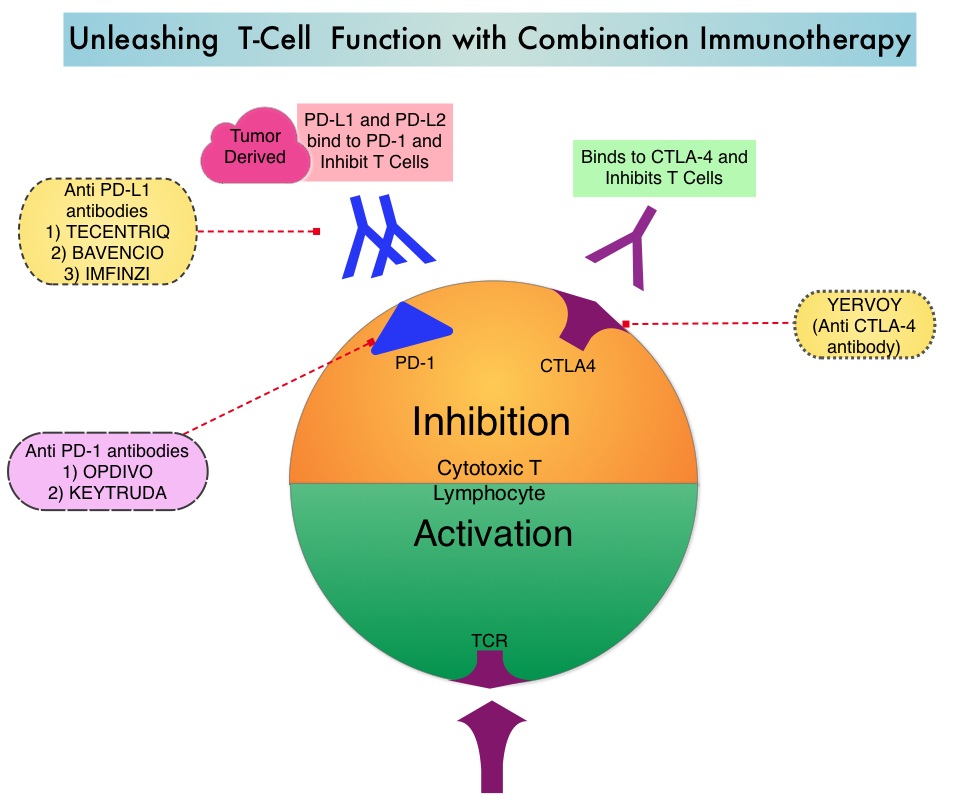
KEYNOTE-407 is a global, double-blind, placebo-controlled, phase 3 trial which compared KEYTRUDA® plus chemotherapy with placebo plus chemotherapy in patients with squamous NSCLC of any level of PD-L1 expression. In this study, 559 patients with untreated metastatic, squamous NSCLC were randomly assigned, in a 1:1 ratio to receive KEYTRUDA® 200 mg IV along with Carboplatin AUC 6 and either TAXOL® (Paclitaxel) 200 mg/m2 IV or ABRAXANE® (nab-paclitaxel) 100 mg/m2 IV days 1, 8 and 15. every 3 weeks for 4 cycles (N=278) or placebo with the same chemotherapy regimen for 4 cycles (N=281). Patients in the experimental arm following the first 4 cycles continued KEYTRUDA® every 3 weeks, for an additional 31 cycles, whereas the control group received placebo. Patients in the placebo-combination group were eligible to cross over to receive KEYTRUDA® monotherapy and 42.8% of patients assigned to the placebo plus chemotherapy group who discontinued chemotherapy went on to receive subsequent anti PD-1 or anti PD-L1 therapy and 75 patients received KEYTRUDA® monotherapy as part of in-study crossover. Patients were stratified according to the PD-L1 Tumor Proportion Score (1% or less versus more than 1%), choice of Taxane (Paclitaxel versus nab-Paclitaxel), and geographic region of enrollment. Tumor Proportion Score is the percentage of tumor cells with membranous PD-L1 staining, with less than 1% indicating PD-L1 negative score. Both treatment groups were well balanced. The co-Primary end points were Overall Survival and Progression Free Survival and the Secondary end points included Response Rate, Duration of Response and Safety. The effects of PD-L1 expression on Overall Survival (OS), Progression Free Survival (PFS), and Objective Response Rate (ORR) were prespecified exploratory end points.

At the second interim analysis, after a median follow-up of 7.8 months, the median Overall Survival was 15.9 months in the KEYTRUDA® combination group and 11.3 months in the placebo combination group (HR=0.64; P<0.001). This meant that there was a 36% reduction in the risk of death with the addition of KEYTRUDA® to chemotherapy. This OS benefit was consistently seen regardless of the level of PD-L1 expression. The median PFS was 6.4 months in the KEYTRUDA® combination group and 4.8 months in the placebo combination group (HR=0.56; P<0.001) and this suggested that the risk of disease progression or death was 44% lower with the addition of KEYTRUDA® to chemotherapy. The PFS benefit with the addition of KEYTRUDA® to chemotherapy was observed in all prespecified subgroups with incremental improvements noted with increasing PD-L1 Tumor Proportion Score. The Objective Response Rate was also significantly higher in the KEYTRUDA® chemotherapy group compared to the placebo chemotherapy group (59.4% versus 38%; P=0.0004), with a median time to response of 1.4 months and median Duration of Response of 7.7 months versus 4.8 months, respectively. Grade 3 or higher adverse events were similar in both treatment groups. Treatment discontinuation due to adverse events was more frequent in the KEYTRUDA® combination group (13.3% versus 6.4%).

It was concluded that inpatients with previously untreated metastatic, squamous NSCLC, the addition of KEYTRUDA® to chemotherapy resulted in significantly longer Overall Survival and Progression Free Survival than chemotherapy alone, and should become a new standard of care for squamous NSCLC. Pembrolizumab plus Chemotherapy for Squamous Non–Small-Cell Lung Cancer. Paz-Ares L, Luft A, Vicente D, et al. for the KEYNOTE-407 Investigators. September 25, 2018. DOI: 10.1056/NEJMoa1810865
FDA Approves COPIKTRA® for Chronic Lymphocytic Leukemia and Follicular Lymphoma

SUMMARY: The FDA on Sept. 24, 2018 granted regular approval to COPIKTRA® (Duvelisib), for adult patients with Relapsed or Refractory Chronic Lymphocytic Leukemia (CLL) or Small Lymphocytic Lymphoma (SLL), after at least two prior therapies. In addition, COPIKTRA® received accelerated approval for adult patients with Relapsed or Refractory Follicular Lymphoma (FL) after at least two prior systemic therapies.

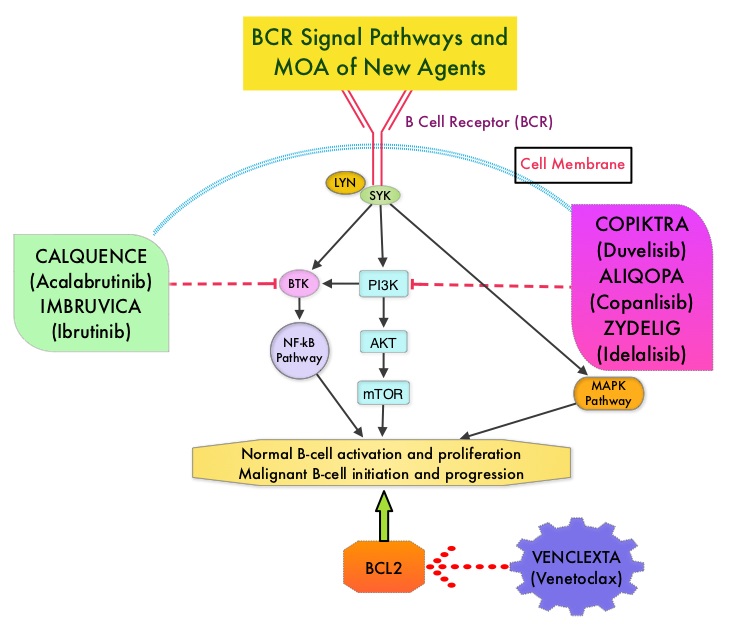
COPIKTRA® is a first-in-class novel, oral, dual inhibitor of PhosphoInositide 3-Kinase (PI3K)-delta and PI3K-gamma, two enzymes/isoforms known to help support the growth and survival of malignant B-cells and T-cells. PI3K-delta is constitutively expressed in hematologic malignancies and its inhibition has been shown to reduce the proliferation and survival of malignant leukemia and lymphoma cells, while allowing normal immune cell survival. Inhibiting PI3K-gamma impairs the function of cancer-supportive macrophages and T cells, which sustain leukemia and lymphoma cells in a protective tumor microenvironment. This broader dual inhibition may provide greater benefit than inhibiting just one isoform alone, by significantly inhibiting chemokines from both cancer cells and the tumor microenvironment. BCR-Signal-Pathways-and-MOA-of-New-Agents

DUO Trial is a randomized, multicenter, open-label, Phase III study in which COPIKTRA® was compared to ARZERRA® (Ofatumumab), in patients with Relapsed or Refractory CLL or SLL. This study randomized 319 patients in a 1:1 ratio to receive either COPIKTRA® 25 mg orally twice daily or ARZERRA®. ARZERRA® was administered at an initial dose of 300 mg IV, followed one week later by 2000 mg once weekly for 7 doses, and then 2000 mg once every 4 weeks for 4 additional doses. The median age was 69 years and 23% of patients had tumors with 17p deletion. All patients received Pneumocystis prophylaxis while on treatment. The Primary endpoint was Progression Free Survival (PFS) and Secondary endpoints included Overall Response Rate (ORR), Duration of Response (DOR) and Overall Survival (OS). The FDA approval of COPIKTRA® for CLL and SLL was based on a subset of these 319 patients (N=196), with CLL or SLL, who had received at least 2 prior therapies. In this subset, 95 patients were randomized to the COPIKTRA® group and 101 patients to ARZERRA® group. The estimated median PFS as assessed by an Independent Review Committee (IRC), was 16.4 months in the COPIKTRA® group and 9.1 months in the ARZERRA® group (HR=0.40). The Overall Response Rate (ORR) per IRC was 78% and 39% for the COPIKTRA® and ARZERRA® arms, respectively.

The accelerated approval for Follicular Lymphoma was based on a single-arm, multicenter, Phase II monotherapy study (DYNAMO Trial), in patients with refractory, indolent Non-Hodgkin Lymphoma. In this study, 83 patients with Follicular Lymphoma who were refractory to RITUXAN® (Rituximab) and to either chemotherapy or radioimmunotherapy, were enrolled. The median age was 64 years, 37% had bulky disease with lesions 5 cm or more and 81% were refractory to 2 or more prior lines of therapy. The ORR determined by an IRC, was 42%, with 41% of patients experiencing Partial Responses and one patient having a Complete Response. Of the 35 responding patients, 43% maintained responses for at least 6 months and 17% maintained responses for at least 12 months. The most common adverse reactions were nausea, diarrhea or colitis, anemia, neutropenia, rash, fatigue, fever, cough, upper respiratory infection, pneumonia and musculoskeletal pain.

It was concluded that monotherapy with COPIKTRA® is an effective oral treatment option for patients with Relapsed or Refractory CLL/SLL and Follicular Lymphoma and addresses an unmet need for patients who have limited options, once they have progressed after two prior therapies. https://www.fda.gov/Drugs/InformationOnDrugs/ApprovedDrugs/ucm621503.htm

Selection of Optimal Adjuvant Chemotherapy and Targeted Therapy for Early Breast Cancer ASCO Clinical Practice Guideline Focused Update

SUMMARY: Breast cancer is the most common cancer among women in the US and about 1 in 8 women (12%) will develop invasive breast cancer during their lifetime. Approximately 266,120 new cases of invasive breast cancer will be diagnosed in 2018 and about 40,920 women will die of the disease. Approximately 15-20% of invasive breast cancers overexpress HER2/neu oncogene, which is a negative predictor of outcomes without systemic therapy. HERCEPTIN® (Trastuzumab) is a humanized monoclonal antibody targeting HER2, and adjuvant and neoadjuvant chemotherapy given along with HERCEPTIN® reduces the risk of disease recurrence and death, among patients with HER2-positive, early stage as well as advanced metastatic breast cancer.

ASCO published an adaptation of the Cancer Care Ontario guideline, on optimal adjuvant chemotherapy regimens for early breast cancer and adjuvant targeted therapy for HER2 (Human Epidermal Growth Factor receptor 2) positive breast cancers, in 2016. The recent publication of phase III studies relevant to the clinical care of breast cancer patients prompted the ASCO Update Steering Group of the original Expert Panel, to provide a focused update of the 2016 guideline. With the exception of this focused update, the remaining recommendations from the 2016 ASCO guideline are unchanged.

Selection of Optimal Adjuvant Chemotherapy and Targeted Therapy for Early Breast Cancer: ASCO Clinical Practice Guideline Focused Update

Questions Addressed in Focused Update

1) Should adjuvant Capecitabine be given following completion of standard preoperative Anthracycline- and Taxane-based combination chemotherapy in patients with early-stage HER2-negative breast cancer with residual invasive disease at surgery?

2) Should 1 year of adjuvant Pertuzumab be added to Trastuzumab-based combination chemotherapy in patients with early stage HER2-positive breast cancer?

3) Should Neratinib be offered as extended adjuvant therapy for patients after combination chemotherapy and Trastuzumab-based adjuvant therapy with early-stage, HER2-positive breast cancer?

Target Population

Patients who are being considered for, or who are receiving, systemic therapy following definitive surgery for early-stage invasive breast cancer, defined largely as invasive cancer anatomic Stages I to IIIC

Target Audience

Medical oncologists, Pathologists, Surgeons, Oncology nurses, Patients, and Caregivers.

Focused Update Recommendations

Patients with early-stage HER2-negative breast cancer with pathologic invasive residual disease at surgery following standard Anthracycline and Taxane-based preoperative therapy may be offered up to six to eight cycles of adjuvant Capecitabine (XELODA®).

Qualifying statements: If clinicians decide to use Capecitabine, then the Expert Panel preferentially supports the use of adjuvant Capecitabine in the subgroup of patients with Hormone Receptor negative, HER2-negative disease. The Capecitabine dosage used in the CREATE-X study (1,250 mg/m2 PO twice daily) is associated with higher toxicity in patients 65 years or older.

Clinicians may add 1 year of adjuvant Pertuzumab (PERJETA® ) to Trastuzumab (HERCEPTIN®)-based combination chemotherapy in patients with high-risk, early-stage, HER2-positive breast cancer.

Qualifying statements: The Expert Panel preferentially supports Pertuzumab in patients with node-positive, HER2-positive breast cancer in view of the clinically insignificant absolute benefit observed among node-negative patients. After a median follow up of 3.8 years, Pertuzumab offered a modest Disease Free Survival (DFS) benefit. The first planned interim analysis did not show an Overall Survival (OS) benefit in the trial population. There are no data to guide the duration of Pertuzumab in patients who received neoadjuvant Pertuzumab and achieved a pathologic Complete Response.

Clinicians may use extended adjuvant therapy with Neratinib (NERLYNX®) to follow Trastuzumab in patients with early stage, HER2-positive breast cancer. Neratinib causes substantial diarrhea and diarrhea prophylaxis must be used.

Qualifying statements: The Expert Panel preferentially favors use of Neratinib in patients with HER2-positive, Hormone Receptor positive, and node-positive disease. At a median follow-up of 5.2 years, no OS benefit has been observed. Patients who began Neratinib within 1 year of Trastuzumab completion appeared to derive the greatest benefit. There are no data on the added benefit of Neratinib in patients who also received Pertuzumab in the neoadjuvant or adjuvant setting.

Selection of Optimal Adjuvant Chemotherapy and Targeted Therapy for Early Breast Cancer: ASCO Clinical Practice Guideline Focused Update. Denduluri N, Chavez-MacGregor M, Telli ML, et al. J Clin Oncol. 2018;36:2433-2443.

MicroRNA-31-3p Expression is a Predictive Biomarker of Anti-EGFR Efficacy in Patients with RAS Wild-type Metastatic Colorectal Cancer

Advanced ColoRectal Cancer (CRC) is often incurable and standard chemotherapy when combined with anti EGFR (Epidermal Growth Factor Receptor) targeted monoclonal antibodies such as VECTIBIX® (Panitumumab) and ERBITUX® (Cetuximab) as well as anti VEGF agent AVASTIN® (Bevacizumab), have demonstrated improvement in Progression Free Survival (PFS) and Overall Survival (OS). The benefit with anti EGFR agents however is only demonstrable in patients with metastatic CRC, whose tumors do not harbor RAS mutations. It is now becoming clear that among these pan RAS wild type tumors, a predictive biomarker, MiR-31-3p expression in tumors, may further determine who would benefit from Anti-EGFR targeted therapy.
In a recently published study (Clin Cancer Res 2018), tumors with Low MiR-31-3p expression benefited from ERBITUX® combination compared to AVASTIN® for PFS (HR=0.74;P=0.05), OS (HR=0.61;P<0.01) and Objective Response Rate (P<0.01). There was however no difference in outcomes among High MiR-31-3p expressors between the two treatment groups. This study suggested that only low MiR-31-3p expressing tumors among the pan RAS wild type CRC patients benefit from Anti-EGFR targeted therapies.

Immunotherapy Effective for Melanoma Metastatic to the Brain

SUMMARY: It is estimated that in the US, approximately 91,270 new cases of melanoma will be diagnosed in 2018 and about 9,320 patients are expected to die of the disease. The incidence of melanoma has been on the rise for the past three decades. Brain metastases are a frequent complication of solid tumors and these patients tend to have a very poor prognosis with a median survival of a few weeks to months. Malignant melanoma has the highest propensity to metastasize to the brain. More than one third of patients with advanced melanoma have brain metastases at the time of diagnosis, and up to 75% of patients have brain metastases at the time of death. Prognosis of patients with melanoma who have brain metastases is poor, with a median Overall Survival of 4-5 months and a 5 year survival of 5%. This is because systemic chemotherapy has minimal antitumor activity in the brain, does not decrease the risk of development of new brain metastases, does not control of extracranial disease and does not improve Overall Survival.Unleashing-T-Cell-Function-with-Combination-Immunotherapy

Immune checkpoint inhibitors by blocking immune checkpoint proteins unleash T cells, resulting in T cell proliferation, activation and a therapeutic response. YERVOY® (Ipilimumab) is a fully human immunoglobulin G1 monoclonal antibody that blocks immune checkpoint protein/receptor CTLA-4, and has been shown to have activity against brain metastases from melanoma when used individually as monotherapy. OPDIVO® (Nivolumab) is a fully human, Immunoglobulin G4, anti PD-1 targeted monoclonal antibody. It binds to the PD-1 receptor and blocks its interaction with ligands PD-L1 and PD-L2, following which the tumor-specific effector T cells are unleashed. OPDIVO® when combined with YERVOY® significantly improved Overall Survival in patients with previously untreated advanced melanoma, compared with YERVOY® alone, in phase II and III studies. These studies however excluded patients with untreated brain metastases.

CheckMate 204 is an open-label, multicenter, phase II study, conducted at 28 sites in the United States and the authors in this study evaluated the efficacy and safety of OPDIVO® plus YERVOY® in patients with melanoma who had untreated brain metastases. This study enrolled 101 patients with metastatic melanoma and at least one measurable, nonirradiated brain metastasis (tumor diameter 0.5-3 cm) and no neurologic symptoms. Patients received OPDIVO® 1 mg/kg plus YERVOY® 3 mg/kg every 3 weeks for up to four doses, followed by OPDIVO® 3 mg/kg every 2 weeks until progression or unacceptable toxic effects. The median age was 59 years, 44% of patients had PD-L1 expression of 1% or more, 22% of the patients had 3 or more target lesions and 17% had received previous systemic anticancer therapy, with BRAF inhibitor being the most common (11%), a MEK inhibitor (9%), or both. Patients with known leptomeningeal involvement, those with metastases larger than 3 cm in diameter, and those patients receiving glucocorticoid therapy, were excluded from the study. The Primary end point was the rate of intracranial clinical benefit, defined as the percentage of patients who had stable disease for at least 6 months, Complete Response, or Partial Response. Of the 101 patients enrolled, 94 patients had a minimum follow up of 6 months (median follow up 14.0 months), and could be evaluated for the Primary end point.

With a median follow up of 14 months, the rate of intracranial clinical benefit was 57%, with a Complete Response rate of 26%, Partial Response rate of 30%, and 2% of the patients had stable disease for at least 6 months. Similar rates of Objective Response Rate (50%) and Clinical Benefit (56%) were observed for extracranial lesions. The median time to intracranial response was 2.3 months. The safety profile of the regimen was similar to that reported in patients with melanoma who did not have brain metastases, and treatment-related grade 3/ 4 Adverse Events were reported in 55% of patients.

It was concluded that OPDIVO® combined with YERVOY® is an effective treatment for metastatic melanoma patients with asymptomatic, untreated brain metastases. In this study, patients had clinically meaningful intracranial efficacy, concordant with extracranial activity. The safety profile in this population was similar to that reported in studies involving patients without brain metastases. This regimen should be considered as first-line therapy for all eligible metastatic melanoma patients, with brain metastases. Combined Nivolumab and Ipilimumab in Melanoma Metastatic to the Brain. Tawbi HA, Forsyth PA, Algazi A, et al. N Engl J Med 2018; 379:789-790

MicroRNA-31-3p Expression is a Predictive Biomarker of Anti-EGFR Efficacy in Patients with RAS Wild-type Metastatic Colorectal Cancer

SUMMARY: ColoRectal Cancer (CRC) is the third most common cancer diagnosed in both men and women in the United States. The American Cancer Society estimates that approximately 140,250 new cases of CRC will be diagnosed in the United States in 2018 and about 50,630 patients are expected to die of the disease. The lifetime risk of developing CRC is about 1 in 21 (4.7%). Advanced colon cancer is often incurable and standard chemotherapy when combined with anti EGFR (Epidermal Growth Factor Receptor) targeted monoclonal antibodies such as VECTIBIX® (Panitumumab) and ERBITUX® (Cetuximab) as well as anti VEGF agent AVASTIN® (Bevacizumab), have demonstrated improvement in Progression Free Survival (PFS) and Overall Survival (OS). The benefit with anti EGFR agents however is only demonstrable in patients with metastatic CRC, whose tumors do not harbor KRAS mutations in codons 12 and 13 of exon 2 (KRAS Wild Type). It is now also clear that even among the KRAS Wild Type patients, about 15-20% have other rare mutations such as NRAS and BRAF mutations, which confer resistance to anti EGFR agents.

MicroRNAs (MiRNA) are small non-coding RNA molecules that play a key role in the regulation of intracellular processes through post-transcriptional regulation of gene expression. It has been shown that MicroRNAs controlling expression of oncogenes and tumor suppressor genes are frequently deregulated in cancer cells. One MiRNA which is frequently deregulated in a variety of cancers is MiR-31, which is frequently overexpressed in colorectal cancer, with high expression correlating with advanced disease. A mature sequence of MiR-31, MiR-31-3p, has been shown to predict outcomes among for colorectal cancer patients treated with anti-EGFR therapy such as ERBITUX® and VECTIBIX®.

FIRE-3 is an open-label, randomized Phase III trial in which FOLFIRI plus ERBITUX® was compared with FOLFIRI plus AVASTIN®, as first line treatment in patients with metastatic ColoRectal Cancer (CRC). This study suggested that patients with KRAS exon 2 wild-type metastatic CRC had a longer Overall Survival (OS) when treated with FOLFIRI plus ERBITUX® compared with FOLFIRI plus AVASTIN®.

Based on the premise that MiR-31-3p expression has been shown to be associated with response to anti-EGFR therapy, in previously published studies, the authors investigated the predictive role of this biomarker in the FIRE-3 study patient population, in its ability to differentiate outcomes between patients receiving anti-EGFR and anti-VEGF therapy. In this study, MiR-31-3p expression was measured in primary tumors obtained from 340 RAS wild-type mCRC patients enrolled in the FIRE-3 Trial. The study population included 164 patients randomized to receive FOLFIRI plus ERBITUX® and 176 patients to FOLFIRI plus AVASTIN®. Patients were divided into subgroups, defined by Low or High MiR-31-3p expression.

It was noted that patients with Low MiR-31-3p expression benefited from ERBITUX® combination compared to AVASTIN® for PFS (HR=0.74;P=0.05), OS (HR=0.61;P<0.01) and Objective Response Rate (P<0.01). There was however no difference in outcomes among High MiR-31-3p expressors between the two treatment groups.

It was concluded that MiR-31-3p expression level is a validated predictive biomarker of anti EGFR therapy efficacy for RAS wild-type mCRC patients, and can enable clinicians to identify patients who would benefit from first-line anti-EGFR treatment. MiRNAs are well preserved in Formalin-Fixed Paraffin-Embedded (FFPE) tissues and MiR-31- 3p expression levels can be measured using RT qPCR. Validation of miR-31-3p Expression to Predict Cetuximab Efficacy When Used as First-Line Treatment in RAS Wild-Type Metastatic Colorectal Cancer. Laurent-Puig P, Grisoni ML, Heinemann V, et al. Clin Cancer Res. 2018 Aug 14. pii: clincanres.1324.2018. doi: 10.1158/1078-0432.CCR-18-1324. [Epub ahead of print]

Dual Inhibition Improves Outcomes for Patients with BRAF-Mutated Colorectal Tumors

Dual Inhibition Improves Outcomes for Patients with BRAF-Mutated Colorectal Tumors
SUMMARY: ColoRectal Cancer (CRC) is the third most common cancer diagnosed in both men and women in the United States. The American Cancer Society estimates that approximately 135,430 new cases of ColoRectal Cancer will be diagnosed in the United States in 2017 and over 50,260 patients are expected to die of the disease. The DNA MisMatchRepair (MMR) system is responsible for molecular surveillance and works as an editing tool that identifies errors within the microsatellite regions of DNA and removes them. Defective MMR system leads to MSI (Micro Satellite Instability) and hypermutation, triggering an enhanced antitumor immune response. MSI (Micro Satellite Instability) is therefore a hallmark of defective/deficient DNA MisMatchRepair (MMR) system and occurs in 15% of all colorectal cancers. Defective MisMatchRepair can be a sporadic or heritable event. Approximately 65% of the MSI tumors are sporadic and MSI-High tumors tend to have better outcomes. Patients with stage IV colorectal cancer are now routinely analyzed for extended RAS and BRAF mutations. KRAS mutations are predictive of resistance to Epidermal Growth Factor Receptor (EGFR) targeted therapy. Approximately 5-10% of all metastatic CRC tumors present with BRAF V600 mutations and BRAF V600 is recognized as a marker of poor prognosis in this patient group. These patients tend to have aggressive disease with a higher rate of peritoneal metastasis and do not respond well to standard treatment intervention. Approximately 25% of the BRAF-mutated population in the metastatic setting has MSI-High tumors, but MSI-High status does not confer protection to this patient group.BRAF-and-EGFR-Inhibition-in-MAPK-Pathway
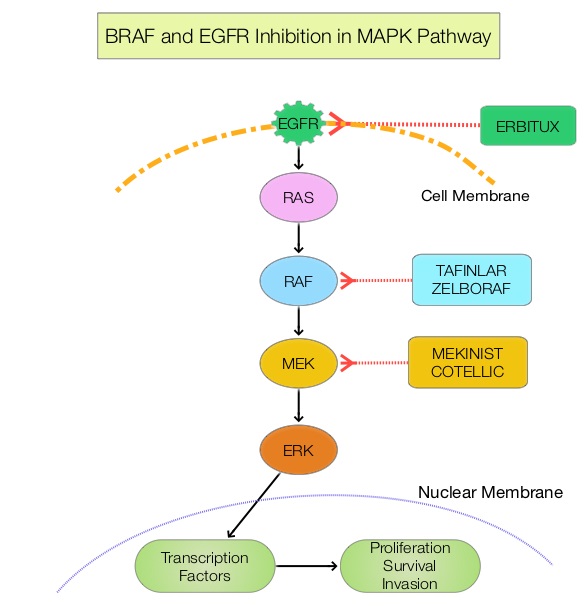
The Mitogen-Activated Protein Kinase pathway (MAPK pathway) is an important signaling pathway which enables the cell to respond to external stimuli. This pathway plays a dual role, regulating cytokine production and participating in cytokine dependent signaling cascade. The MAPK pathway of interest is the RAS-RAF-MEK-ERK pathway. The RAF family of kinases includes ARAF, BRAF and CRAF signaling molecules.BRAF is a very important intermediary of the RAS-RAF-MEK-ERK pathway. The BRAF V600 mutations results in constitutive activation of the MAP kinase pathway. Inhibiting BRAF can transiently reduce MAP kinase signaling. However, this can result in feedback upregulation of EGFR signaling pathway, which can then reactivate the MAP kinase pathway. This aberrant signaling can be blocked by dual inhibition of both BRAF and EGFR.
ZELBORAF® (Vemurafenib), is a selective oral inhibitor of mutated BRAF whereas ERBITUX® (Cetuximab) is a monoclonal antibody targeting Epidermal Growth Factor Receptor (EGFR). Preclinical studies have shown that adding CAMPTOSAR® (Irinotecan) to ZELBORAF® and ERBITUX®, in patients with refractory BRAF V600E metastatic CRC, led to a durable responses and this combination was safe and tolerable. However, both single agent ZELBORAF® and ERBITUX® were shown to have limited activity in this patient group.
Based on this scientific rationale, a phase II trial was conducted (SWOG 1406), in which 106 metastatic ColoRectal Cancer patients, with mutations in BRAF V600 and extended RAS wild-type, were enrolled. Patients were randomized to receive CAMPTOSAR® 180 mg/m2 IV every 14 days and ERBITUX® 500 mg/m2 IV every 14 days, with or without ZELBORAF® 960 mg orally twice daily. The median age was 62 years and about 50% of patients had received 1 prior regimen for metastatic or locally advanced unresectable metastatic CRC, and 39% had received prior treatment with CAMPTOSAR® . Prior therapy with anti-EGFR agent or RAF or MEK inhibitors was not allowed. Crossover from the control arm to the experimental group was allowed, after documented disease progression. The primary endpoint was Progression Free Survival.
The median Progression Free Survival was 4.4 months with the triplet, versus 2.0 months with CAMPTOSAR® plus ERBITUX® (HR=0.42; P =0.0002). The response rate was 16% versus 4%, and the Disease Control Rate was 67% versus 22% (P =0.001), with a higher Duration of Response with the addition of ZELBORAF® to CAMPTOSAR® and ERBITUX® (Triplet). Approximately 50% of the patients in the control group crossed over to the experimental group at the time of disease progression. Overall Survival data and efficacy at cross-over, data, remain immature. Patients in the experimental group (Triplet group) experienced more grade 3/4 toxicities such as neutropenia, anemia and nausea, and this increase was attributed to increased duration of exposure to therapy.
The authors concluded that the addition of ZELBORAF® to the combination of CAMPTOSAR® and ERBITUX® resulted in a 58% reduction in the risk of disease progression and a higher Disease Control Rate, suggesting that simultaneous EGFR and BRAF inhibition (Dual Inhibition) is effective in BRAF V600 mutated ColoRectal Cancer. Subgroup analysis will examine the role of CAMPTOSAR® pre-treatment and the outcomes of patients based on tumor MicroSatellite Instability. Randomized trial of irinotecan and cetuximab with or without vemurafenib in BRAF-mutant metastatic colorectal cancer (SWOG 1406). Kopetz S, McDonough SL, Morris VK, et al. J Clin Oncol 35, 2017 (suppl 4S; abstract 520)

XARELTO® in Cancer Patients Associated with Fewer Episodes of VTE Compared with FRAGMIN® but Increase in Nonmajor Bleeding

SUMMARY: The Center for Disease Control and Prevention (CDC) estimates that approximately 1-2 per 1000 individuals develop Deep Vein Thrombosis (DVT)/Pulmonary Embolism (PE) each year in the United States, resulting in 60,000-100,000 deaths. Venous ThromboEmbolism (VTE) is the third leading cause of cardiovascular mortality, after myocardial infarction and stroke.

Approximately 20% of cancer patients develop VTE and there is a two-fold increase in the risk of recurrent thrombosis in patients with cancer, compared with those without cancer. The current recommendations are treatment with parenteral Low Molecular Weight Heparin (LMWH) preparations for at least 6 months or probably longer, as long as the cancer is active. This however can be inconvenient and expensive, leading to premature discontinuation of treatment. LMWH accelerates the inhibition by Antithrombin of activated Factor X, in the conversion of Prothrombin to Thrombin. Direct Oral AntiCoagulants (DOACs) have been proven to be noninferior to COUMADIN® (Warfarin), a Vitamin K antagonist, for the treatment of acute VTE, and are associated with less frequent and less severe bleeding and fewer drug interactions. However, the efficacy and safety of DOACs for the treatment of cancer-associated VTE have not been established. The Direct Oral AntiCoagulants (DOACs) include PRADAXA® (Dabigatran), which is a direct Thrombin inhibitor and XARELTO® (Rivaroxaban), ELIQUIS® (Apixaban), SAVAYSA® (Endoxaban), BEVYXXA® (Betrixaban) which are Factor Xa inhibitors. Compared to COUMADIN® , the New Oral Anticoagulants have a rapid onset of action, wider therapeutic window, shorter half-lives (7-14 hours in healthy individuals), no laboratory monitoring and fixed dosing schedule. In the EINSTEIN trial which compared XARELTO® with LMWH followed by COUMADIN® in patients with acute symptomatic DVT or PE, only 5.5% of patients had active cancer at baseline.

This study was conducted to assess VTE recurrence rates in patients with active cancer, treated with either XARELTO® or FRAGMIN® (Dalteparin) and whether XARELTO® would offer an alternative treatment for cancer patients with VTE. SELECT-D (Selected Cancer Patients at Risk of Recurrence of Venous Thromboembolism) is a randomized, open-label, multicenter pilot trial in which patients with active cancer, who had symptomatic Pulmonary Embolism (PE), incidental PE, or symptomatic lower-extremity proximal Deep Vein Thrombosis (DVT) were enrolled to receive either XARELTO® or FRAGMIN®. Active cancer was defined as a diagnosis of cancer (other than Basal-cell or Squamous-cell skin carcinoma) in the previous 6 months, any treatment for cancer within the previous 6 months, recurrent or metastatic cancer, or cancer not in Complete Remission (hematologic malignancy). In this study, 58% of the patients had metastatic disease, approximately 25% of patients had Colorectal cancer and 83% were receiving chemotherapy at the time of their VTE. A total of 406 patients were randomly assigned in a 1:1 ratio to receive either FRAGMIN® 200 IU/kg SC once daily for the first 30 days and then 150 IU/kg SC daily for an additional 5 months or XARELTO® 15 mg orally twice daily for 3 weeks, then 20 mg once daily for a total of 6 months. Patients were assessed at 3-month intervals until month 12 and then at 6-month intervals until month 24. The primary outcome was VTE recurrence over 6 months, using compression ultrasound (CUS). Secondary outcomes were major bleeding and Clinically Relevant NonMajor Bleeding (CRNMB).

The cumulative VTE recurrence rate at 6 months was 11% for patients receiving FRAGMIN® and 4% for patients receiving XARELTO® (HR=0.43). The 6-month cumulative rate of major bleeding was 4% for FRAGMIN® and 6% for XARELTO® (HR= 1.83). Corresponding cumulative rate of CRNMB at 6 months was 4% and 13% respectively. Most major bleeding events were GI, and there were no CNS bleeds. Patients with esophageal or gastroesophageal cancer experienced more major bleeds with XARELTO® than with FRAGMIN® (36% versus 11%). Overall Survival at 6 months was 70% with FRAGMIN® and 75% with XARELTO®.

It was concluded that XARELTO® was associated with relatively low VTE recurrencein patients with cancer but with higher Clinically Relevant NonMajor Bleeding, compared with LMWH, FRAGMIN®. Comparison of an Oral Factor Xa Inhibitor With Low Molecular Weight Heparin in Patients With Cancer With Venous Thromboembolism: Results of a Randomized Trial (SELECT-D). Young AM, Marshall A, Thirlwall J, et al. Journal of Clinical Oncology 2018;36:2017-2023

Hyperprogressive Disease after Immunotherapy in Advanced Non-Small Cell Lung Cancer

SUMMARY: Lung cancer is the second most common cancer in both men and women and accounts for about 14% of all new cancers and 27% of all cancer deaths. The American Cancer Society estimates that for 2018 about 234,030 new cases of lung cancer will be diagnosed and over 154,050 patients will die of the disease. Lung cancer is the leading cause of cancer-related mortality in the United States. Immunotherapy with PD-1 (Programmed cell Death 1) and PD-L1 (Programmed cell Death Ligand 1) inhibitors have demonstrated a clear survival benefit both as a single agent or in combination, compared with standard chemotherapy, in both treatment-naive and previously treated patients for advanced Non Small Cell Lung Cancer (NSCLC). Immuno-Oncology therapies unleash the T cells by blocking the Immune checkpoint proteins, thereby resulting in T cell proliferation, activation and a therapeutic response.

Recent reports of an acceleration of tumor growth during immunotherapy, defined as HyperProgressive Disease (HPD), has been observed in 9% of advanced malignancies and in 29% of patients with Head and Neck cancer treated with PD-1/PD-L1 inhibitors. It has been postulated that high level of interferon gamma (IFN-gamma) usually released by PD-1 blockade may have detrimental effects on immunity. Alternatively PD-1/PD-L1 blockade may upregulate Interleukin 6, Interleukin 17, and neutrophil axis, generating a potent aberrant inflammation, responsible for immune escape and accelerated growth.

HyperProgressive Disease should be differentiated from Pseudoprogression. The later  is defined as progressive disease, followed by Complete Response and/or Partial Response or Stable Disease longer than 6 months. The Tumor Growth Rate (TGR) estimates the increase in tumor volume over time based on two Computed Tomography (CT) scan measurements. TGR can be used to quantitatively assess tumor dynamics and kinetics during treatment and can be specifically applied to identify the subset of patients experiencing HPD.

This study was conducted to investigate whether HPD is observed in patients with advanced NSCLC treated with PD-1/PD-L1 inhibitors compared with single-agent chemotherapy and whether there is an association between treatment and HPD. This multicenter, retrospective study included 406 consecutive eligible patients with confirmed Stage III or IV NSCLC treated with PD-1/PD-L1 inhibitors such as OPDIVO® (Nivolumab), KEYTRUDA® (Pembrolizumab), TECENTRIQ® (Atezolizumab), or IMFINZI® (Durvalumab) as monotherapy in second or later line treatment, at eight French institutions between November 2012 and April 2017. The control cohort included equivalent data collected on 59 eligible patients with advanced NSCLC, who had failed a Platinum-based regimen and received single-agent chemotherapy (Taxanes, Pemetrexed, Vinorelbine , or Gemcitabine) in 4 French institutions from August 2011, to June 2016. The median age was 50 years, over 70% of the patients had nonsquamous histology and approximately 20% of the patients had PD-L1 positive status (1% or more by IHC) confirmed. The median followup was 12.1 months. Measurable disease (defined by Response Evaluation Criteria in Solid Tumors – RECIST version 1.1) on at least two CT scans before treatment and one CT scan during treatment, was required. HyperProgressive Disease (HPD) was defined as disease progression on the first CT scan during treatment with an absolute increase in Tumor Growth Rate exceeding 50%. The Primary end point was assessment of the HyperProgressive Disease rate in patients treated with Immunotherapy or chemotherapy.

Among those treated with PD-1/PD-L1 inhibitors, HyperProgressive Disease was noted in 13.8% of patients. HPD was significantly associated with more than two metastatic sites prior to treatment with PD-1/PD-L1 inhibitors, compared with those without HPD (62.5% versus 42.6%; P=0.006). However, baseline tumor burden and number of previous lines of therapy did not make a significant difference. Patients experiencing HPD within the first 6 weeks of beginning PD-1/PD-L1 inhibitor therapy had significantly lower median Overall Survival compared with those with progressive disease without HyperProgression at the first evaluation (3.4 months versus 6.2 months; HR=2.18; P=0.003). Pseudoprogression was observed in 4.7% patients.

Among patients treated with single-agent chemotherapy, only 5.1% were classified as having HyperProgressive Disease and the median Overall Survival was 4.5 months in those with HPD and 3.9 months in other patients with progressive disease without HyperProgression at the first evaluation (P=0.60).

The authors concluded that HyperProgressive Disease is more common with PD-1/PD-L1 inhibitors compared with chemotherapy, among previously treated patients with advanced NSCLC, and is also associated with high number of metastatic sites at baseline and poor survival. They added that the present study is the largest analysis exploring HPD to date and is the first conducted, in a dedicated NSCLC population, with a control cohort of chemotherapy-treated patients Hyperprogressive Disease in Patients With Advanced Non–Small Cell Lung Cancer Treated With PD-1/PD-L1 Inhibitors or With Single-Agent Chemotherapy. Ferrara R, Mezquita L, Texier M, et al. JAMA Oncol. Published online September 6, 2018. doi:10.1001/jamaoncol.2018.3676

Smoking Associated with Increased Risk of Recurrence and Mortality among Prostate Cancer Patients after Curative Therapy

SUMMARY: Prostate cancer is the most common cancer in American men with the exclusion of skin cancer, and 1 in 9 men will be diagnosed with prostate cancer during their lifetime. It is estimated that in the United States, about 164,690 new cases of Prostate cancer will be diagnosed in 2018 and 29,430 men will die of the disease. Approximately 35% of the patients with Prostate cancer will experience PSA only relapse within 10 years of their primary treatment with Radical Prostatectomy or Radiation Therapy and a third of these patients will develop documented metastatic disease within 8 years following PSA only relapse. Several studies have addressed how diet and environmental factors affect the risk of Prostate cancer.

According to the American Cancer Society, tobacco use is responsible for nearly 1 in 5 deaths in the United States and accounts for at least 30% of all cancer deaths. Tobacco smoke contains more than 70 well known carcinogens and smoking is known as a preventable risk factor for several genitourinary malignancies cancers such as upper tract urothelial carcinoma, Bladder cancer and Renal Cell Carcinoma. The effect of smoking on the incidence of Prostate cancer has however remained unclear. Nicotine in tobacco smoke has been implicated as a disease driver and there is a significant correlation between smoking and multigene hypermethylation. Further, more unfavorable pathologic features have been noted during Radical Prostatectomy among smokers. Additionally, there is an independent association of cigarette smoking with time to castration resistance, in patients with advanced Prostate cancer undergoing Androgen Deprivation Therapy.

The purpose of this study was to systematically review and analyze the association of smoking status with biochemical recurrence, metastasis, and cancer-specific mortality among patients with localized Prostate cancer undergoing primary curative treatment with radical prostatectomy or radiotherapy. The authors performed a systematic search of original articles published between January 2000 and March 2017 using PubMed, MEDLINE, Embase, and Cochrane Library databases and they identified a total of 5157 studies of which 16 articles were selected for qualitative analysis and 11 articles were selected for quantitative analysis. All included studies were observational and nonrandomized. The meta-analysis overall included 22 549 patients, of whom 4202 (18.6%) were current smokers at the time of primary curative treatment, and 18,347 (81.4%) were nonsmokers (former and never smokers combined). The overall median follow-up was 72 months. The prespecified outcomes evaluated were, biochemical recurrence, metastasis, and cancer-specific mortality.

It was noted that current smokers had a significantly higher risk of experiencing BCR (BioChemical Recurrence) compared with nonsmokers whether they had undergone RP or RT (HR=1.40; P< 0.001). The same findings were noted among former smokers (HR=1.19; P<0.001). Current smokers were also at a higher risk of metastasis (HR=2.51; P<0 .001) and cancer-specific mortality (HR=1.89; P<0.001), but this was not observed among former smokers, for metastasis (HR=1.61; P=0.31) and cancer-specific mortality (HR=1.05; P=0.70).

It was concluded that current smokers at the time of primary curative treatment for localized Prostate cancer are at higher risk of experiencing Biochemical Recurrence, metastasis, and cancer-specific mortality, suggesting that smoking is a modifiable risk factor that affects all disease phases of Prostate cancer. Health Care Providers caring for Prostate cancer patients should be encouraged to counsel patients on smoking cessation, given the risk of poorer outcomes associated with smoking. The authors also noted that this is the first systematic review and meta-analysis that investigated the association of smoking with oncologic outcomes, after primary treatment for localized Prostate cancer. Association of Smoking Status With Recurrence, Metastasis, and Mortality Among Patients With Localized Prostate Cancer Undergoing Prostatectomy or Radiotherapy A Systematic Review and Meta-analysis. Foerster B, Pozo C, Abufaraj M, et al. JAMA Oncol. 2018;4:953-961.